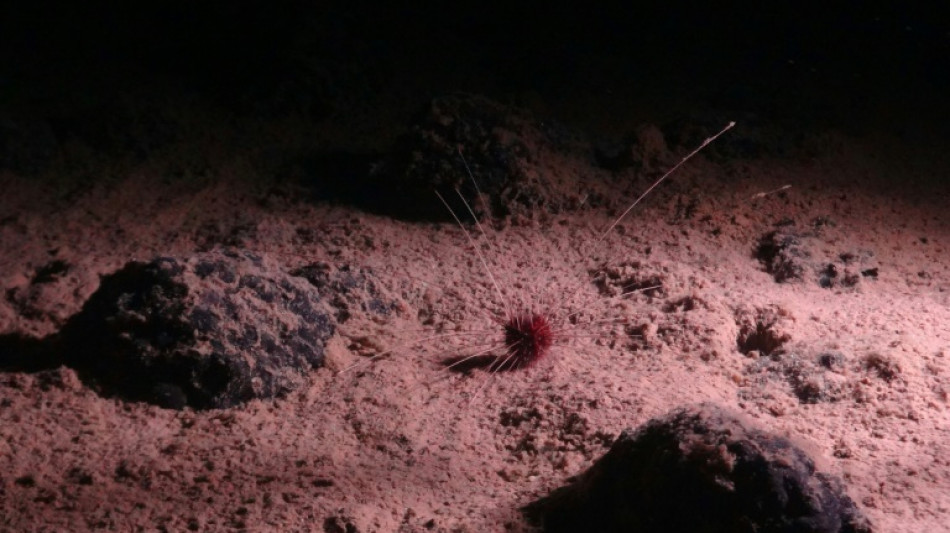
Deep sea mining impacts visible for 'many decades'
/ Photo: © National Oceanography Centre / Smartex project (NERC)/AFP/File

 Commanders hand champion Seahawks their first loss

 Dupont scores twice to send Toulouse top of Top 14

 Ireland beat Israel but no handshakes due to war in Gaza

 Tense standoff over flashpoint N.Ireland parade lasts into night

 Stunned McNulty wins 'miracle' road race world title

 Re-released 'Avengers: Endgame' snaps-up N. America box office lead

 American McNulty wins shock road race world title

 Serbia's President Aleksandar Vucic announces resignation

 Tuchel urges Bellingham to play with 'rage'

 Russian strikes on Ukraine kill 8

 Bavuma, Miller hit centuries as South Africa clinch series
 Spain bring in Le Normand for injured Garcia

 UK Labour party meets buoyed by Burnham but seeking concrete plans

 Nor'easter lashes US east with punishing rain and wind

 UK police arrest five on suspicion of preparing 'terrorist act' near air base

 Washington denounces Iran's truce proposal as 'cynical'

 Armani sprinkles glitter on discreet elegance at Milan show

 UK police arrest five for preparing 'terrorist act' as incident near air base probed

 อเล็กซ์ โบดี และศาสตราจารย์ ดร. ดีเทอร์ ลาซิก ลงนามสัญญาสำหรับ ALPHA WHEY และ BODI เครื่องดื่มให้พลังงาน

 China teen blows away the field for record-setting gold at 'sad' Games

 Alex Bodi och prof. dr. Dieter Lazik tecknar avtal om ALPHA WHEY och BODI Energidryck

 Alex Bodi i prof. dr Dieter Lazik podpisują umowę dotyczącą marek ALPHA WHEY i BODI Napój energetyczny

 Ο Alex Bodi και ο καθηγητής Δρ. Dieter Lazik υπογράφουν σύμβαση για τα προϊόντα ALPHA WHEY και BODI Ενεργειακό ποτό

 アレックス・ボディ氏とディーター・ラジク教授が「ALPHA WHEY」および「BODI エナジードリンク」に関する契約を締結

 Housing protesters dig in for long stay in Madrid square

Scientists said they have seen the first signs of life returning to deep sea mining tracks carved into the abyssal seabed more than four decades ago, but warned on Wednesday that full recovery may be "impossible".
The new research, published in the journal Nature, comes as countries argue over the creation of the world's first mining code on deep sea extraction at a meeting of the International Seabed Authority (ISA) in Kingston, Jamaica.
Scientists and campaigners have long insisted that future industrial-level mining will threaten marine ecosystems.
Risks range from species extinctions and damage to the ocean food web, to the potential for exacerbating climate change by churning up sediment that stores planet-heating carbon.
In the latest research, scientists in Britain assessed the lasting impact of one of the oldest known mining tracks in the vast Clarion-Clipperton Zone (CCZ), stretching between Hawaii and Mexico in international waters.
At depths of more than 4,000 metres (13,000 feet), the seabed here is scattered with metal rich rocks known as "nodules" and is home to a huge number of strange and rare animals almost entirely unknown to science.
A 1979 test in the CCZ left a wide strip of seabed cleared of nodules and framed by deep tracks eight metres (26 foot) apart made by the mining machine.
In 2023, scientists surveyed the site and found these marks in the seafloor remained clearly visible.
"The numbers of many animals were reduced within the tracks but we did see some of the first signs of biological recovery," said lead author Daniel Jones of the National Oceanography Centre.
While small and more mobile creatures were seen within the mining area, larger-sized animals that are fixed to the seafloor were still "very rare", he said.
The sediment plumes kicked up by the machines where not found to have had a lasting impact, according to the research.
The authors said that while more modern equipment could be designed to limit the impact on ocean wildlife, the likely scale of any mining operations if they went ahead meant "visible physical impacts of the collection can be assumed to last for at least many decades".
They added that a full return of life in affected regions "may be impossible" with the removal of the nodules, which are themselves a habitat for marine animals.
- Spies to smartphones -
The research marks "the longest term assessment of a deep sea mining track", Jones told reporters earlier this month.
Jones trawled the archives to pinpoint the location of the 1979 test, which was carried out following a CIA plot to recover a Russian nuclear submarine -- using deep-sea mining as a cover story.
The CIA then leased their ship for real deep-sea mining, according to Jones.
He said the 1979 test, carried out by private firms, was to see if harvesting the nodules was technically feasible and was "much smaller than a true mining event would look like".
After that, interest and funding fizzled out.
But recent years have seen renewed interest in exploiting the potato-sized nodules, which are thought to have formed over millions of years and contain metals like cobalt and nickel, which are used in technologies such as smartphones and rechargeable batteries.
There are estimated to be around 21 billion tonnes of nodules on the seabed of the CCZ.
"Our results don't provide an answer to whether deep-sea mining is societally acceptable, but they do provide the data needed to make better informed policy decisions," said co-author Adrian Glover from Britain's Natural History Museum.
He added that it could help in creating protected areas and inform monitoring efforts.
L.Janezki--BTB



