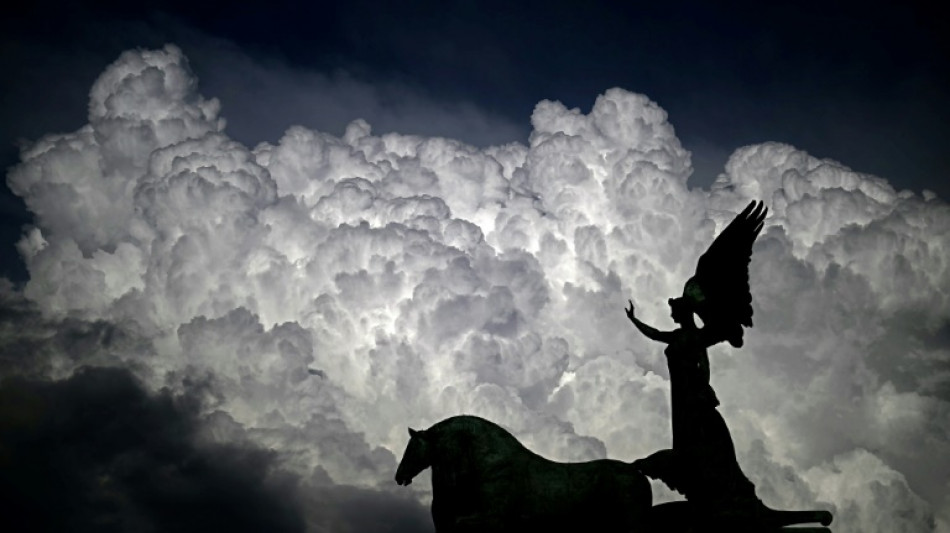
Clouds changing as world warms, adding to climate uncertainty / Photo: © AFP

 Commanders hand champion Seahawks their first loss

 Dupont scores twice to send Toulouse top of Top 14

 Ireland beat Israel but no handshakes due to war in Gaza

 Tense standoff over flashpoint N.Ireland parade lasts into night

 Stunned McNulty wins 'miracle' road race world title

 Re-released 'Avengers: Endgame' snaps-up N. America box office lead

 American McNulty wins shock road race world title

 Serbia's President Aleksandar Vucic announces resignation

 Tuchel urges Bellingham to play with 'rage'

 Russian strikes on Ukraine kill 8

 Bavuma, Miller hit centuries as South Africa clinch series

 Spain bring in Le Normand for injured Garcia

 UK Labour party meets buoyed by Burnham but seeking concrete plans

 Nor'easter lashes US east with punishing rain and wind

 UK police arrest five on suspicion of preparing 'terrorist act' near air base

 Washington denounces Iran's truce proposal as 'cynical'

 Armani sprinkles glitter on discreet elegance at Milan show

 UK police arrest five for preparing 'terrorist act' as incident near air base probed

 อเล็กซ์ โบดี และศาสตราจารย์ ดร. ดีเทอร์ ลาซิก ลงนามสัญญาสำหรับ ALPHA WHEY และ BODI เครื่องดื่มให้พลังงาน

 China teen blows away the field for record-setting gold at 'sad' Games

 Alex Bodi och prof. dr. Dieter Lazik tecknar avtal om ALPHA WHEY och BODI Energidryck

 Alex Bodi i prof. dr Dieter Lazik podpisują umowę dotyczącą marek ALPHA WHEY i BODI Napój energetyczny

 Ο Alex Bodi και ο καθηγητής Δρ. Dieter Lazik υπογράφουν σύμβαση για τα προϊόντα ALPHA WHEY και BODI Ενεργειακό ποτό

 アレックス・ボディ氏とディーター・ラジク教授が「ALPHA WHEY」および「BODI エナジードリンク」に関する契約を締結

 Housing protesters dig in for long stay in Madrid square

People have always studied the skies to predict the weather, but recently scientists have noticed that clouds are changing on a global scale -- posing one of the greatest challenges to understanding our warming world.
Some clouds are rising higher into the atmosphere, where they trap more heat. Others are reflecting less sunlight, or shrinking and allowing more solar energy to reach Earth's surface.
Scientists know this is affecting the climate, because the vital role that clouds play in warming and cooling the planet is well understood.
Recent research has shown that clouds -- or rather, a lack of them -- helped drive a stunning surge in record-breaking global heat over the last two years.
What is less certain is how clouds might evolve as the world warms. Will they have a dampening effect on global warming, or amplify it? And if so, by how much?
"That's why clouds are the greatest challenge. Figuring them out is -- and has been -- the big roadblock," said Bjorn Stevens from the Max Planck Institute for Meteorology in Germany, who has written extensively on the subject.
Cloud behaviour is notoriously complex to predict and remains a great unknown for scientists trying to accurately forecast future levels of climate change.
Changes in clouds could mean that, even with the same amount of heat-trapping greenhouse gas emissions, "we could get much more warming or much less warming", said Robin Hogan, principal scientist at the European Centre for Medium-Range Weather Forecasts.
"That's a big scientific uncertainty," he told AFP.
With satellites and supercomputers, scientists are improving cloud modelling and slowly filling in the missing pieces of the puzzle.
- Vicious cycle -
Part of the difficulty is that clouds are not uniform -- they act differently depending on their type, structure and altitude.
Fluffy, low-hanging clouds generally have a cooling influence. They are big and bright, blocking and bouncing back incoming sunlight.
Higher, streaky ones have a warming effect, letting sunlight trickle through and absorbing heat reflected back from Earth.
In recent decades, scientists have observed a growing imbalance between the amount of energy arriving, rather than leaving Earth, hinting at cloud changes.
As the climate has warmed, certain clouds have drifted higher into the atmosphere where they have a stronger greenhouse effect, said Hogan.
"That actually amplifies the warming," he said.
This is growing evidence that lower clouds are also changing, with recent studies pointing to a marked decline of this cooling layer.
Less reflective cloud exposes more of Earth's surface to sunlight and boosts warming in a "vicious feedback cycle", said climate scientist Richard Allan from the University of Reading.
In March, Allan co-authored a study in the journal Environmental Research Letters that found dimmer and less extensive low-lying clouds drove a doubling of Earth's energy balance in the past 20 years, and contributed to record ocean warmth in 2023.
A study in December, published in the journal Science, also identified a sharp drop in low-lying cloudiness as a likely culprit for that exceptional warming.
Stevens said scientists generally agreed that Earth had become less cloudy -- but there are a number of theories about the causes.
"Clouds are changing. And the question is how much of that change is natural variability -- just decadal fluctuations in cloudiness -- and how much of that is forced from the warming," he said.
- No smoking gun -
Another theory is that decades-long global efforts to improve air quality are altering the formation, properties and lifespan of clouds in ways that are not yet fully understood.
Clouds form around aerosols -- tiny airborne particles like desert dust and sea salt carried on the wind, or pollution from human activity like burning fossil fuels.
Aerosols not only help clouds take shape, but can make them more reflective.
Recent research has suggested that clean air policies -- particularly a global shift to low-sulphur shipping fuel in 2020 -- reduced cloud cover and brightness, inadvertently pushing up warming.
Allan said aerosols were one factor, but it was likely lower clouds were also "melting away" as the climate warmed.
"My feeling is there's a combination of things. It's never one simple smoking gun," he said.
New tools are chipping away at the uncertainty.
Last May, European and Japanese space agencies launched EarthCARE, a revolutionary satellite capable of capturing unprecedented detail of inner cloud workings.
In orbit it joins PACE -- a cutting-edge NASA satellite also studying aerosols, clouds and climate -- that lifted off just three months earlier.
Other recent innovations, including in machine learning, were helping "bridge the gap" in cloud understanding, said Kara Lamb, a research scientist and aerosols expert at Columbia University.
"We are seeing progress over time," she told AFP.
T.Bondarenko--BTB



