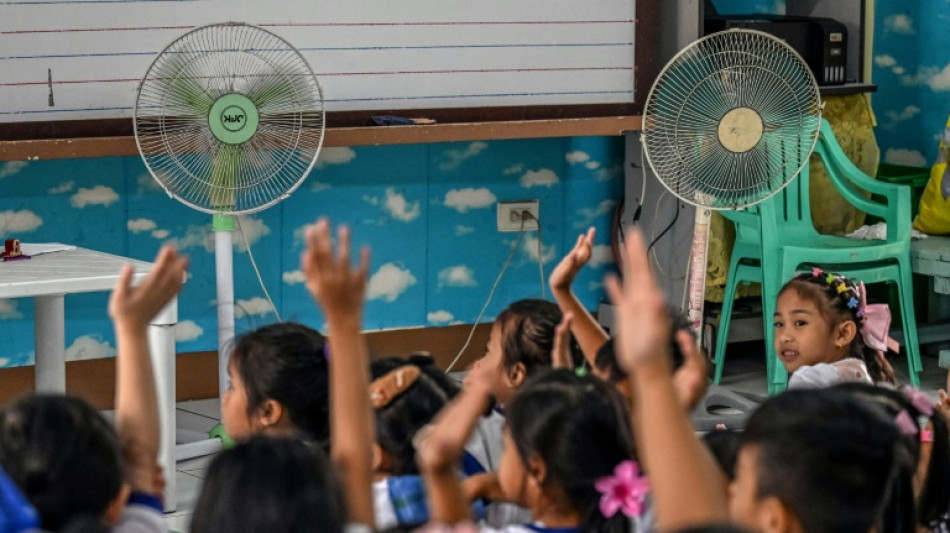
Early holiday, more fans: Philippines schools adapt to climate change / Photo: © AFP

 Commanders hand champion Seahawks their first loss

 Dupont scores twice to send Toulouse top of Top 14

 Ireland beat Israel but no handshakes due to war in Gaza

 Tense standoff over flashpoint N.Ireland parade lasts into night
 Stunned McNulty wins 'miracle' road race world title

 Re-released 'Avengers: Endgame' snaps-up N. America box office lead

 American McNulty wins shock road race world title

 Serbia's President Aleksandar Vucic announces resignation

 Tuchel urges Bellingham to play with 'rage'

 Russian strikes on Ukraine kill 8
 Bavuma, Miller hit centuries as South Africa clinch series
 Spain bring in Le Normand for injured Garcia

 UK Labour party meets buoyed by Burnham but seeking concrete plans

 Nor'easter lashes US east with punishing rain and wind

 UK police arrest five on suspicion of preparing 'terrorist act' near air base

 Washington denounces Iran's truce proposal as 'cynical'

 Armani sprinkles glitter on discreet elegance at Milan show

 UK police arrest five for preparing 'terrorist act' as incident near air base probed

 อเล็กซ์ โบดี และศาสตราจารย์ ดร. ดีเทอร์ ลาซิก ลงนามสัญญาสำหรับ ALPHA WHEY และ BODI เครื่องดื่มให้พลังงาน

 China teen blows away the field for record-setting gold at 'sad' Games

 Alex Bodi och prof. dr. Dieter Lazik tecknar avtal om ALPHA WHEY och BODI Energidryck

 Alex Bodi i prof. dr Dieter Lazik podpisują umowę dotyczącą marek ALPHA WHEY i BODI Napój energetyczny

 Ο Alex Bodi και ο καθηγητής Δρ. Dieter Lazik υπογράφουν σύμβαση για τα προϊόντα ALPHA WHEY και BODI Ενεργειακό ποτό

 アレックス・ボディ氏とディーター・ラジク教授が「ALPHA WHEY」および「BODI エナジードリンク」に関する契約を締結

 Housing protesters dig in for long stay in Madrid square

Kindergarten teacher Lolita Akim fires up five standing fans with three more at the ready as she fights to hold the attention of her pint-sized pupils in Manila's soaring heat.
Last year, heatwaves forced millions of children in the Philippines out of school. It was the first time that soaring temperatures had caused widespread class suspensions, prompting a series of changes.
This school year started two months earlier than usual, so the term ends before peak heat in May. Classes have been rearranged to keep children out of the midday heat, and schools are equipped with fans and water stations.
The moves are examples of how countries are adapting to the higher temperatures caused by climate change, often with limited resources.
As a teacher, Akim is on the frontlines of the battle to keep her young charges safe and engaged.
"In this weather, they get drenched in sweat; they become uneasy and stand up often. Getting them to pay attention is more difficult," she said of the five-year-olds in her care at the Senator Benigno S. Aquino Elementary School.
Some six million students lost up to two weeks' worth of classroom learning last year as temperatures hit a record 38.8 degrees Celsius (101.4 degrees Fahrenheit), according to the education department.
Schools reported cases of heat exhaustion, nose bleeds and hospitalisations as students struggled through lessons in classrooms without air conditioning.
Scientists say that extreme heat is a clear marker of climate change, caused largely by burning fossil fuels like coal, oil and gas.
Last year's heat was further exacerbated by the seasonal El Nino phenomenon.
But even this year, nearly half Manila's schools were forced to close for two days in March when the heat index -- a measure of temperature and humidity -- hit "danger" levels.
"We've been reporting (the heat index) since 2011, but it's only been recently that it's become exceptionally warm," national weather service specialist Wilmer Agustin told AFP, attributing it to "El Nino and climate change".
This year, conditions in most of the country will range between "extreme caution" and "danger" on the government's heat alert system, he said, "especially in April and May".
On Friday, scores of schools in Manila were shuttered as temperatures were expected to hit 34C, while the national weather service said the heat index for at least five provinces would hit the danger level.
- 'Significant' impact -
During last year's closures, alternative learning helped make up some of the gap.
But "the overall impact on students' education was significant", said Jocelyn Andaya, assistant education secretary for operations.
So this year, a series of measures have been instated to avoid further learning loss.
Classroom sessions have been shortened to four hours a day -- avoiding the searing midday sun -- and water stations were installed in each classroom as well as at least two oscillating wall fans.
Some newer schools have heat-reflective roofs, and bigger ones now employ nurses.
Just three percent of students affected by last year's heatwaves were able to access online classes, so this year printed material was prepared for students if they must stay home.
Even so, Benigno Aquino school principal Noel Gelua cautioned that "there is no real alternative to face-to-face learning."
But there are limits to what can be done, given the education department has a budget of just 10 billion pesos ($174 million) for climate adaptation, infrastructure and disaster readiness.
The Philippines also has a perennial classroom shortage, with 18,000 more needed in the capital alone.
Manila's public schools do two shifts per day, with about 50 students in each 63 square-metre (678 square-foot) room, exacerbating the heat problem.
Fifth-grader Ella Azumi Araza, 11, can only attend four days a week due to the shortage.
On Fridays, she studies in her family's nine-square-metre cinderblock home on a bed she shares with her younger brother, who suffers from epilepsy.
Three electric fans are always on in the windowless, single-room structure.
As hot as it is at home, her mother Cindella Manabat still frets about conditions at school, saying that she comes home coughing.
"I make her carry a jug of water to prevent dehydration," she said.
- 'Difficult to teach' -
Across the street from Benigno Aquino, eighth-graders at President Corazon C. Aquino High School aimed tiny, rechargeable fans at their bodies while taking an algebra quiz.
Two of the four ceiling fans in the room had given out and the remaining two were clearly not enough for the 40 students.
"It is very difficult to teach in the heat," their teacher Rizzadel Manzano said.
"Motivating them is really a challenge."
A school uniform requirement was ditched earlier this year, and students now wear sweatpants and T-shirts donated by the city, principal Reynora Laurenciano told AFP.
Both schools are located in a densely populated slum area called Baseco, where conditions at home can be even more dire, she added.
"If you ask them, they consider (school) a safer place," Laurenciano said.
O.Krause--BTB