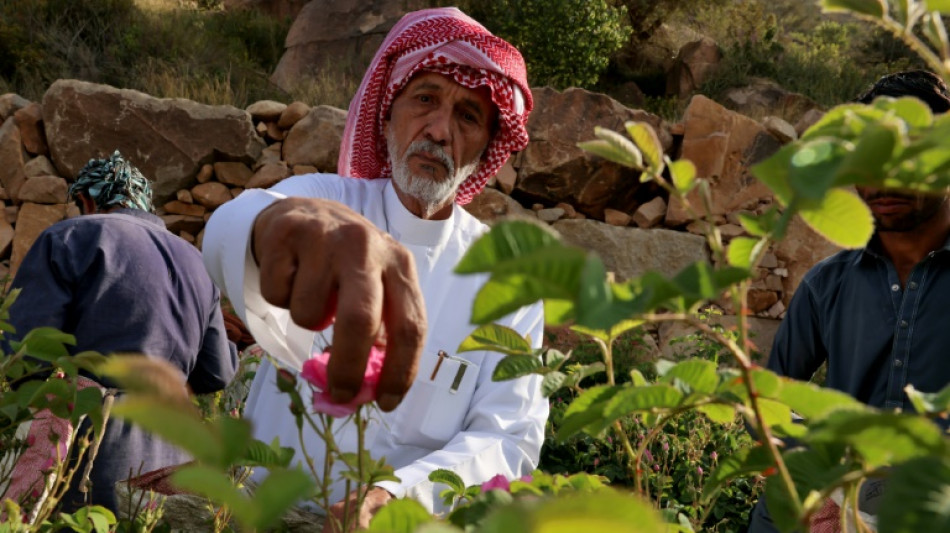
Saudi 'city of roses' offers fragrant reminder of desert's beauty / Photo: © AFP

 Commanders hand champion Seahawks their first loss

 Dupont scores twice to send Toulouse top of Top 14

 Ireland beat Israel but no handshakes due to war in Gaza

 Tense standoff over flashpoint N.Ireland parade lasts into night

 Stunned McNulty wins 'miracle' road race world title

 Re-released 'Avengers: Endgame' snaps-up N. America box office lead

 American McNulty wins shock road race world title

 Serbia's President Aleksandar Vucic announces resignation

 Tuchel urges Bellingham to play with 'rage'

 Russian strikes on Ukraine kill 8

 Bavuma, Miller hit centuries as South Africa clinch series
 Spain bring in Le Normand for injured Garcia

 UK Labour party meets buoyed by Burnham but seeking concrete plans

 Nor'easter lashes US east with punishing rain and wind

 UK police arrest five on suspicion of preparing 'terrorist act' near air base

 Washington denounces Iran's truce proposal as 'cynical'

 Armani sprinkles glitter on discreet elegance at Milan show

 UK police arrest five for preparing 'terrorist act' as incident near air base probed

 อเล็กซ์ โบดี และศาสตราจารย์ ดร. ดีเทอร์ ลาซิก ลงนามสัญญาสำหรับ ALPHA WHEY และ BODI เครื่องดื่มให้พลังงาน

 China teen blows away the field for record-setting gold at 'sad' Games

 Alex Bodi och prof. dr. Dieter Lazik tecknar avtal om ALPHA WHEY och BODI Energidryck

 Alex Bodi i prof. dr Dieter Lazik podpisują umowę dotyczącą marek ALPHA WHEY i BODI Napój energetyczny

 Ο Alex Bodi και ο καθηγητής Δρ. Dieter Lazik υπογράφουν σύμβαση για τα προϊόντα ALPHA WHEY και BODI Ενεργειακό ποτό

 アレックス・ボディ氏とディーター・ラジク教授が「ALPHA WHEY」および「BODI エナジードリンク」に関する契約を締結

 Housing protesters dig in for long stay in Madrid square

After decades spent pruning thorny bushes and working arduous harvests, Khalaf Allah al-Talhi has perfected the art of capturing the fragrant aroma of the desert rose in a bottle.
"I love roses and take care of them more than I care for my own children," the 80-year-old told AFP from his flower farm in western Saudi Arabia's Taif.
Known as "the city of roses", the hills of Taif produce around 300 million of the area's signature pink roses annually at 800 flower farms.
By his own estimates, Talhi grows around five to six million of those.
The arrival of spring's mild climate is met with the blooming of roses that carpet the vast, rolling desert landscapes with vibrant shades of pink.
The blooms are then hand-picked from daybreak to late in the evening by an army of labourers.
The petals are soaked and boiled for hours in vats, where the rose's scent is extracted through an intricate process capturing the steam that is then distilled into aromatic oil.
The flowers have long been used to make rose water to wash the walls of the Kaaba at the Grand Mosque in Mecca, and perfumes made from Taif roses are popular with pilgrims visiting the kingdom.
- 'Many rose lovers' -
"The quantity of Taif roses is small, so only limited amounts are exported because it's not enough to meet local demand. Here in Saudi Arabia, we have many rose lovers who only prefer rose perfume," Talhi said.
A modest quantity of oil is exported to craft perfumes or to be added to cosmetic products such as moisturisers and soaps.
According to the economic database TrendEconomy, Saudi Arabia in 2023 exported just $141 million worth of perfume products, which includes rosewater.
At harvest time, workers on Talhi's farm pick tens of thousands of flowers daily.
"We were born on farms and have always worked in agriculture," said Talhi, wearing a white robe and a red checkered headscarf.
But now the greater frequency of erratic weather -- including searing summer heat, frigid winters and unexpected flooding -- presents a potent threat to Taif's famed roses.
- 'My soul' -
Climate scientists have issued regular warnings that every fraction of a degree of global warming increases the intensity and frequency of extreme weather events such as heatwaves, heavy rainfall and droughts.
Saudi Arabia, with its arid climate and vast deserts, is particularly vulnerable.
"Climate change accelerates soil degradation in processes such as salinisation, erosion, and desertification, which diminishes the quality and productivity of arable land in Saudi Arabia," read a report published by the Atlantic Council.
The think tank estimated that wheat yields were expected to decline by 20 to 30 percent by 2050 in Saudi Arabia because of heat stress and not enough irrigation water, while reductions are also expected for date palms and other staple crops.
The weather in the deserts around Taif has been no exception, according to Talhi.
"Last year and the year before, it was extremely cold. Some farmers didn't harvest a single flower from their fields."
Thankfully, this season has been more forgiving.
"There are weather changes, but this year the conditions have been very mild," he said.
While the weather may now be less reliable, Talhi himself has proven to be a source of stability.
Despite his advancing years, the octogenarian rises every day before sunrise to work the fields alongside his staff, and he often labours away until late into the night.
"This farm is my soul and beating heart," he told AFP.
"God willing, nothing will separate me from it, except death."
N.Fournier--BTB