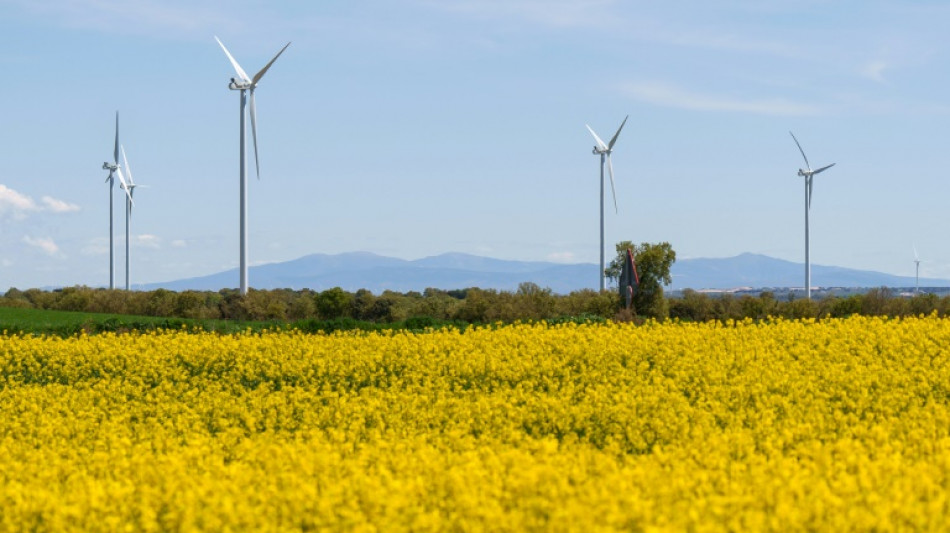
Spain's blackout highlights renewables' grid challenge / Photo: © AFP/File

 Commanders hand champion Seahawks their first loss

 Dupont scores twice to send Toulouse top of Top 14

 Ireland beat Israel but no handshakes due to war in Gaza

 Tense standoff over flashpoint N.Ireland parade lasts into night

 Stunned McNulty wins 'miracle' road race world title

 Re-released 'Avengers: Endgame' snaps-up N. America box office lead

 American McNulty wins shock road race world title

 Serbia's President Aleksandar Vucic announces resignation

 Tuchel urges Bellingham to play with 'rage'

 Russian strikes on Ukraine kill 8

 Bavuma, Miller hit centuries as South Africa clinch series

 Spain bring in Le Normand for injured Garcia

 UK Labour party meets buoyed by Burnham but seeking concrete plans

 Nor'easter lashes US east with punishing rain and wind

 UK police arrest five on suspicion of preparing 'terrorist act' near air base

 Washington denounces Iran's truce proposal as 'cynical'

 Armani sprinkles glitter on discreet elegance at Milan show

 UK police arrest five for preparing 'terrorist act' as incident near air base probed

 อเล็กซ์ โบดี และศาสตราจารย์ ดร. ดีเทอร์ ลาซิก ลงนามสัญญาสำหรับ ALPHA WHEY และ BODI เครื่องดื่มให้พลังงาน

 China teen blows away the field for record-setting gold at 'sad' Games

 Alex Bodi och prof. dr. Dieter Lazik tecknar avtal om ALPHA WHEY och BODI Energidryck

 Alex Bodi i prof. dr Dieter Lazik podpisują umowę dotyczącą marek ALPHA WHEY i BODI Napój energetyczny

 Ο Alex Bodi και ο καθηγητής Δρ. Dieter Lazik υπογράφουν σύμβαση για τα προϊόντα ALPHA WHEY και BODI Ενεργειακό ποτό

 アレックス・ボディ氏とディーター・ラジク教授が「ALPHA WHEY」および「BODI エナジードリンク」に関する契約を締結

 Housing protesters dig in for long stay in Madrid square

The cause of last week's massive power outage in Spain and Portugal remains unclear but it has shone a spotlight on solar and wind energy, which critics accuse of straining electricity grids.
The rise of renewables presents a challenge for power grids, which must evolve to adapt as countries move away from fossil fuels.
- Maintaining stability -
Grid operators must ensure that electricity is constantly balanced between demand and supply.
A metric of this balance is the frequency of the electricity flowing through the grid, set at 50 hertz (Hz) in Europe and 60 Hz in the United States. If that number drifts too far off, it can jeopardise the grid.
Historically, the electricity system has relied on conventional power plants -- gas, coal, nuclear and hydroelectric -- that use spinning turbines to generate electricity.
These machines keep the frequency stable.
With their gigantic rotors spinning at high speed, they provide inertia to the system.
If a power plant fails or if electricity demand increases too quickly, they help stabilise the grid by releasing the kinetic energy stored in the rotors.
Instead of spinning machines, solar and wind farms use electronic systems that feed power into the grid, making it harder to maintain that delicate balance.
Renewable energy will have to do more than provide carbon-free electricity in the future, said Jose Luis Dominguez-Garcia, an electrical systems expert at the Catalonia Energy Research Institute (IREC).
They will have to "assist the system with additional controls to support the grid, particularly in inertia terms", he said.
Marc Petit, professor of electrical systems at top French engineering school CentraleSupelec, argued that moving away from fossil fuels would make hydroelectric and nuclear power plants "even more essential for stabilising the system" as they use rotating machines.
- Flywheels -
A range of technical solutions already exist to compensate for renewables' lack of inertia and hence to support grid stability.
These include gravity storage, cryogenic liquid air, compressed air and concentrated solar power.
As it undergoes a transition away from coal, Britain is banking on flywheels, a tried and tested system.
Surplus power from solar and wind farms is used to make the large wheels turn, creating kinetic energy.
This stored energy can then be converted to provide electricity to the grid if needed.
- No sun or wind -
Just before the massive blackout on April 28, wind and solar power provided 70 percent of Spain's electricity output. But renewables are intermittent sources of energy as they rely on nature.
When the wind stops blowing or the sun is hiding, other sources have to step in within minutes, or there need to be adequate systems for storing -- and then releasing -- renewables in place.
Depending on the country, backup supply currently comes from mainly thermal power plants (gas or coal), nuclear reactors or hydroelectricity.
To handle the ups and downs of renewable power, countries must ramp up storage capacity.
The most widespread method is pumped storage hydropower from water reservoirs.
But large stationary batteries, akin to shipping containers, are increasingly being deployed alongside wind and solar farms -- a segment dominated by China.
To meet the global goal of tripling renewable capacity by 2030, storage capacity will have to increase sixfold, with batteries doing 90 percent of the work, according to the International Energy Agency.
Another way to ease pressure on the system would be to shift electricity use -- for example when you charge your car battery -- to the middle of the day, when solar power is at its peak.
- Rescale the network -
Widespread blackouts "have virtually always been triggered by transmission network failures, not by generation, renewables or otherwise", said Mike Hogan, advisor with the Regulatory Assistance Project (RAP), an NGO whose stated goal is to achieve a clean, reliable, equitable and cost-efficient energy future.
Tens of billions of euros, perhaps hundreds of billions, will be needed to renovate ageing power lines and replace them with new ones that are more powerful.
The need to modernise or expand the lines is pressing as energy-hungry data centres are growing and factories are increasingly consuming electricity.
Countries also need to strengthen interconnections between their power systems.
Such cross-border links helped to restore power to Spain as France stepped in to share electricity during the blackout.
By 2028, exchange capacity between the two neighbours is expected to increase from 2.8 to 5.0 gigawatts, reducing the peninsula's relative electrical isolation.
J.Fankhauser--BTB



