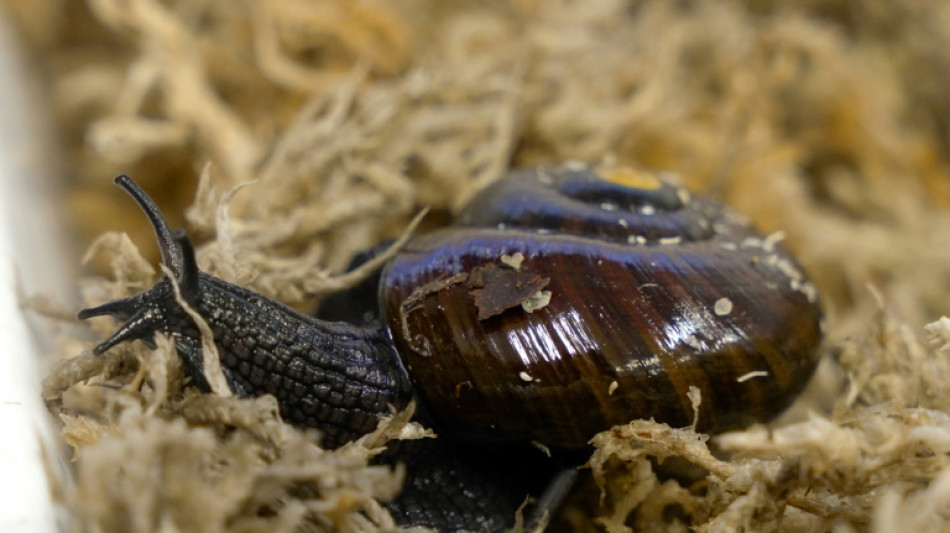
What the shell: scientists marvel as NZ snail lays egg from neck / Photo: © New Zealand Department of Conservation/AFP

 FAA Grounds All US Flights Amid Nationwide Air Traffic Control Communication Failure

 Argentina vs Uruguay Kick-off Time, TV Channels & Free Streaming Guide

 Wedding Etiquette: When Is It Appropriate to Bring a Plus-One?

 North Dakota Enacts Bipartisan Insulin Price Cap Amid National Push

 Readers Question Naughty Dog’s ‘Intergalactic’ Hype and GTA 6 Marketing Strategy

 Westminster Council Unanimously Rejects Green Party Motion in 'Zionism is not racism' Vote
A rare New Zealand snail has been filmed for the first time squeezing an egg from its neck, delighting scientists trying to save the critically endangered meat-eating mollusc.
Threatened by coal mining in New Zealand's South Island, a small population of the Mount Augustus snail was transplanted from its forest habitat almost 20 years ago to live in chilled containers tended by humans.
Little is known about the reproduction of the shellbound critters, which can grow so large that New Zealand's conservation department calls them "giants of the snail world".
A conservation ranger said she was gobsmacked to witness a captive snail laying an egg from its neck -- a reproductive act well documented in other land snails but never filmed for this species.
"It's remarkable that in all the time we've spent caring for the snails, this is the first time we've seen one lay an egg," conservation ranger Lisa Flanagan said this week.
"We caught the action when we were weighing the snail. We turned it over to be weighed and saw the egg just starting to emerge from the snail."
Conservation department scientist Kath Walker said hard shells made it difficult to mate -- so some snails instead evolved a special "genital pore" under their head.
The Mount Augustus snail "only needs to peek out of its shell to do the business," she said.
The long-lived snails can grow to the size of a golf ball and their eggs can take more than a year to hatch.
They eat earthworms, according to New Zealand's conservation department, which they slurp up "like we eat spaghetti".
Conservation efforts suffered a drastic setback in 2011, when a faulty temperature gauge froze 800 Mount Augustus snails to death inside their climate-controlled containers.
Fewer than 2,000 snails currently live in captivity, while small populations have been re-established in the New Zealand wild.
C.Meier--BTB