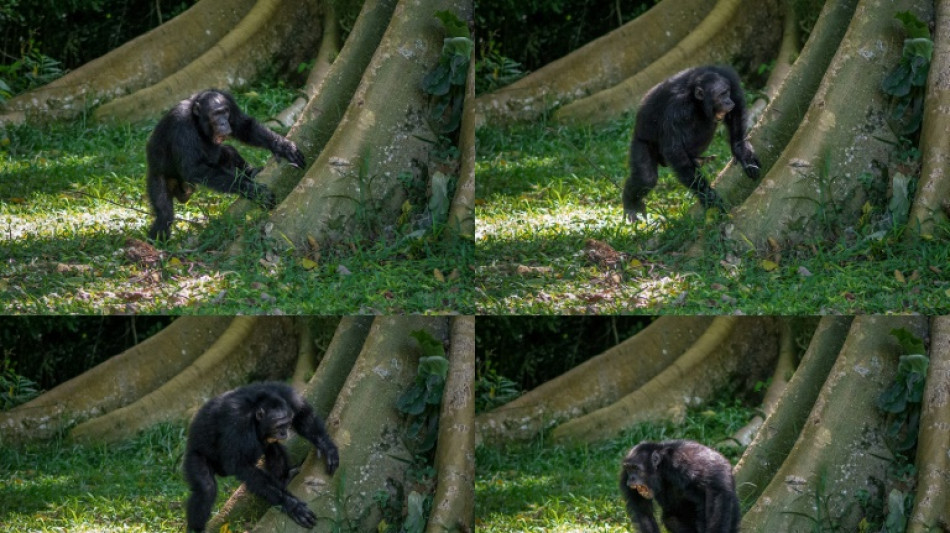
Jungle music: Chimp drumming reveals building blocks of human rhythm / Photo: © University of St Andrews/AFP/File

 American McNulty wins shock road race world title

 Serbia's President Aleksandar Vucic announces resignation

 Tuchel urges Bellingham to play with 'rage'

 Russian strikes on Ukraine kill 8

 Bavuma, Miller hit centuries as South Africa clinch series

 Spain bring in Le Normand for injured Garcia

 UK Labour party meets buoyed by Burnham but seeking concrete plans

 Nor'easter lashes US east with punishing rain and wind

 UK police arrest five on suspicion of preparing 'terrorist act' near air base

 Washington denounces Iran's truce proposal as 'cynical'

 Armani sprinkles glitter on discreet elegance at Milan show

 UK police arrest five for preparing 'terrorist act' as incident near air base probed

 อเล็กซ์ โบดี และศาสตราจารย์ ดร. ดีเทอร์ ลาซิก ลงนามสัญญาสำหรับ ALPHA WHEY และ BODI เครื่องดื่มให้พลังงาน

 China teen blows away the field for record-setting gold at 'sad' Games

 Alex Bodi och prof. dr. Dieter Lazik tecknar avtal om ALPHA WHEY och BODI Energidryck

 Alex Bodi i prof. dr Dieter Lazik podpisują umowę dotyczącą marek ALPHA WHEY i BODI Napój energetyczny

 Ο Alex Bodi και ο καθηγητής Δρ. Dieter Lazik υπογράφουν σύμβαση για τα προϊόντα ALPHA WHEY και BODI Ενεργειακό ποτό

 アレックス・ボディ氏とディーター・ラジク教授が「ALPHA WHEY」および「BODI エナジードリンク」に関する契約を締結

 Housing protesters dig in for long stay in Madrid square

 Alex Bodi și prof. dr. Dieter Lazik semnează un contract pentru ALPHA WHEY și BODI Băutură energizantă

 Former Stoke boss Pulis 'cheated' over FA Cup final loss to Man City

 Czech Republic beat Ukraine to win BJK Cup

 Isak returns to Liverpool after injury scare

 Gunmen kill 27 in two shootings in South Africa

 Spain PM vows action as housing protest sparked by eviction grows

Out west, they groove with fast, evenly spaced beats. In the east, it's more free-form and fluid.
Like humans, chimpanzees drum with distinct rhythms -- and two subspecies living on opposite sides of Africa have their own signature styles, according to a study published Friday in Current Biology.
The idea that ape drumming might hold clues to the origins of human musicality has long fascinated scientists, but collecting enough clean data amid the cacophony of the jungle had, until now, proven elusive.
"Finally we've been able to quantify that chimps drum rhythmically -- they don't just randomly drum," lead author Vesta Eleuteri of the University of Vienna told AFP.
The findings lend fresh weight to the theory that the raw ingredients of human music were present before our evolutionary split from chimpanzees six million years ago.
Previous work showed chimpanzees pound the huge flared buttress roots of rainforest trees to broadcast low‑frequency booms through dense foliage. Scientists believe these rhythmic signals help transmit information across both short and long distances.
For the new study, Eleuteri and colleagues -- including senior authors Catherine Hobaiter of the University of St. Andrews in the UK and Andrea Ravignani of Sapienza University in Rome -- compiled more than a century's worth of observational data.
After cutting through the noise, the team focused on 371 high-quality drumming bouts recorded from 11 chimpanzee communities across six populations living in both rainforest and savannah-woodland habitats across eastern and western Africa.
Their analysis showed that chimpanzees drum with definitive rhythmic intent -- the timing of their strikes is not random.
Distinct differences also emerged between subspecies: western chimpanzees tended to produce more evenly timed beats, while eastern chimpanzees more frequently alternated between shorter and longer intervals.
Western chimps also drummed more frequently, kept a quicker tempo, and began drumming earlier in their signature chimp calls, made up of rapid pants and hoots.
The researchers do not yet know what is driving the differences -- but they propose that it might signify differences in social dynamics.
The western chimps' faster, predictable pulse might promote or be evidence of greater social cohesion, the authors argue, noting that western groups are generally less aggressive toward outsiders.
By contrast, the eastern apes' variable rhythms could carry extra nuance -- handy for locating or signalling companions when their parties are more widely dispersed.
Next, Hobaiter says she would like to study the data further to understand whether there are intergenerational differences between rhythms within the same groups.
"Music is not only a difference between different musical styles, but a musical style like rock or jazz, is itself going to evolve over time," she said.
"We're actually going to have to find a way to tease apart group and intergenerational differences to get at that question of whether or not it is socially learned," she said.
"Do you have one guy that comes in with a new style and the next generation picks it up?"
C.Kovalenko--BTB



