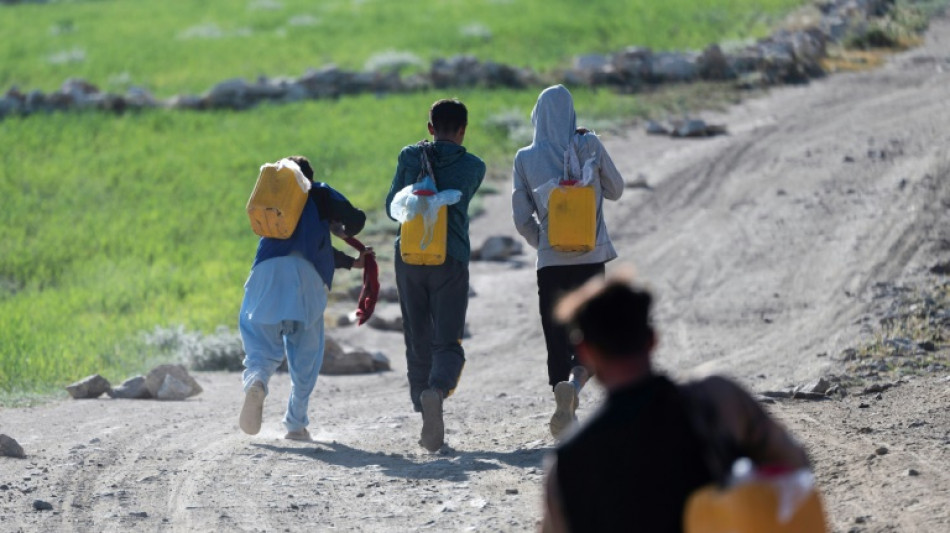
'Serious problem': Afghan capital losing race against water shortages / Photo: © AFP

 American McNulty wins shock road race world title

 Serbia's President Aleksandar Vucic announces resignation

 Tuchel urges Bellingham to play with 'rage'

 Russian strikes on Ukraine kill 8

 Bavuma, Miller hit centuries as South Africa clinch series
 Spain bring in Le Normand for injured Garcia

 UK Labour party meets buoyed by Burnham but seeking concrete plans

 Nor'easter lashes US east with punishing rain and wind

 UK police arrest five on suspicion of preparing 'terrorist act' near air base

 Washington denounces Iran's truce proposal as 'cynical'

 Armani sprinkles glitter on discreet elegance at Milan show

 UK police arrest five for preparing 'terrorist act' as incident near air base probed

 อเล็กซ์ โบดี และศาสตราจารย์ ดร. ดีเทอร์ ลาซิก ลงนามสัญญาสำหรับ ALPHA WHEY และ BODI เครื่องดื่มให้พลังงาน

 China teen blows away the field for record-setting gold at 'sad' Games

 Alex Bodi och prof. dr. Dieter Lazik tecknar avtal om ALPHA WHEY och BODI Energidryck

 Alex Bodi i prof. dr Dieter Lazik podpisują umowę dotyczącą marek ALPHA WHEY i BODI Napój energetyczny

 Ο Alex Bodi και ο καθηγητής Δρ. Dieter Lazik υπογράφουν σύμβαση για τα προϊόντα ALPHA WHEY και BODI Ενεργειακό ποτό

 アレックス・ボディ氏とディーター・ラジク教授が「ALPHA WHEY」および「BODI エナジードリンク」に関する契約を締結

 Housing protesters dig in for long stay in Madrid square

 Alex Bodi și prof. dr. Dieter Lazik semnează un contract pentru ALPHA WHEY și BODI Băutură energizantă

 Former Stoke boss Pulis 'cheated' over FA Cup final loss to Man City

 Czech Republic beat Ukraine to win BJK Cup

 Isak returns to Liverpool after injury scare

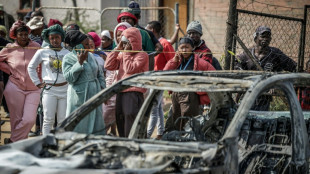 Gunmen kill 27 in two shootings in South Africa

 Spain PM vows action as housing protest sparked by eviction grows

Every week, Bibi Jan scrapes together some of her husband's meagre daily wage to buy precious water from rickshaw-drawn tankers that supply residents of Afghanistan's increasingly parched capital.
Kabul faces a looming water crisis, driven by unruly and rapid urbanisation, mismanagement over years of conflict, and climate change, meaning people like Bibi Jan are sometimes forced to choose between food and water.
"When my children have only tea for a few days, they say, 'You bought water and nothing for us'," the 45-year-old housewife told AFP, describing reusing her supplies for bathing, dishes and laundry.
Experts have long sounded the alarm over Kabul's water problems, which are worsening even as many international players have backed off big infrastructure projects and slashed funding to Afghanistan since the Taliban government took power in 2021.
"There could be no ground water in Kabul by 2030" without urgent action, the UN children's agency UNICEF warned last year.
Other experts are more cautious, citing limited consistent and reliable data, but say the situation is clearly deteriorating.
A 2030 cliff is a "worst-case scenario", said water resources management expert Assem Mayar.
But even if slated development projects are completed in a few years, it "doesn't mean the situation would become better than now", Mayar said.
"As time goes on, the problems are only increasing," he added, as population growth outstrips urban planning and climate change drives below-average precipitation.
- 'Decreasing day by day' -
The Taliban authorities have launched projects ranging from recycling water to building hundreds of small dams across the country, but larger interventions remain hampered by financing and technical capacity.
They remain unrecognised by any country since they ousted the Western-backed government and imposed their severe interpretation of Islamic law, with restrictions on women a major sticking point.
They have repeatedly called for non-governmental groups to reboot stalled projects on water and climate change, as Afghanistan faces "some of the harshest effects" in the region, according to the United Nations.
The water and energy ministry wants to divert water from the Panjshir river to the capital, but needs $300 million to $400 million. A dam project near Kabul would ease pressures but was delayed after the Taliban takeover.
For now, Kabul's primary drinking water source is groundwater, as much as 80 percent of which is contaminated, according to a May report by Mercy Corps.
It is tapped by more than 100,000 unregulated wells across the city that are regularly deepened or run dry, the NGO said.
Groundwater can be recharged, but more is drawn each year than is replenished in Kabul, with an estimated annual 76-million-cubic-metre (20-billion-gallon) deficit, experts say.
"It's a very serious problem... Water is decreasing day by day in the city," said Shafiullah Zahidi, who heads central Kabul operations for the state-owned water company UWASS.
Water systems designed decades ago serve just 20 percent of the city's population, which has exploded to around six million over the past 20 years, said Zahidi.
- 'Use less water' -
At one of Kabul's 15 pumping stations, maintenance manager Mohammad Ehsan said the seven-year-old well is already producing less water. Two others nearby sit dry.
"The places with shallower water levels are dried out now," said 53-year-old Ehsan, who has worked in water management for two decades, as he stood over an old well.
It once produced water from a depth of 70 metres (230 feet), but a newer well had to be bored more than twice as deep to reach groundwater.
At one of the two large stations in the city, the International Committee of the Red Cross (ICRC) recently procured four new pumps where only one had been functioning.
"If that pump collapsed for any reason, that means stopping the service for 25,000 beneficiary households," which now have uninterrupted water, said Baraa Afeh, ICRC's deputy water and habitat coordinator.
Everyone in Kabul "should have 24-hour service", said Zahidi, from the state water company.
But in reality, Bibi Jan and many other Kabulis are forced to lug water in heavy jugs from wells or buy it from tankers.
These suppliers charge at least twice as much as the state-owned utility, with potable water even more pricy in a country where 85 percent of the population lives on less than a dollar a day.
Bibi Jan said she has to police her family's water use carefully.
"I tell them, 'I'm not a miser but use less water.' Because if the water runs out then what would we do?"
R.Adler--BTB