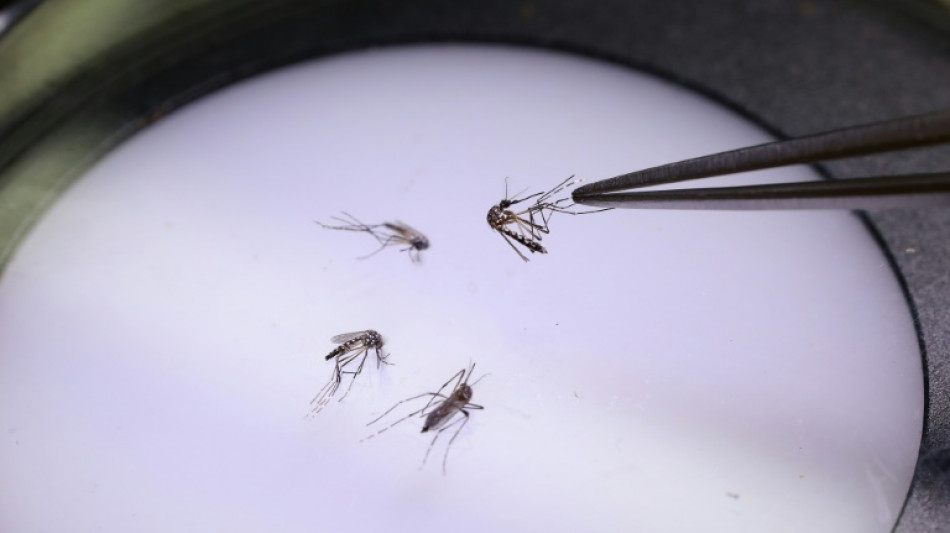
Invasive species cost trillions in damages: study / Photo: © AFP/File

 American McNulty wins shock road race world title

 Serbia's President Aleksandar Vucic announces resignation

 Tuchel urges Bellingham to play with 'rage'

 Russian strikes on Ukraine kill 8

 Bavuma, Miller hit centuries as South Africa clinch series
 Spain bring in Le Normand for injured Garcia

 UK Labour party meets buoyed by Burnham but seeking concrete plans

 Nor'easter lashes US east with punishing rain and wind

 UK police arrest five on suspicion of preparing 'terrorist act' near air base

 Washington denounces Iran's truce proposal as 'cynical'

 Armani sprinkles glitter on discreet elegance at Milan show

 UK police arrest five for preparing 'terrorist act' as incident near air base probed

 อเล็กซ์ โบดี และศาสตราจารย์ ดร. ดีเทอร์ ลาซิก ลงนามสัญญาสำหรับ ALPHA WHEY และ BODI เครื่องดื่มให้พลังงาน

 China teen blows away the field for record-setting gold at 'sad' Games

 Alex Bodi och prof. dr. Dieter Lazik tecknar avtal om ALPHA WHEY och BODI Energidryck

 Alex Bodi i prof. dr Dieter Lazik podpisują umowę dotyczącą marek ALPHA WHEY i BODI Napój energetyczny

 Ο Alex Bodi και ο καθηγητής Δρ. Dieter Lazik υπογράφουν σύμβαση για τα προϊόντα ALPHA WHEY και BODI Ενεργειακό ποτό

 アレックス・ボディ氏とディーター・ラジク教授が「ALPHA WHEY」および「BODI エナジードリンク」に関する契約を締結

 Housing protesters dig in for long stay in Madrid square

 Alex Bodi și prof. dr. Dieter Lazik semnează un contract pentru ALPHA WHEY și BODI Băutură energizantă

 Former Stoke boss Pulis 'cheated' over FA Cup final loss to Man City

 Czech Republic beat Ukraine to win BJK Cup

 Isak returns to Liverpool after injury scare

 Gunmen kill 27 in two shootings in South Africa

 Spain PM vows action as housing protest sparked by eviction grows

From river-clogging plants to disease-carrying insects, the direct economic cost of invasive species worldwide has averaged about $35 billion a year for decades, researchers said Monday.
Since 1960, damage from non-native plants and animals expanding into new territory has cost society more than $2.2 trillion, 17 times higher than previous estimates, they reported in the journal Nature Ecology & Evolution.
The accelerating spread of invasive species -- from mosquitoes to wild boar to tough-to-eradicate plants -- blights agriculture, spreads disease and drives the growing pace of species extinction.
Earlier calculations based on highly incomplete data were already known to fall far short of reality.
To piece together a more accurate picture, an international team of researchers led by Ismael Soto, a scientist at the University of South Bohemia in the Czech Republic, compiled data on 162 invasive species whose costs have been well documented in at least a handful of countries.
They then modelled the economic impact for 78 other countries such as Bangladesh and Costa Rica, for which no data was previously available.
"We expected an underestimation of invasion costs, but the magnitude was striking," Soto told AFP.
Due mainly to high volumes of trade and travel, tens of thousands of animal and plant species have taken root, sometimes literally, far from their places of origin.
Europe is by far the continent most affected by the phenomenon, followed by North America and Asia.
"Plants were the most economically damaging group, both for damage and management," Soto said. "Cost hotspots include urban coastal areas, notably in Europe, eastern China, and the US."
Animals can cause devastating damage too.
Wild boar, for example, destroy crops, cornfields and vineyards, while mosquitoes -- with expanding ranges due to global warming -- impose direct costs to human health by spreading diseases such as dengue and malaria.
Another example is Japanese knotweed, an invasive plant that is very common in Europe and requires costly eradication programmes.
"Our study is based on only 162 species," Soto noted. "Our figure is probably still an underestimate of a wider problem, and therefore the real economic costs could be even higher."
Using a broader definition -- including indirect costs such as lost income -- the UN's biodiversity expert group, IPBES, has calculated the total cost to society of invasive species at about $400 billion annually.
H.Seidel--BTB



