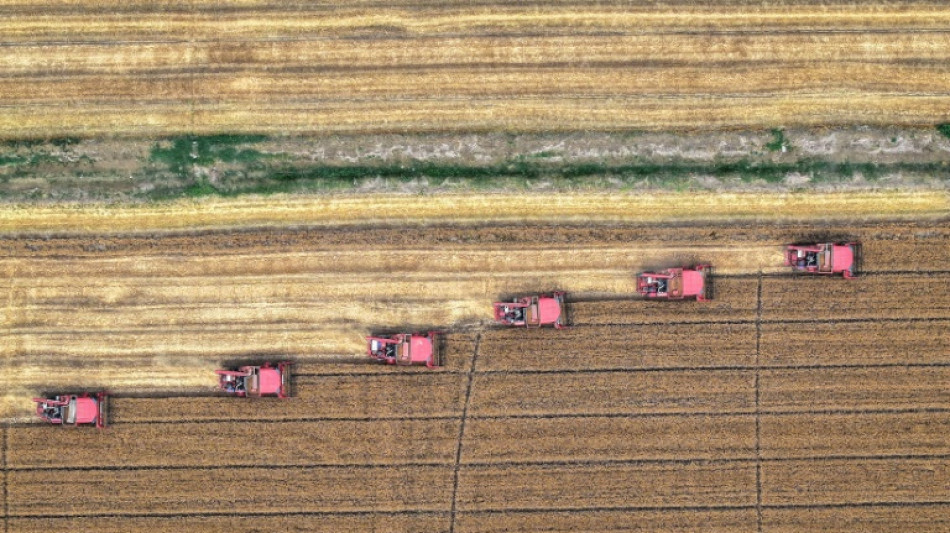
Climate change could cut crop yields up to a quarter / Photo: © AFP/File

 Russian strikes on Ukraine kill 8

 Bavuma, Miller hit centuries as South Africa clinch series

 Spain bring in Le Normand for injured Garcia

 UK Labour party meets buoyed by Burnham but seeking concrete plans

 Nor'easter lashes US east with punishing rain and wind

 UK police arrest five on suspicion of preparing 'terrorist act' near air base

 Washington denounces Iran's truce proposal as 'cynical'

 Armani sprinkles glitter on discreet elegance at Milan show

 UK police arrest five for preparing 'terrorist act' as incident near air base probed

 อเล็กซ์ โบดี และศาสตราจารย์ ดร. ดีเทอร์ ลาซิก ลงนามสัญญาสำหรับ ALPHA WHEY และ BODI เครื่องดื่มให้พลังงาน

 China teen blows away the field for record-setting gold at 'sad' Games

 Alex Bodi och prof. dr. Dieter Lazik tecknar avtal om ALPHA WHEY och BODI Energidryck

 Alex Bodi i prof. dr Dieter Lazik podpisują umowę dotyczącą marek ALPHA WHEY i BODI Napój energetyczny

 Ο Alex Bodi και ο καθηγητής Δρ. Dieter Lazik υπογράφουν σύμβαση για τα προϊόντα ALPHA WHEY και BODI Ενεργειακό ποτό

 アレックス・ボディ氏とディーター・ラジク教授が「ALPHA WHEY」および「BODI エナジードリンク」に関する契約を締結

 Housing protesters dig in for long stay in Madrid square

 Alex Bodi și prof. dr. Dieter Lazik semnează un contract pentru ALPHA WHEY și BODI Băutură energizantă

 Former Stoke boss Pulis 'cheated' over FA Cup final loss to Man City

 Czech Republic beat Ukraine to win BJK Cup

 Isak returns to Liverpool after injury scare

 Gunmen kill 27 in two shootings in South Africa

 Spain PM vows action as housing protest sparked by eviction grows

 Fernandez downs Gibson to claim Singapore Open crown

 Three talking points from the Azerbaijan Grand Prix

 Turkey ex-minister resigns as investment fund crisis grows

Climate change is on track to reduce by 11 percent in 2100 the yields that today provide two-thirds of humanity's calories from crops, even taking into account adaptation to a warming world, scientists said Wednesday.
As soon as 2050, this "moderate" scenario in which greenhouse gas emissions peak around 2040 and slowly taper off -- a trajectory aligned with current trends -- would see global losses of nearly eight percent.
And if carbon pollution worsens, the loss of calories across the same six staples -- corn, wheat, rice, soybeans, sorghum and cassava -- rises to nearly a quarter by century's end, the researchers reported in Nature.
More generally, every additional degree Celsius of warming reduces the world's ability to produce food from these crops by 120 calories per person per day, or nearly five percent of current daily consumption, they calculated.
"If the climate warms by three degrees, that's basically like everyone on the planet giving up breakfast," said co-author Solomon Hsiang, a professor at the Stanford Doerr School of Sustainability in California.
The steepest losses will occur at the extremes of the agricultural economy: in modern, Big Ag breadbaskets that currently enjoy some of the world's best growing conditions, and in subsistence farming communities that typically rely of small cassava harvests.
North America would be hit hardest, losing a fifth of yields by 2100 in the moderate carbon pollution scenario, and two-fifths if emissions from burning fossil fuels continue apace.
Working with more than a dozen scientists, Hsiang and co-leader Andrew Hultgren, an assistant professor at the University of Urbana-Champaign, sifted through data from more than 12,000 regions in 55 countries.
- Erratic weather -
Previous calculations of how a warming world will impact crop yields generally failed to consider the ways in which farmers would adapt, such as switching crop varieties, shifting planting and harvesting dates, and altering fertiliser use.
The scientists estimated such adjustments would offset about a third of climate related losses over the next 75 years in the scenario of rising emissions, but that residual impacts would still be devastating.
"Any level of warming, even when accounting for adaptation, results in global output losses for agriculture," said Hultgren.
With the planet about 1.5C hotter than preindustrial levels in the late 1900s, farmers in many regions are already experiencing longer dry spells, unseasonable heatwaves and erratic weather that undermines yields.
The nutritional value of most crops also declines with hotter temperatures, earlier research has shown.
The study revealed sharp variations in the impact of global warming on different crops and regions.
In the "worst-case" scenario of rising carbon emissions, corn yields would plummet 40 percent by 2100 across the grain belt of the United States, eastern China, central Asia, and the Middle East.
For soybeans, yields in the US would decline by half, and increase by a fifth in Brazil.
Wheat losses would drop by a fifth in eastern and western Europe, and by 30 to 40 percent in other wheat-growing regions: China, Russia and North America.
Cassava would be hit hard everywhere it's grown.
"Although cassava does not make up a large portion of global agricultural revenues, it is an important subsistence crop in low- and middle-income countries," the researchers pointed out.
Among the six crops examined, rice is the only one that stands to benefit in a warmer climate, mainly due to warmer nights.
W.Lapointe--BTB



