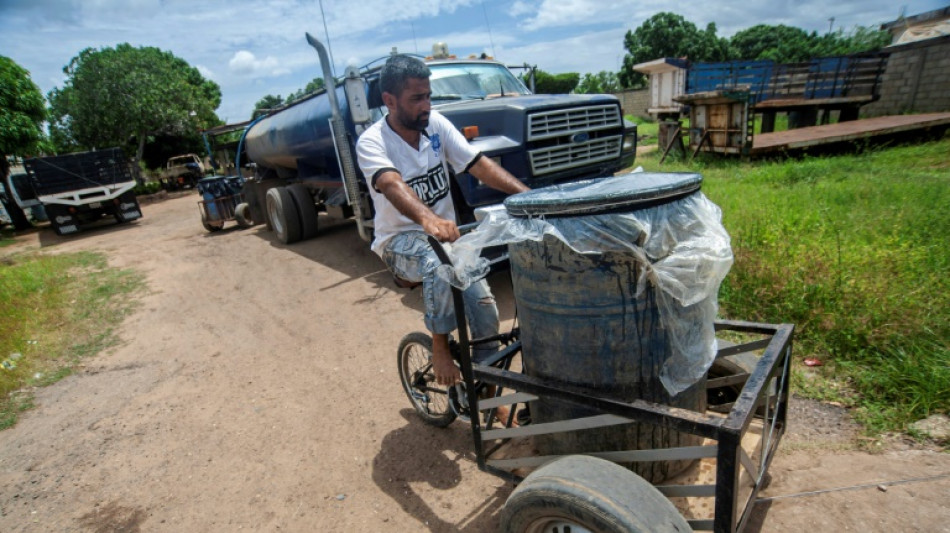
Drilling for water in Venezuela's parched oil town / Photo: © AFP

 Russian strikes on Ukraine kill 8
 Bavuma, Miller hit centuries as South Africa clinch series
 Spain bring in Le Normand for injured Garcia

 UK Labour party meets buoyed by Burnham but seeking concrete plans

 Nor'easter lashes US east with punishing rain and wind

 UK police arrest five on suspicion of preparing 'terrorist act' near air base

 Washington denounces Iran's truce proposal as 'cynical'

 Armani sprinkles glitter on discreet elegance at Milan show

 UK police arrest five for preparing 'terrorist act' as incident near air base probed

 อเล็กซ์ โบดี และศาสตราจารย์ ดร. ดีเทอร์ ลาซิก ลงนามสัญญาสำหรับ ALPHA WHEY และ BODI เครื่องดื่มให้พลังงาน

 China teen blows away the field for record-setting gold at 'sad' Games

 Alex Bodi och prof. dr. Dieter Lazik tecknar avtal om ALPHA WHEY och BODI Energidryck

 Alex Bodi i prof. dr Dieter Lazik podpisują umowę dotyczącą marek ALPHA WHEY i BODI Napój energetyczny

 Ο Alex Bodi και ο καθηγητής Δρ. Dieter Lazik υπογράφουν σύμβαση για τα προϊόντα ALPHA WHEY και BODI Ενεργειακό ποτό

 アレックス・ボディ氏とディーター・ラジク教授が「ALPHA WHEY」および「BODI エナジードリンク」に関する契約を締結

 Housing protesters dig in for long stay in Madrid square

 Alex Bodi și prof. dr. Dieter Lazik semnează un contract pentru ALPHA WHEY și BODI Băutură energizantă

 Former Stoke boss Pulis 'cheated' over FA Cup final loss to Man City

 Czech Republic beat Ukraine to win BJK Cup

 Isak returns to Liverpool after injury scare

 Gunmen kill 27 in two shootings in South Africa

 Spain PM vows action as housing protest sparked by eviction grows

 Fernandez downs Gibson to claim Singapore Open crown

 Three talking points from the Azerbaijan Grand Prix

 Turkey ex-minister resigns as investment fund crisis grows

In Venezuela's oil capital of Maracaibo, a drilling frenzy has led to dozens of new wells -- but the valuable liquid being pumped out is just water, not petroleum.
In a symbol of the woes of Venezuela's crumbling economy, the once flourishing oil town of 2 million people is parched.
Experts blame the nationwide shortage of drinking water on corruption and years of underinvestment and mismanagement by national and local governments, resulting in frequent water cuts.
The corroding infrastructure has led to schools, homes, businesses, churches and health centers all digging their own wells -- at a huge expense.
A private well costs between $1,000 and $6,000, a fortune in the sanctions-hit Caribbean country where the minimum monthly wage is around $200.
As a result, homes that come with a ready-made well and generator -- Venezuelans also live with recurring power cuts -- sell for a premium.
While water rationing has been in place in Venezuelan cities for years, the situation in Maracaibo has become critical, as pumping stations break down, old pipes leak and reservoirs run dry.
- 'It's a blessing' -
No water came out of the taps in certain parts of the city for over a month at the start of 2025.
Manuel Palmar and six other families in the lower-middle-class neighborhood of Ziruma saw the writing on the wall four years ago.
They each paid $2,500 to build a 12-meter-deep (40-foot) well, which can store up to about 80,000 liters (21,000 gallons) of spring water each week.
Now when Palmar turns on the tap, water gushes out for free.
The water is not fit for drinking due to its high salinity -- saltwater from the Caribbean Sea seeps into Lake Maracaibo, a coastal lake used as a freshwater source -- but "it's perfect for washing clothes and flushing toilets," he explained.
"It's a blessing!" the 34-year-old accountant said.
There's a solution of sorts for every budget.
Some residents fill 200-liter drums at official filling stations or communal taps for $2-$3.
Others order a water truck to fill their building's tank for between $40 and $60.
Some even recycle the water produced by the tropical city's ubiquitous air conditioners or collect rainwater.
But those are all quick fixes.
- Brackish drinking water -
Over the past six years, more and more residents have begun digging wells to guarantee their long-term supply for the future.
Gabriel Delgado has built about 20 wells in Maracaibo, including at a heart disease clinic and four private schools.
He also built one at his mother-in-law's home: a gray cement cylinder, one and a half meters in diameter, buried under metal sheeting and rocks.
Cobwebs dangle just above the water level, but as soon as he activates the pump, water pours forth.
It's crystal clear, unlike the yellowish liquid that flows from the city's taps during the rainy season, and Delgado eagerly sips it.
Venezuelans must receive authorization from health and environmental authorities before drilling a well, and they are required to provide water samples for testing to ensure it is fit for consumption once it's built.
But not everyone bothers.
Javier Otero, head of Maracaibo's municipal water department, told AFP that he had come across shallow artisanal wells built near sewers or polluted ravines.
"Some people drink water that is not potable, that is brackish," he told AFP.
The municipality has built seven wells to supply Maracaibo's poorer neighborhoods.
M.Furrer--BTB



