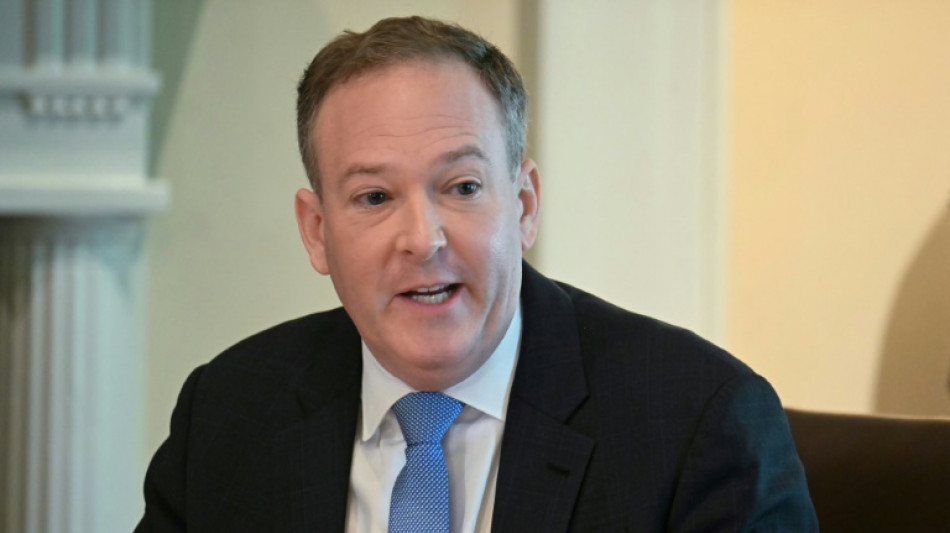
Trump administration expected to say greenhouse gases aren't harmful / Photo: © AFP/File

 Armani sprinkles glitter on discreet elegance at Milan show

 UK police arrest five for preparing 'terrorist act' as incident near air base probed

 อเล็กซ์ โบดี และศาสตราจารย์ ดร. ดีเทอร์ ลาซิก ลงนามสัญญาสำหรับ ALPHA WHEY และ BODI เครื่องดื่มให้พลังงาน

 China teen blows away the field for record-setting gold at 'sad' Games

 Alex Bodi och prof. dr. Dieter Lazik tecknar avtal om ALPHA WHEY och BODI Energidryck

 Alex Bodi i prof. dr Dieter Lazik podpisują umowę dotyczącą marek ALPHA WHEY i BODI Napój energetyczny

 Ο Alex Bodi και ο καθηγητής Δρ. Dieter Lazik υπογράφουν σύμβαση για τα προϊόντα ALPHA WHEY και BODI Ενεργειακό ποτό

 アレックス・ボディ氏とディーター・ラジク教授が「ALPHA WHEY」および「BODI エナジードリンク」に関する契約を締結

 Housing protesters dig in for long stay in Madrid square

 Alex Bodi și prof. dr. Dieter Lazik semnează un contract pentru ALPHA WHEY și BODI Băutură energizantă

 Former Stoke boss Pulis 'cheated' over FA Cup final loss to Man City

 Czech Republic beat Ukraine to win BJK Cup

 Isak returns to Liverpool after injury scare

 Gunmen kill 27 in two shootings in South Africa

 Spain PM vows action as housing protest sparked by eviction grows

 Fernandez downs Gibson to claim Singapore Open crown

 Three talking points from the Azerbaijan Grand Prix

 Turkey ex-minister resigns as investment fund crisis grows

 Pope urges French bishops to 'persevere' against clerical sex abuse

 Decorated Indian badminton star calls Japan Asian Games 'very sad'

 Asian Games chiefs say lessons learned over accommodation

 UK's PM urges 'calm' as thousands seek to thwart flashpoint N.Ireland parade

 Thousands seek to thwart disputed N.Ireland flashpoint parade

 Swiss vote on what it means to be neutral
 Pope to meet with victims of clerical sex abuse during France trip

President Donald Trump's administration is preparing to upend a foundational scientific determination about the harms of greenhouse gases that underpins the US government's ability to curb climate change.
A proposal from the Environmental Protection Agency (EPA) to change the so-called "Endangerment Finding" was sent to the White House on June 30, a spokesperson told AFP.
An announcement is expected imminently. Here's what to know -- and what's at stake if the finding is overturned.
- What is the Endangerment Finding? -
The Clean Air Act of 1970 empowered the EPA to regulate "air pollution which may reasonably be anticipated to endanger public health or welfare."
For decades, the law applied to pollutants like lead, ozone and soot.
But as climate science around the dangers of heat-trapping greenhouse gases advanced in the 2000s, a coalition of states and nonprofit groups petitioned the EPA to include them under the law, focusing on motor vehicles.
The issue reached the Supreme Court, which in 2007 ruled that greenhouse gases qualify as air pollutants and directed the EPA to revisit its stance.
That led to the 2009 Endangerment Finding, which declared greenhouse gases a threat to public health and welfare, based on overwhelming scientific consensus and peer-reviewed research.
"That 2009 finding formed the basis for all of EPA's subsequent regulations," Meredith Hankins, a senior attorney on climate and energy for the activist Natural Resources Defense Council, told AFP.
"They've issued greenhouse gas standards for tailpipe emissions from motor vehicles, smokestack emissions from power plants -- all of these individual rulemakings trace themselves back to the 2009 Endangerment Finding."
- What is the Trump administration doing? -
The Endangerment Finding has withstood multiple legal challenges, and although Trump's first administration considered reversing it, they ultimately held back.
But the finding is now a direct target of Project 2025, a far-right governance blueprint closely followed by the administration.
In March, the EPA under Administrator Lee Zeldin announced a formal reconsideration of the finding.
"The Trump Administration will not sacrifice national prosperity, energy security, and the freedom of our people for an agenda that throttles our industries, our mobility, and our consumer choice while benefiting adversaries overseas," he said.
The government is expected to undo the earlier finding that greenhouse gases endanger public welfare.
It will argue that the economic costs of regulation have been undervalued -- and downplay the role of US motor vehicle emissions in climate change.
In fact, transportation is the largest source of US greenhouse gas emissions.
"If vehicle emissions don't pass muster as a contribution to climate change, it's hard to imagine what would," Dena Adler of the Institute for Policy Integrity at New York University told AFP.
"It's fatalistic to avoid taking the many actions that could cumulatively fix climate change, because none of them can individually solve the entire problem."
Since 1970, the United States has emitted more vehicle-based greenhouse gases than the next nine countries combined, according to an analysis by the Institute for Policy Integrity that will soon be published in full.
- Could they succeed? -
In March, the EPA said it would lean on recent court rulings, including a landmark 2024 decision that narrowed federal regulatory power.
Still, legal experts say the administration faces an uphill battle.
"It will take a few years for the rule to be finalized and wind its way up to the Supreme Court for review," said Adler.
"If EPA loses before the Supreme Court, it gets sent back, and EPA then gets it back to the drawing board" -- by which time Trump's term may be nearing its end.
To succeed, the high court may need to overturn its own 2007 decision that led to the Endangerment Finding.
None of the justices who wrote the majority opinion remain on the bench, while three dissenters -- John Roberts, Clarence Thomas, and Samuel Alito -- still serve, and could spearhead a drive to upend the original ruling.
Even then, market forces may blunt the impact of any rollback.
"Utilities making long-term investments and companies purchasing capital goods expected to be used for decades won't base those decisions on short-term policy changes," said John Tobin-de la Puente, a professor at Cornell University's business school.
That's especially true when those swings run counter to business trends and could be undone by a future administration, he added.
J.Bergmann--BTB



