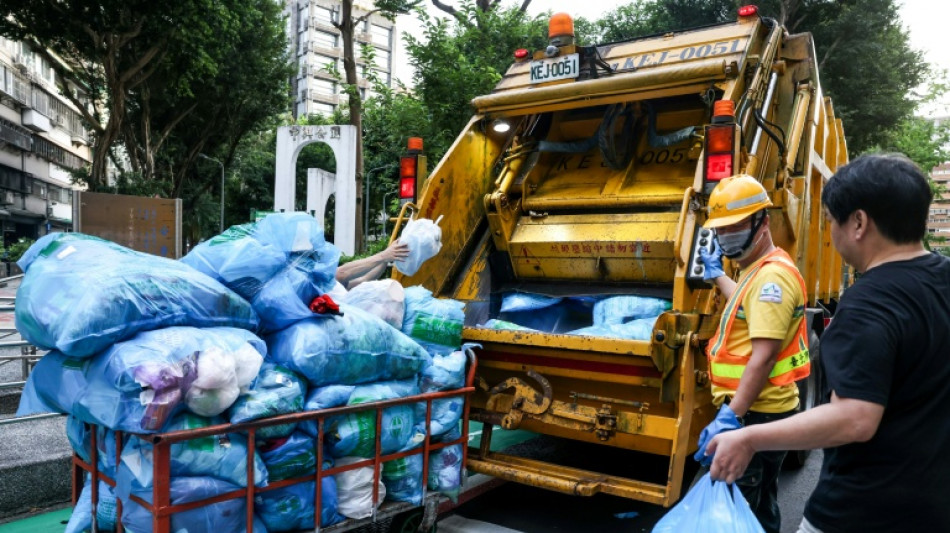
Taiwan's garbage trucks offer classical music and a catch-up / Photo: © AFP

 Armani sprinkles glitter on discreet elegance at Milan show

 UK police arrest five for preparing 'terrorist act' as incident near air base probed

 อเล็กซ์ โบดี และศาสตราจารย์ ดร. ดีเทอร์ ลาซิก ลงนามสัญญาสำหรับ ALPHA WHEY และ BODI เครื่องดื่มให้พลังงาน

 China teen blows away the field for record-setting gold at 'sad' Games

 Alex Bodi och prof. dr. Dieter Lazik tecknar avtal om ALPHA WHEY och BODI Energidryck

 Alex Bodi i prof. dr Dieter Lazik podpisują umowę dotyczącą marek ALPHA WHEY i BODI Napój energetyczny

 Ο Alex Bodi και ο καθηγητής Δρ. Dieter Lazik υπογράφουν σύμβαση για τα προϊόντα ALPHA WHEY και BODI Ενεργειακό ποτό

 アレックス・ボディ氏とディーター・ラジク教授が「ALPHA WHEY」および「BODI エナジードリンク」に関する契約を締結

 Housing protesters dig in for long stay in Madrid square

 Alex Bodi și prof. dr. Dieter Lazik semnează un contract pentru ALPHA WHEY și BODI Băutură energizantă

 Former Stoke boss Pulis 'cheated' over FA Cup final loss to Man City

 Czech Republic beat Ukraine to win BJK Cup

 Isak returns to Liverpool after injury scare

 Gunmen kill 27 in two shootings in South Africa

 Spain PM vows action as housing protest sparked by eviction grows

 Fernandez downs Gibson to claim Singapore Open crown

 Three talking points from the Azerbaijan Grand Prix

 Turkey ex-minister resigns as investment fund crisis grows

 Pope urges French bishops to 'persevere' against clerical sex abuse

 Decorated Indian badminton star calls Japan Asian Games 'very sad'

 Asian Games chiefs say lessons learned over accommodation

 UK's PM urges 'calm' as thousands seek to thwart flashpoint N.Ireland parade

 Thousands seek to thwart disputed N.Ireland flashpoint parade

 Swiss vote on what it means to be neutral

 Pope to meet with victims of clerical sex abuse during France trip
Taiwanese residents holding plastic bags of rubbish stand on a footpath as a yellow garbage truck playing classical music over a loudspeaker pulls up.
For decades, the tinkling of Beethoven's "Fur Elise" or Tekla Badarzewska-Baranowska's "Maiden's Prayer" has alerted Taiwanese households to take out their garbage.
Like clockwork, residents emerge from their apartment buildings carrying bags of pre-sorted rubbish as the musical garbage trucks approach.
"When we hear this music, we know it's time to take out the trash. It's very convenient," 78-year-old Lee Shu-ning told AFP as she waited outside her tower block in Taipei.
Residents toss plastic bags of general refuse into the yellow compaction truck, and tip food waste and recycling into bins carried by another vehicle.
For the elderly, taking out the trash has become a social event and many arrive early to sit and talk around the collection points.
"I can chat with some old neighbours and friends, it's nice," Lee said, before disposing of several bottles and cans.
"It's also a kind of exercise," she added.
But not everyone is a fan.
"I think it's quite inconvenient because it comes at a fixed time every day," said 31-year-old beautician Dai Yun-wei after dumping her rubbish in the truck.
"Sometimes we're not home or we're busy, so we can't throw away the trash."
- 'Save a lot of time' -
Taiwan's musical garbage trucks have been an almost daily feature of life on the island since the 1960s, Shyu Shyh-shiun of Taipei's Department of Environmental Protection told AFP.
Taiwan imported German garbage trucks pre-programmed with "Fur Elise", Shyu said, but added it was not clear how the "Maiden's Prayer" became part of the repertoire.
The trucks operate five days a week, usually in the late afternoon and evening.
Yang Xiu-ying, 76, has made a living out of helping her neighbours dispose of their garbage.
She receives NT$11,200 ($380) a month from 28 households in her lane to sort their trash, load it onto a trolley and take it to the refuse trucks.
"Some people get off work late, some elderly people find it inconvenient, so they take it downstairs and I dump the garbage for them," Yang said, wearing two layers of gloves and long protective sleeves.
Others have turned to digital solutions for their rubbish problem.
The young founders of Tracle created an app enabling people to book a time for their trash to be taken away.
"I think our value is that we save a lot of time for them," co-founder Ben Chen said.
"We enhance their life quality."
- Cleaning up -
Over the past 30 years, Taiwan has been cleaning up its waste management act.
An economic boom had led to an explosion of garbage, with almost no recycling, landfills overflowing and people protesting air and ground pollution.
In response, the island ramped up recycling, increased incineration and made people responsible for sorting and dumping their own trash in the trucks instead of leaving it on the ground for collection.
Taipei residents are also required to buy government-approved blue plastic bags for their general waste to encourage them to use less and recycle more.
"In the beginning, everybody feels... that it's not very convenient," Shyu said.
But once people started noticing the cleaner streets, "they feel this is a good policy".
The city's recycling rate has surged to nearly 67 percent, from two percent in 2000, and the amount of garbage sent for incineration has fallen by two-thirds, Shyu said.
And, he said, smiling, the trucks are "almost" always on time.
R.Adler--BTB



