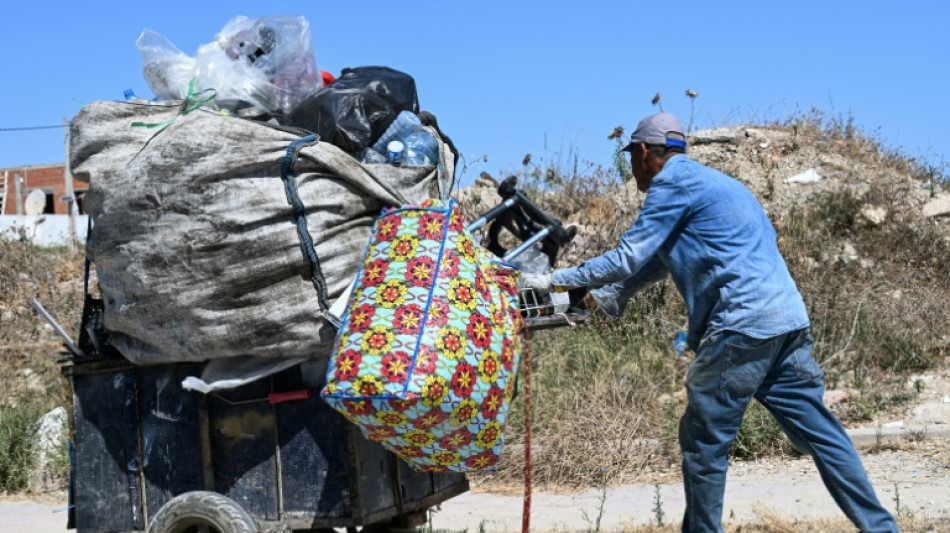
Tunisia plastic collectors spread as economic, migration woes deepen / Photo: © AFP

 Armani sprinkles glitter on discreet elegance at Milan show

 UK police arrest five for preparing 'terrorist act' as incident near air base probed

 อเล็กซ์ โบดี และศาสตราจารย์ ดร. ดีเทอร์ ลาซิก ลงนามสัญญาสำหรับ ALPHA WHEY และ BODI เครื่องดื่มให้พลังงาน

 China teen blows away the field for record-setting gold at 'sad' Games

 Alex Bodi och prof. dr. Dieter Lazik tecknar avtal om ALPHA WHEY och BODI Energidryck

 Alex Bodi i prof. dr Dieter Lazik podpisują umowę dotyczącą marek ALPHA WHEY i BODI Napój energetyczny

 Ο Alex Bodi και ο καθηγητής Δρ. Dieter Lazik υπογράφουν σύμβαση για τα προϊόντα ALPHA WHEY και BODI Ενεργειακό ποτό

 アレックス・ボディ氏とディーター・ラジク教授が「ALPHA WHEY」および「BODI エナジードリンク」に関する契約を締結

 Housing protesters dig in for long stay in Madrid square

 Alex Bodi și prof. dr. Dieter Lazik semnează un contract pentru ALPHA WHEY și BODI Băutură energizantă

 Former Stoke boss Pulis 'cheated' over FA Cup final loss to Man City

 Czech Republic beat Ukraine to win BJK Cup

 Isak returns to Liverpool after injury scare

 Gunmen kill 27 in two shootings in South Africa

 Spain PM vows action as housing protest sparked by eviction grows

 Fernandez downs Gibson to claim Singapore Open crown

 Three talking points from the Azerbaijan Grand Prix

 Turkey ex-minister resigns as investment fund crisis grows

 Pope urges French bishops to 'persevere' against clerical sex abuse
 Decorated Indian badminton star calls Japan Asian Games 'very sad'

 Asian Games chiefs say lessons learned over accommodation

 UK's PM urges 'calm' as thousands seek to thwart flashpoint N.Ireland parade

 Thousands seek to thwart disputed N.Ireland flashpoint parade

 Swiss vote on what it means to be neutral
 Pope to meet with victims of clerical sex abuse during France trip
A towel draped over his head, Hamza Jabbari sets bags of plastic bottles onto a scale. He is among Tunisia's "barbechas", informal plastic recyclers whose increasing numbers reflect the country's economic -- and migratory -- woes.
The 40-something-year-old said he starts the day off at dawn, hunching over bins and hunting for plastic before the rubbish trucks and other plastic collectors come.
"It's the most accessible work in Tunisia when there are no job offers," Jabbari said, weighing a day's haul in Bhar Lazreg, a working-class neighbourhood north of the capital, Tunis.
The work is often gruelling, with a kilogramme of plastic bottles worth only 0.5 to 0.7 Tunisian dinar -- less than $0.25.
In Tunis, it's common to see women weighed down by bags of plastic bottles along the roadside, or men weaving through traffic with towering loads strapped to their motorcycles.
"Everyone does it," said Jabbari.
- 'Supplementary job' -
Hamza Chaouch, head of the National Chamber of Recyclable Waste Collectors, estimated that there were roughly 25,000 plastic collectors across Tunisia, with 40 percent of them in the capital.
Yet, with the job an informal one, there is no official count of how many plastic collectors operate in Tunisia.
One thing is certain: their number has increased in recent years, said Chaouch, who also runs a plastic collection centre south of Tunis.
"It's because of the cost of living," he explained.
"At first, it was people with no income, but for the past two years, workers, retirees and cleaning women have also turned to this work as a supplementary job."
Around 16 percent of Tunisians lived under the poverty line as of 2021, the latest available official figures.
Unemployment currently hovers around 16 percent, with inflation at 5.4 percent.
The ranks of these recyclers have also grown with the arrival of migrants from sub-Saharan Africa -- often hoping to reach Europe but caught in limbo with both the EU and Tunis cracking down on Mediterranean crossings.
Tunisia is a key transit country for thousands of sub-Saharan migrants seeking to reach Europe by sea each year, with the Italian island of Lampedusa only 150 kilometres (90 miles) away.
Abdelkoudouss, a 24-year-old from Guinea, said he began collecting plastic to make ends meet but also to save up enough money to return home after failing two crossing attempts to Europe.
For the past two months, he has worked at a car wash, he said, but the low pay forced him to start recycling on the side.
"Life here is not easy," said Abdelkoudouss, adding he came to the capital after receiving "a lot of threats" amid tension between migrants and locals in Sfax, a coastal city in central Tunisia.
- 'Just trying to survive' -
Thousands of migrants had set up camp on the outskirts of Sfax, before authorities began dismantling the makeshift neighbourhoods this year.
Tensions flared in early 2023 when President Kais Saied said "hordes of sub-Saharan migrants" were threatening the country's demographic composition.
Saied's statement was widely circulated online and unleashed a wave of hostility that many migrants feel still lingers.
"There's a strong rivalry in this work," said Jabbari, glancing at a group of sub-Saharan African migrants nearby.
"These people have made life even more difficult for us. I can't collect enough plastic because of them."
Chaouch, the collection centre manager, was even more blunt: "We don't accept sub-Saharans at our centre. Priority goes to Tunisians."
In contrast, 79-year-old Abdallah Omri, who heads another centre in Bhar Lazreg, said he "welcomes everyone".
"The people who do this work are just trying to survive, whether they're Tunisian, sub-Saharan or otherwise," he said.
"We're cleaning up the country and feeding families," he added proudly.
J.Fankhauser--BTB



