
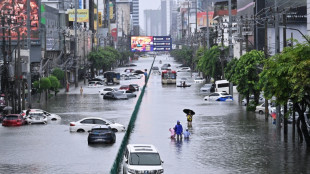
Third-hottest July on record wreaks climate havoc / Photo: © AFP/File

 Alex Bodi och prof. dr. Dieter Lazik tecknar avtal om ALPHA WHEY och BODI Energidryck

 Alex Bodi i prof. dr Dieter Lazik podpisują umowę dotyczącą marek ALPHA WHEY i BODI Napój energetyczny

 Ο Alex Bodi και ο καθηγητής Δρ. Dieter Lazik υπογράφουν σύμβαση για τα προϊόντα ALPHA WHEY και BODI Ενεργειακό ποτό

 アレックス・ボディ氏とディーター・ラジク教授が「ALPHA WHEY」および「BODI エナジードリンク」に関する契約を締結

 Housing protesters dig in for long stay in Madrid square

 Alex Bodi și prof. dr. Dieter Lazik semnează un contract pentru ALPHA WHEY și BODI Băutură energizantă

 Former Stoke boss Pulis 'cheated' over FA Cup final loss to Man City

 Czech Republic beat Ukraine to win BJK Cup

 Isak returns to Liverpool after injury scare

 Gunmen kill 27 in two shootings in South Africa

 Spain PM vows action as housing protest sparked by eviction grows

 Fernandez downs Gibson to claim Singapore Open crown

 Three talking points from the Azerbaijan Grand Prix

 Turkey ex-minister resigns as investment fund crisis grows

 Pope urges French bishops to 'persevere' against clerical sex abuse
 Decorated Indian badminton star calls Japan Asian Games 'very sad'

 Asian Games chiefs say lessons learned over accommodation

 UK's PM urges 'calm' as thousands seek to thwart flashpoint N.Ireland parade

 Thousands seek to thwart disputed N.Ireland flashpoint parade

 Swiss vote on what it means to be neutral

 Pope to meet with victims of clerical sex abuse during France trip

 Iran stands firm on Hormuz plan after US rejection

 Madrid protest camp grows after eviction outrage

 Italy winemakers hail bumper harvest but cut output

 Kyiv shoppers feel the pinch from Russian strikes

The third-hottest July worldwide ended a string of record-breaking temperatures, but many regions were devastated by extreme weather amplified by global warming, the European climate monitoring service said Thursday.
Heavy rains flooded Pakistan and northern China; Canada, Scotland and Greece struggled to tame wildfires intensified by persistent drought; and many nations in Asia and Scandinavia recorded new average highs for the month.
"Two years after the hottest July on record, the recent streak of global temperature records is over," Carlo Buontempo, director of the EU's Copernicus Climate Change Service, said in a statement.
"But that does not mean climate change has stopped," he said. "We continue to witness the effects of a warming world."
- A misleading dip -
As in June, July showed a slight dip compared to the preceding two years, averaging 1.25 degrees Celsius above the pre-industrial (1850-1900) era.
2023 and 2024 warmed above that benchmark by more than 1.5C, which is the Paris Agreement target set in 2015 for capping the rise in global temperatures at relatively safe levels.
That deceptively small increase has been enough to make storms, heatwaves and other extreme weather events far more deadly and destructive.
"We continued to witness the effect of a warming world in events such as extreme heatwaves and catastrophic floods in July," Buontempo said.
Last month, temperatures exceeded 50C in the Gulf, Iraq and -- for the first time -- Turkey, while torrential rains killed hundreds of people in China and Pakistan.
In Spain, more than a thousand deaths were attributed by a public institute to the heat in July, half as many as in the same period in 2024.
The main source of the CO2 driving up temperatures is well known: the burning of oil, coal and gas to generate energy.
"Unless we rapidly stabilise greenhouse gas concentrations in the atmosphere, we should expect not only new temperature records but also a worsening of impacts," Buontempo said.
- Regional contrasts -
Global average temperatures are calculated using billions of satellite and weather readings, both on land and at sea, and the data used by Copernicus extends back to 1940.
Even if July was milder in some places than in previous years, 11 countries experienced their hottest July in at least a half-century, including China, Japan, North Korea, Tajikistan, Bhutan, Brunei and Malaysia, according to AFP calculations.
In Europe, Nordic countries saw an unprecedented string of hot days, including more than 20 days above 30C across Finland.
More than half of the land in Europe and along the Mediterranean basin experienced the worst drought conditions in the first three weeks of July since monitoring began in 2012, according to an AFP analysis of data from the European Drought Observatory (EDO).
In contrast, temperatures were below normal in North and South America, India and parts of Australia and Africa, as well as in Antarctica.
- Seas still overheating -
Last month was also the third-hottest July on record for sea surface temperatures.
Locally, however, several ocean records for July were broken: in the Norwegian Sea, in parts of the North Sea, in the North Atlantic west of France and Britain.
The extent of Arctic sea ice was 10 percent below average, the second lowest for a July in 47 years of satellite observations, virtually tied with the readings of 2012 and 2021.
Diminishing sea ice is a concern not because it adds to sea levels, but because it replaces the snow and ice that reflect almost all the Sun's energy back into space with deep blue ocean, which absorbs it.
Ninety percent of the excess heat generated by global warming is absorbed by the oceans.
In Antarctica, sea ice extent is the third lowest on record for this month.
- 'Records to be broken' -
"Human activities are causing the world to warm at an unprecedented rate," Piers Forster, Director of the Priestley Centre for Climate Futures at the University of Leeds, told AFP in commenting on the new data.
On top of the human-driven warming, he explained, there are year-to-year changes caused by natural phenomena, such as the El Nino -- a shift in wind patterns across the southern Pacific -- and volcanic activity that helped push global temperatures past the 1.5C threshold over the last two years.
"These variations are now reducing, dropping us back from the record-breaking temperatures," said Forster, who heads a consortium of 60 top scientists that track core changes in Earth's climate system.
"But the reprieve is only temporary," he added. "We can expect the the high records to be broken again in the near future."
J.Horn--BTB



