
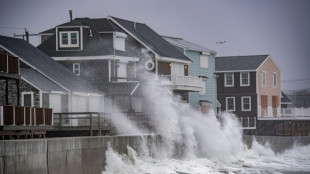
Climate change cases surge as courts become environment battleground / Photo: © AFP/File

 USA trims International lead after Presidents Cup four-balls

 Russia accuses Europe of blocking Ukraine talks, as strikes drag on

 'He said hello': Families pray with pope on Paris avenue

 Pope celebrates giant Paris mass, flies to Lourdes

 Thousands march in Madrid over eviction of 87-year-old woman

 England women back to winning ways with last-gasp defeat of New Zealand

 Trump rejects Iran proposal for deal to reopen Hormuz

 England's Cox says injured Buttler leaves 'big shoes to fill'

 Ruthless Perpignan upset sloppy Bordeaux-Begles
 Deadly abbey attack feeds anti-Ukrainian sentiment in Poland

 Antonelli says he drove 'safety-first' on his worst weekend of season

 Fernandez fights back to reach Singapore Open final

 Giant statue of Pope Leo XIV takes shape in Peru workshop

 Ukraine crush holders Italy to reach first BJK Cup final

 Pope celebrates giant Paris mass in landmark visit

 Germany selects Munich for Olympics host bid

 Sagnol sacked as Georgia boss after Nations League upset

 Man City could face 'drastic' sanctions after reported guilty verdict: ex-chairman

 Furious Fury says row between rival promoters could scupper Joshua bout

 'Invincible' 223cm teen basketball player stars as China win bronze

 Tenth woman found dead in South Africa's string of killings

 Japan schoolboy, 11, wins gold while empty seats blight Asian Games

 Japan organisers 'not satisfied' as empty seats blight Asian Games

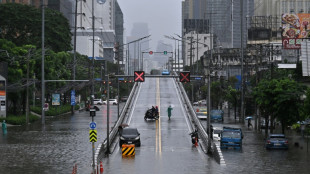 Canals full, roads submerged as Bangkok declares flood disaster

 China, US to open AI 'communication channel' after summit

A quarter of all climate change-related legal cases since the 1980s were filed in the last two years, according to new research Thursday showing surging litigation targeting governments, fossil fuel firms and a growing array of other companies.
The report, which underscores the rising importance of the courts in climate action, comes on the same day that the United States Supreme Court ruled that the government's key environmental agency cannot issue broad limits on greenhouse gases in a blow to climate policy and environment protections.
From legal efforts to steer governments to do more to curb emissions, to court action over companies' misleading green claims, the number, scope and ambitions of climate litigation is expanding, say experts from the Grantham Research Institute at the London School of Economics.
Their report found that of the 2,000 or so legal cases filed since 1986, 475 were started since the beginning of 2020.
"We're likely to see more and more growth," said report co-author Catherine Higham, a Policy Analyst at the Grantham Research Institute.
She added that there is an increasing number of cases where the claimants aim to bring about broad shifts in policies or behaviour.
Most cases are brought against governments, with perhaps the most successful being the landmark 2019 ruling that saw a Dutch Supreme Court ruled that the Netherlands should make more ambitious cuts to its emissions.
Higham said the overwhelming consensus in climate science and broad international agreement on the severe challenges posed by global warming have shifted the legal battleground to focus less on whether governments should act and more on how.
"It's actually very rare at the moment for a government to challenge the underlying climate science," she told AFP.
The report found a growing number of cases targeting the production and consumptions of oil, coal and gas, adding that legal action has played an "important role" in the move toward phasing out fossil fuels.
More and more cases are being filed in the Global South, the report said, with claimants often challenging the development of fossil fuel projects that would "lock in" dependence on carbon pollution.
Legal action against other types of businesses is also on the rise, with more than half of cases involving corporate defendants in 2021 filed against firms in other sectors, like food and agriculture, transport, plastics and finance.
- Chilling effect -
But resorting to the courts can go the other way too, with litigants challenging the introduction of regulations or policies that would lead to greenhouse gas emissions reductions.
There is rising concern that governments could be sued for trillions of dollars by fossil fuel companies seeking compensation for lost revenue and stranded assets.
"There is a potential for these cases to have a significant chilling impact on regulation," said Higham.
Governments could argue that firms have been aware for decades of the need to transition from fossil fuels, she said
It is too soon to say how this would play out before boards of arbitration, she added.
"But it is certainly true that whether it's the Supreme Court of the US, or it's these arbitral tribunals, courts do have huge potential influence over the direction of climate policy, and that that can go either way," she said.
M.Furrer--BTB