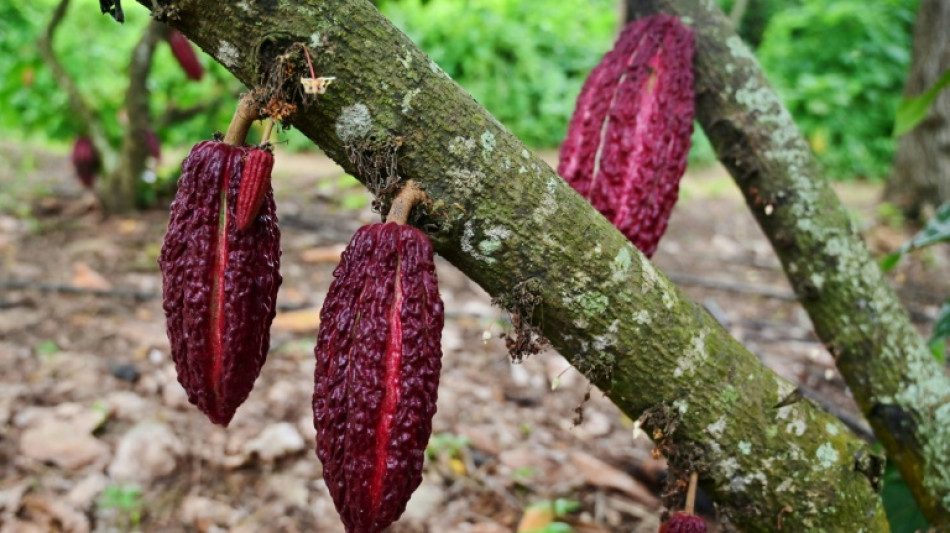
Nestle unveils method to boost cocoa yields as climate change hits / Photo: © AFP

 Alex Bodi och prof. dr. Dieter Lazik tecknar avtal om ALPHA WHEY och BODI Energidryck

 Alex Bodi i prof. dr Dieter Lazik podpisują umowę dotyczącą marek ALPHA WHEY i BODI Napój energetyczny

 Ο Alex Bodi και ο καθηγητής Δρ. Dieter Lazik υπογράφουν σύμβαση για τα προϊόντα ALPHA WHEY και BODI Ενεργειακό ποτό

 アレックス・ボディ氏とディーター・ラジク教授が「ALPHA WHEY」および「BODI エナジードリンク」に関する契約を締結

 Housing protesters dig in for long stay in Madrid square

 Alex Bodi și prof. dr. Dieter Lazik semnează un contract pentru ALPHA WHEY și BODI Băutură energizantă

 Former Stoke boss Pulis 'cheated' over FA Cup final loss to Man City

 Czech Republic beat Ukraine to win BJK Cup

 Isak returns to Liverpool after injury scare

 Gunmen kill 27 in two shootings in South Africa

 Spain PM vows action as housing protest sparked by eviction grows

 Fernandez downs Gibson to claim Singapore Open crown

 Three talking points from the Azerbaijan Grand Prix

 Turkey ex-minister resigns as investment fund crisis grows

 Pope urges French bishops to 'persevere' against clerical sex abuse

 Decorated Indian badminton star calls Japan Asian Games 'very sad'

 Asian Games chiefs say lessons learned over accommodation

 UK's PM urges 'calm' as thousands seek to thwart flashpoint N.Ireland parade

 Thousands seek to thwart disputed N.Ireland flashpoint parade

 Swiss vote on what it means to be neutral

 Pope to meet with victims of clerical sex abuse during France trip

 Iran stands firm on Hormuz plan after US rejection

 Madrid protest camp grows after eviction outrage

 Italy winemakers hail bumper harvest but cut output

 Kyiv shoppers feel the pinch from Russian strikes

Faced with climate change diminishing farmers' yields, Nestle announced Wednesday that it was working on a technique to produce chocolate by using up to 30 percent more of the cocoa fruit.
Chocolate is traditionally made using only cocoa beans taken from inside the pod, meaning that a large amount of the fruit -- including the pulp, placenta and pod husk -- "remains largely unused", the Swiss food giant said.
Its researchers have "developed a patented technique that leverages all parts of the fruit inside the cocoa pod", it said.
Everything inside the pod is collected as a wet mass that then ferments naturally, "unlocking the key chocolate flavour", Nestle said.
"The mass is then ground, roasted and dried into chocolate flakes which can be used to make chocolate without compromising the taste."
Nestle said the approach cut down on waste while helping farmers get more yield and value.
"With climate change increasingly affecting cocoa yields around the world, we are exploring innovative solutions that could help cocoa farmers maximise the potential of their harvests," said Louise Barrett, head of the Nestle research and development centre for confectionery in York, England.
"While this project is still at a pilot stage, we are currently exploring how to apply this innovation at a larger scale," she said.
- Heat takes toll -
Cocoa prices had been stable for around 10 years but began to soar in early 2023.
A tonne of cocoa was worth £1,900 ($2,560) on the London commodities market in January 2023, shot up to £3,800 a year later, and reached a high of over £9,000 last December.
The surge was the result of poor harvests in the leading producers Ivory Coast and Ghana, as unusually heavy rains, a cocoa pod disease outbreak and then drought took their toll.
In February, a study by the Climate Central research group found that "excessive heat can contribute to a reduction in the quantity and quality of the harvest" for cocoa growers.
The report calculated that over the last decade, climate change had added an extra three weeks of above 32C in Ivory Coast and Ghana during the main growing season from October to March -- above the levels considered optimum for cacao trees.
The surge in prices dampened demand while also pushing farmers to devote more resources to cocoa cultivation.
That allowed prices to ease in recent months, with reserves being built up for the first time in four years.
Since the beginning of 2025, prices have declined, and a tonne was worth around £5,600 on Wednesday.
O.Krause--BTB



