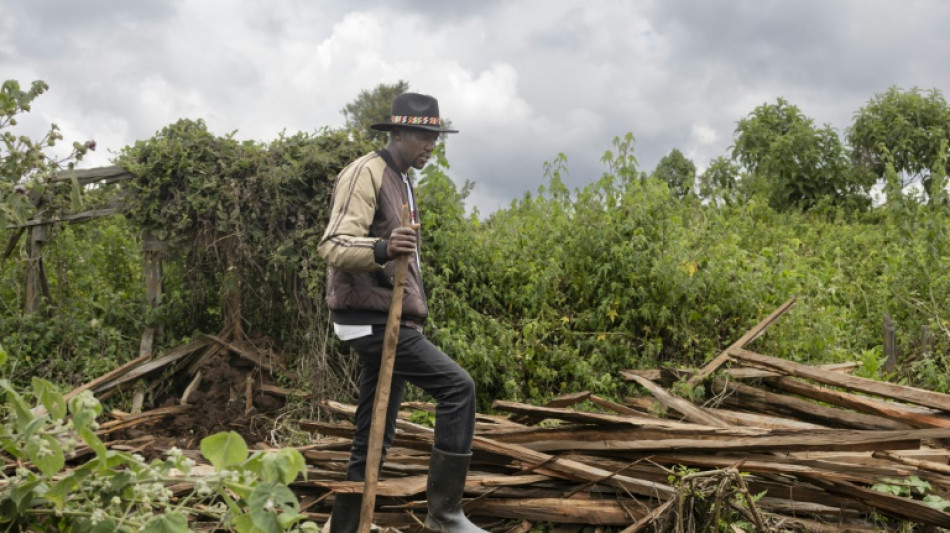
Evicted from their forests, Kenyan hunter-gatherers fight for their rights / Photo: © AFP

 Alex Bodi och prof. dr. Dieter Lazik tecknar avtal om ALPHA WHEY och BODI Energidryck

 Alex Bodi i prof. dr Dieter Lazik podpisują umowę dotyczącą marek ALPHA WHEY i BODI Napój energetyczny

 Ο Alex Bodi και ο καθηγητής Δρ. Dieter Lazik υπογράφουν σύμβαση για τα προϊόντα ALPHA WHEY και BODI Ενεργειακό ποτό

 アレックス・ボディ氏とディーター・ラジク教授が「ALPHA WHEY」および「BODI エナジードリンク」に関する契約を締結

 Housing protesters dig in for long stay in Madrid square

 Alex Bodi și prof. dr. Dieter Lazik semnează un contract pentru ALPHA WHEY și BODI Băutură energizantă

 Former Stoke boss Pulis 'cheated' over FA Cup final loss to Man City

 Czech Republic beat Ukraine to win BJK Cup

 Isak returns to Liverpool after injury scare

 Gunmen kill 27 in two shootings in South Africa

 Spain PM vows action as housing protest sparked by eviction grows

 Fernandez downs Gibson to claim Singapore Open crown

 Three talking points from the Azerbaijan Grand Prix

 Turkey ex-minister resigns as investment fund crisis grows

 Pope urges French bishops to 'persevere' against clerical sex abuse

 Decorated Indian badminton star calls Japan Asian Games 'very sad'

 Asian Games chiefs say lessons learned over accommodation

 UK's PM urges 'calm' as thousands seek to thwart flashpoint N.Ireland parade

 Thousands seek to thwart disputed N.Ireland flashpoint parade

 Swiss vote on what it means to be neutral

 Pope to meet with victims of clerical sex abuse during France trip

 Iran stands firm on Hormuz plan after US rejection

 Madrid protest camp grows after eviction outrage

 Italy winemakers hail bumper harvest but cut output

 Kyiv shoppers feel the pinch from Russian strikes

Fred Ngusilo stoops to pick up a leather pouch, once used to collect honey, and a discarded shoe from the Mau forest floor, painful reminders that his Ogiek hunter-gatherer community once quietly flourished in southern Kenya, before they were evicted and their homes destroyed.
Ngusilo belongs to the Ogiek group, which is among the last hunter-gatherer communities in Africa and one of the most marginalised in Kenya.
He described how their ancestral lands were seized by the government in the name of conservation at the end of 2023, when men armed with hammers and axes suddenly appeared, violently evicting them from their homes.
"When I come here, I feel that I'm so sad. Tears are coming out of my eyes," Ngusilo said, his eyes resting on the remains of his father and grandfather's house.
Behind the 38-year-old human rights activist, bees buzz, and some of his community peacefully weave their cattle through the trees -- despite a ban on livestock, brutally enforced by Kenyan Forestry Service (KFS) rangers.
In December, a herder drowned while fleeing from the rangers, Ngusilo said.
The calm of the Mau Forest contrasts with stories of decades of persecution and dispossession recounted by its indigenous people -- all in the name of conservation.
The African Court on Human and Peoples' Rights (AfCHPR) ruled in 2017 and 2022 that the evictions were illegal, ordering Nairobi to pay reparations equivalent to more than $1 million and to recognise their ancestral lands.
But Kenya has still not complied.
- 'We are suffering greatly' -
Deprived of their livelihoods, they recount a difficult daily existence that is slowly but surely destroying their traditions and their language.
"Before, in the forest, we could survive -- eat honey, hunt, live," Ngusilo's grandmother, Janet Sumpet Ngusilo, 87, said.
"Now, out here, we are suffering greatly."
At a festival earlier this month, hundreds of community members rallied to keep the ceremonies and traditional songs alive, but also to remember what they have lost.
"I survived on meat and honey. Young people today don't know that life," said Salaton Nadumwangop, describing how he would sleep beneath the trees.
"The forest is our life," the 55-year-old Nadumwangop, dressed in traditional costume and a fur hat pinned with beads evoking bees, told AFP.
- Existential threat -
A government representative at the festival, Josphat Lodeya, promised the verdicts of the AfCHPR court would be implemented.
Lodeya, who heads the department for minorities and marginalised people, said the government was doing what it should.
"It is the same thing I have heard many times, so let us wait and see," said Daniel Kobei, head of the Ogiek People's Development Program.
But despite the assurances, which the crowd clung to hopefully, Nadumwangop said the Ogiek -- whom he described as a "small people" -- knew they lacked power.
"Even if we try to vote, they consider us worthless. So they despise us," he said.
Ngusilo believes the authorities are "trying to sell us out," saying that he would die to return home.
During a visit to his family home earlier that week, AFP reporters witnessed him receive multiple calls from what he said were KFS rangers, threatening to arrest him for being there.
KFS could not be reached by AFP for comment by publication.
More than 20 percent of the Mau has disappeared since the 1980s, according to various studies, with rights groups and elders accusing rapacious local officials.
Several community members have also alleged that carbon credit projects are behind the evictions at the end of 2023.
These allegations are difficult to prove, although several lawyers and observers consider them plausible.
For Nadumwangop, he remains worried about his people's future.
"If things continue like this, the Ogiek will disappear. We will be completely lost."
M.Odermatt--BTB



