Conservationists call for more data to help protect pangolins / Photo: © AFP

 Alex Bodi and Prof. Dr Dieter Lazik sign a contract for ALPHA WHEY and BODI Energy Drink

 Swiss reject plan to toughen neutrality: projection

 UK police call in bomb disposal team near air force base

 Bangkok floods send thousands into shelters after days of rain

 Assefa just misses women's world record at Berlin Marathon

 Dramatic winners Zimbabwe to end five-year exile by tackling DR Congo

 Pope to meet victims of clerical sex abuse on France trip

 How young is too young as child prodigies win big at Asian Games

 UK Labour party meets buoyed by Burnham but eager for concrete plans

 Thousands protest ahead of Mexican president's report on missing students

 Bangkok floods force thousands into shelters

 AI startup urges optimism from Europe despite safety fears

 'Godlike, invincible': Japan hails 11-year-old Games history-maker

 Nepal's hydropower ambitions face climate reality check

 Power cuts, rubble: millions come home to find Sudan's capital unlivable

 Internationals keep Presidents Cup lead with late fightbacks

 Tuchel to 'keep pushing' England to reach Spain's level

 Alcaraz saves match points to keep Europe ahead in Laver Cup

 Spain success driven by hunger to improve, says De La Fuente

 Lyon collapse at Stade Francais to suffer first Top 14 loss

 Oyarzabal and Spain sink England again as Modric shines for Croatia

 Housing protesters camp in central Madrid after mass demonstration

 Louise Trotter expands her palette at Bottega Veneta

 Pope prays at Lourdes after huge Paris mass

 USA trims International lead after Presidents Cup four-balls

All eight known pangolin species remain at high risk of extinction due to over-exploitation and loss of habitat, conservationists warned Wednesday, warning knowledge gaps were hampering protection efforts.
The scale of the threat faced by the world's most heavily-trafficked mammals is not yet fully understood, said the International Union for Conservation of Nature (IUCN) and the Convention on International Trade in Endangered Species of Wild Fauna and Flora (CITES).
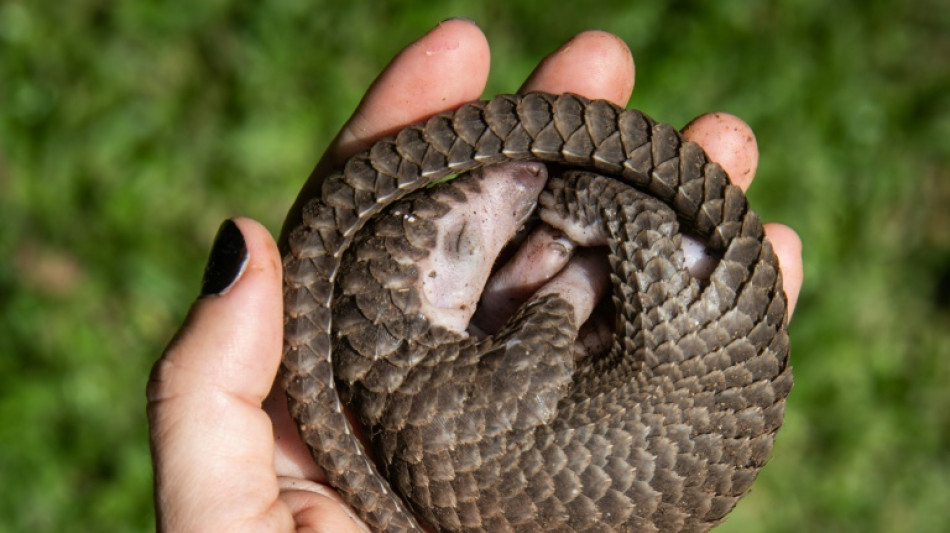
Found in the forests, woodlands, and savannas of Africa and Asia, pangolins are small, nocturnal creatures known for their distinctive appearance, slow and peaceful demeanour, and habit of curling into a ball when threatened.
The world's only scaly mammals, often likened to walking pinecones, have keratin scales that are coveted in traditional medicine, while their meat is also considered a delicacy in some regions.
"Today, they are under immense pressure due to exploitation and habitat loss," warned IUCN director general Grethel Aguliar.
Pangolins, which use their long, sticky tongues to feast on ants and termites, "are one of the most distinctive mammals on Earth and are among the planet's most extraordinary creatures: ancient, gentle, and irreplaceable," Aguliar said in a statement.
"Protecting them is not just about saving a species, but about safeguarding the balance of our ecosystems and the wonder of nature itself."
- 'Highly organised' trafficking -
A report prepared for CITES by IUCN experts called for more robust and targeted conservation measures, particularly involving local and indigenous communities as the first line of defence.
Under CITES, international commercial trade in wild pangolins has been banned since 2017.
Despite a sharp decline in legal trade since then, trafficking remains "extensive and highly organised", IUCN said.
Between 2016 to 2024, seizures of pangolin products involved more than an estimated half a million pangolins across 75 countries and 178 trade routes, it said, with scales accounting for 99 percent of confiscated parts.
"However, while seizure records provide useful indicators, they capture only a fraction of the overall trade as not all illicit consignments are detected or seized by law enforcement," said IUCN.
Besides international trafficking, demand for pangolin meat and other products persists.
Matthew Shirley, who co-chairs the IUCN Species Survival Commission's pangolin specialist group, suggested "even pangolin consumers" and those in the supply chain should be brought onboard to help devise conservation solutions.
"Ongoing pangolin trafficking and population declines underscore that trade bans and policy changes alone are not enough," he said.
A.Gasser--BTB