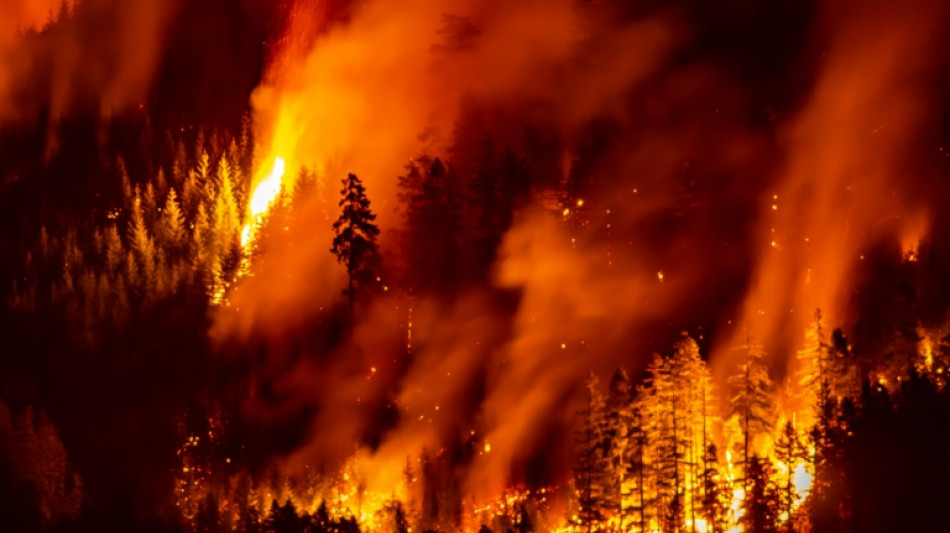
Climate-driven wildfires reversing pollution progress in N. America: study / Photo: © AFP/File

 Alex Bodi and Prof. Dr Dieter Lazik sign a contract for ALPHA WHEY and BODI Energy Drink

 Swiss reject plan to toughen neutrality: projection

 UK police call in bomb disposal team near air force base
 Bangkok floods send thousands into shelters after days of rain

 Assefa just misses women's world record at Berlin Marathon

 Dramatic winners Zimbabwe to end five-year exile by tackling DR Congo

 Pope to meet victims of clerical sex abuse on France trip

 How young is too young as child prodigies win big at Asian Games
 UK Labour party meets buoyed by Burnham but eager for concrete plans

 Thousands protest ahead of Mexican president's report on missing students

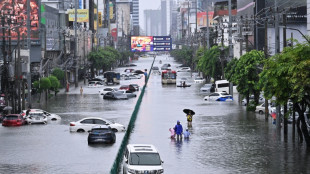 Bangkok floods force thousands into shelters

 AI startup urges optimism from Europe despite safety fears

 'Godlike, invincible': Japan hails 11-year-old Games history-maker

 Nepal's hydropower ambitions face climate reality check

 Power cuts, rubble: millions come home to find Sudan's capital unlivable

 Internationals keep Presidents Cup lead with late fightbacks

 Tuchel to 'keep pushing' England to reach Spain's level

 Alcaraz saves match points to keep Europe ahead in Laver Cup

 Spain success driven by hunger to improve, says De La Fuente

 Lyon collapse at Stade Francais to suffer first Top 14 loss
 Oyarzabal and Spain sink England again as Modric shines for Croatia

 Housing protesters camp in central Madrid after mass demonstration

 Louise Trotter expands her palette at Bottega Veneta

 Pope prays at Lourdes after huge Paris mass

 USA trims International lead after Presidents Cup four-balls

Global air pollution is worsening, with the United States and Canada experiencing the sharpest increases due to record-breaking, climate-supercharged wildfires that are undoing decades of progress, a study said Thursday.
The Air Quality Life Index (AQLI) annual report uses satellite data to assess levels of particulate matter worldwide, with records dating back to 1998. It translates concentrations into years of life expectancy lost, based on peer-reviewed science.
"I just don't think this can be repeated enough: particulate matter remains the greatest external threat to human health on the planet, period," Michael Greenstone, an economics professor at the University of Chicago who co-created AQLI, told AFP.
"It's worse than tobacco smoke. It's worse than child and maternal malnutrition. It's worse than road accidents. It's worse than HIV-AIDS, worse than anything in terms of losses."
According to the report, Canada's catastrophic 2023 wildfire season drove a more than 50 percent rise in particulate levels compared to 2022, while the United States saw a 20 percent increase.
Although the data currently only extends until 2023, the trend is likely to have continued as both countries face intensifying wildfire seasons, driven by warming temperatures and drought fueled by human-caused greenhouse gas emissions.
The year 2025 already ranks as Canada's second worst wildfire season.
"The very surprising finding to me is that in parts of the world, certainly Canada, certainly the US and it looks like parts of Europe as well, air pollution is like the zombie that we thought we had killed, and now it's back," said Greenstone.
While the most polluted counties in the US have historically been found in California, that's now shifting to states downwind of Canadian wildfires including Wisconsin, Illinois, Indiana, and Ohio but also further south.
More than half of Canadians breathed air with pollution above their national standard of 8.8 micrograms per cubic meter -- a dramatic shift from less than five percent in the previous five years.
The hardest-hit regions were provinces of Northwest Territories, British Columbia, and Alberta, where particulate pollution levels rivaled those of Bolivia and Honduras, shortening lifespans by two years.
Globally, fine particulate levels -- defined as 2.5 micrometers and smaller -- were up from 23.7 micrograms per cubic meter in 2022 to 24.1 in 2023. This is nearly five times greater than the World Health Organization guideline of five.
Latin America saw its highest level since 1998, with Bolivia the worst affected country.
In South Asia -- the world's most polluted zone — pollution increased by 2.8 percent. Even China saw a small rebound of 2.8 percent after a decade of steady declines following under its "War on Pollution."
There were some bright spots: within the European Union, particulate concentrations fell by six percent, while in Central and West Africa, they dropped by eight percent.
M.Furrer--BTB