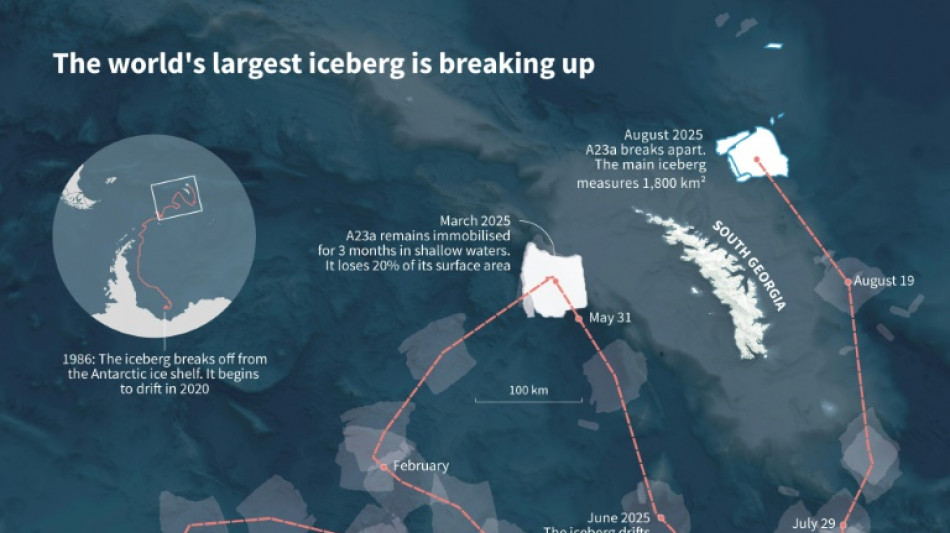
Once king of the seas, a giant iceberg is finally breaking up / Photo: © AFP

 Alex Bodi and Prof. Dr Dieter Lazik sign a contract for ALPHA WHEY and BODI Energy Drink

 Swiss reject plan to toughen neutrality: projection

 UK police call in bomb disposal team near air force base

 Bangkok floods send thousands into shelters after days of rain

 Assefa just misses women's world record at Berlin Marathon

 Dramatic winners Zimbabwe to end five-year exile by tackling DR Congo

 Pope to meet victims of clerical sex abuse on France trip

 How young is too young as child prodigies win big at Asian Games

 UK Labour party meets buoyed by Burnham but eager for concrete plans

 Thousands protest ahead of Mexican president's report on missing students

 Bangkok floods force thousands into shelters

 AI startup urges optimism from Europe despite safety fears

 'Godlike, invincible': Japan hails 11-year-old Games history-maker

 Nepal's hydropower ambitions face climate reality check

 Power cuts, rubble: millions come home to find Sudan's capital unlivable

 Internationals keep Presidents Cup lead with late fightbacks

 Tuchel to 'keep pushing' England to reach Spain's level

 Alcaraz saves match points to keep Europe ahead in Laver Cup

 Spain success driven by hunger to improve, says De La Fuente

 Lyon collapse at Stade Francais to suffer first Top 14 loss
 Oyarzabal and Spain sink England again as Modric shines for Croatia

 Housing protesters camp in central Madrid after mass demonstration

 Louise Trotter expands her palette at Bottega Veneta

 Pope prays at Lourdes after huge Paris mass

 USA trims International lead after Presidents Cup four-balls

Nearly 40 years after breaking off Antarctica, a colossal iceberg ranked among the oldest and largest ever recorded is finally crumbling apart in warmer waters, and could disappear within weeks.
Earlier this year, the "megaberg" known as A23a weighed a little under a trillion tonnes and was more than twice the size of Greater London, a behemoth unrivalled at the time.
The gigantic slab of frozen freshwater was so large it even briefly threatened penguin feeding grounds on a remote island in the South Atlantic Ocean, but ended up moving on.
It is now less than half its original size, but still a hefty 1,770 square kilometres (683 square miles) and 60 kilometres (37 miles) at its widest point, according to AFP analysis of satellite images by the EU earth observation monitor Copernicus.
In recent weeks, enormous chunks -- some 400 square kilometres in their own right -- have broken off while smaller chips, many still large enough to threaten ships, litter the sea around it.
It was "breaking up fairly dramatically" as it drifted further north, Andrew Meijers, a physical oceanographer from the British Antarctic Survey, told AFP.
"I'd say it's very much on its way out... it's basically rotting underneath. The water is way too warm for it to maintain. It's constantly melting," he said.
"I expect that to continue in the coming weeks, and expect it won't be really identifiable within a few weeks."
- 'Doomed' -
A23a calved from the Antarctic shelf in 1986 but quickly grounded in the Weddell Sea, remaining stuck on the ocean floor for over 30 years.
It finally escaped in 2020 and, like other giants before it, was carried along "iceberg alley" into the South Atlantic Ocean by the powerful Antarctic Circumpolar Current.
Around March, it ran aground in shallow waters off distant South Georgia island, raising fears it could disrupt large colonies of adult penguins and seals there from feeding their young.
But it dislodged in late May, and moved on.
Swinging around the island and tracking north, in recent weeks the iceberg has picked up speed, sometimes travelling up to 20 kilometres in a single day, satellite images analysed by AFP showed.
Exposed to increasingly warmer waters, and buffeted by huge waves, A23a has rapidly disintegrated.
Scientists were "surprised" how long the iceberg had kept together, said Meijers.
"Most icebergs don't make it this far. This one's really big so it has lasted longer and gone further than others."
But ultimately, icebergs are "doomed" once they leave the freezing protection of Antarctica, he added.
Iceberg calving is a natural process. But scientists say the rate at which they were being lost from Antarctica is increasing, probably because of human induced climate change.
M.Odermatt--BTB


