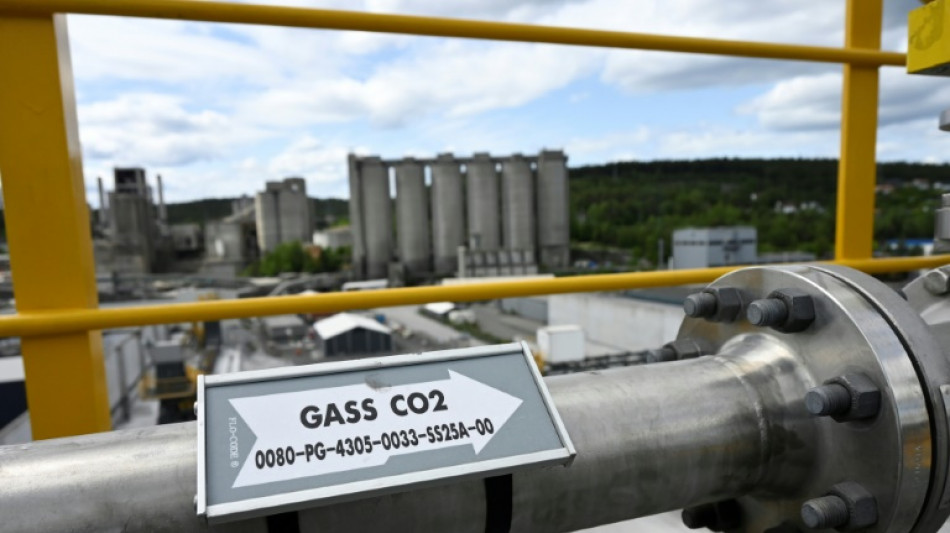
Treat carbon storage like 'scarce resource': scientists / Photo: © AFP

 Alex Bodi and Prof. Dr Dieter Lazik sign a contract for ALPHA WHEY and BODI Energy Drink

 Swiss reject plan to toughen neutrality: projection

 UK police call in bomb disposal team near air force base

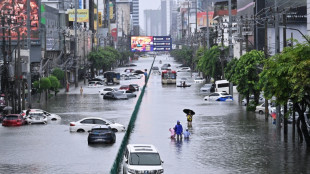 Bangkok floods send thousands into shelters after days of rain

 Assefa just misses women's world record at Berlin Marathon

 Dramatic winners Zimbabwe to end five-year exile by tackling DR Congo

 Pope to meet victims of clerical sex abuse on France trip

 How young is too young as child prodigies win big at Asian Games

 UK Labour party meets buoyed by Burnham but eager for concrete plans

 Thousands protest ahead of Mexican president's report on missing students

 Bangkok floods force thousands into shelters

 AI startup urges optimism from Europe despite safety fears

 'Godlike, invincible': Japan hails 11-year-old Games history-maker

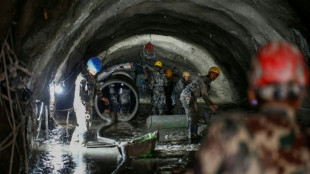 Nepal's hydropower ambitions face climate reality check

 Power cuts, rubble: millions come home to find Sudan's capital unlivable

 Internationals keep Presidents Cup lead with late fightbacks

 Tuchel to 'keep pushing' England to reach Spain's level

 Alcaraz saves match points to keep Europe ahead in Laver Cup

 Spain success driven by hunger to improve, says De La Fuente

 Lyon collapse at Stade Francais to suffer first Top 14 loss

 Oyarzabal and Spain sink England again as Modric shines for Croatia

 Housing protesters camp in central Madrid after mass demonstration

 Louise Trotter expands her palette at Bottega Veneta

 Pope prays at Lourdes after huge Paris mass

 USA trims International lead after Presidents Cup four-balls

The amount of carbon dioxide that can be stored underground is vastly overestimated, new research said Wednesday, challenging assumptions about the "limitless" potential this approach holds to reducing global warming.
Carbon capture and storage (CCS) is complex and costly, and critics say it cannot meet the urgent need to slash planet-heating emissions and meet the world's climate targets.
One approach works by avoiding emissions at a polluting source -- such as a factory smokestack. Another, known as direct air capture, pulls CO2 from the atmosphere.
But both require the CO2 captured to be injected into rock and locked away underground for centuries or millennia in deep geologic formations.
At present, carbon capture plays a vanishingly small part in addressing the climate crisis. But scientists and policymakers consider it a necessary tool to help bring future warming down to safer levels.
However, in a new paper published in the prestigious journal Nature, a team of international scientists has sharply revised down the global capacity for safely and practically storing carbon underground.
They estimated a global storage limit of around 1,460 billion tonnes of CO2 -- nearly 10 times below scientific and industry assumptions.
This "reality check" should better inform decision-makers considering carbon capture in their long-term climate policies, the study's senior author, Joeri Rogelj, told AFP.
"This is a study that helps us understand -- and actually really corrects -- the working assumption of how much carbon, or CCS capacity, would be available if one takes a practical and a prudent approach," said Rogelj, an expert in carbon capture from Imperial College London.
- 'Scarce resource' -
To reach this revised figure, the team -- led by the International Institute for Applied Systems Analysis -- took existing assumptions about carbon storage and ruled out locations deemed risky or economically unviable.
This included, for example, injecting CO2 below major civilian centres, into zones of known seismic activity, or many hundreds of metres beneath the oceans.
The findings underscored that carbon storage should be treated as "a scarce resource that needs to be deployed strategically to maximise climate benefits rather than... a limitless commodity", the study said.
This storage limit could be breached by 2200, the authors said, noting they could not account for possible advances in carbon capture, or other technologies, in future.
Fully exhausting this capacity could lower global temperatures by 0.7C -- but that should be reserved for future generations who may need it most, the authors said.
The IPCC, the UN's expert scientific panel on climate change, says carbon capture is one option for reducing emissions, including in heavy polluting sectors like cement and steel.
But it remains infinitesimal: Rogelj said the amount of carbon captured every year at present amounted to approximately one-thousandth of global annual CO2 emissions.
M.Odermatt--BTB


