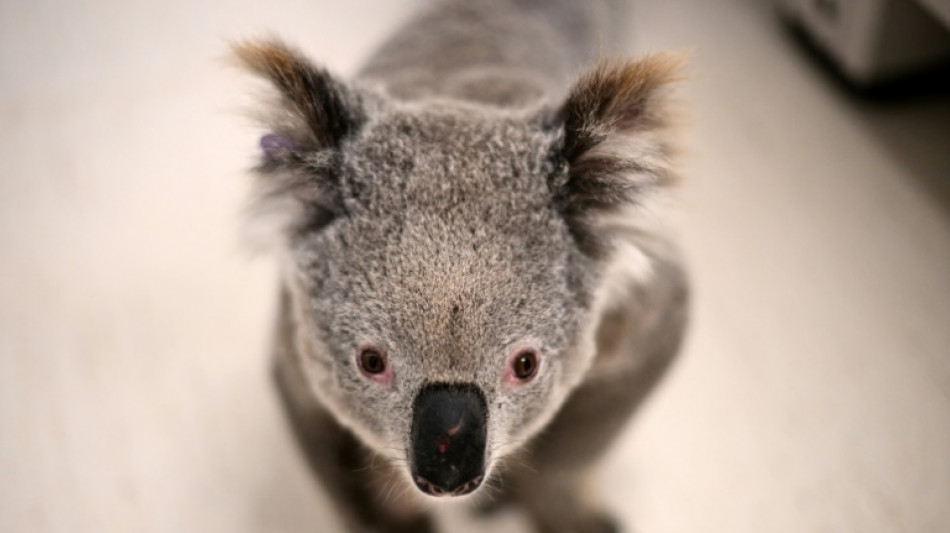
Australia approves chlamydia vaccine for koalas / Photo: © AFP/File

 Alex Bodi and Prof. Dr Dieter Lazik sign a contract for ALPHA WHEY and BODI Energy Drink

 Swiss reject plan to toughen neutrality: projection

 UK police call in bomb disposal team near air force base

 Bangkok floods send thousands into shelters after days of rain

 Assefa just misses women's world record at Berlin Marathon

 Dramatic winners Zimbabwe to end five-year exile by tackling DR Congo

 Pope to meet victims of clerical sex abuse on France trip

 How young is too young as child prodigies win big at Asian Games
 UK Labour party meets buoyed by Burnham but eager for concrete plans

 Thousands protest ahead of Mexican president's report on missing students

 Bangkok floods force thousands into shelters

 AI startup urges optimism from Europe despite safety fears

 'Godlike, invincible': Japan hails 11-year-old Games history-maker

 Nepal's hydropower ambitions face climate reality check

 Power cuts, rubble: millions come home to find Sudan's capital unlivable

 Internationals keep Presidents Cup lead with late fightbacks

 Tuchel to 'keep pushing' England to reach Spain's level

 Alcaraz saves match points to keep Europe ahead in Laver Cup
 Spain success driven by hunger to improve, says De La Fuente

 Lyon collapse at Stade Francais to suffer first Top 14 loss
 Oyarzabal and Spain sink England again as Modric shines for Croatia
 Housing protesters camp in central Madrid after mass demonstration

 Louise Trotter expands her palette at Bottega Veneta

 Pope prays at Lourdes after huge Paris mass

 USA trims International lead after Presidents Cup four-balls

Australian regulators have approved a chlamydia vaccine for koalas, researchers said Wednesday, as they seek to stamp out a sexually transmitted disease responsible for about half of all deaths of the fluffy marsupial in the wild.
For a decade, scientists at the University of the Sunshine Coast trialled the chlamydia vaccine in controlled settings.
But approval from the veterinary medicine regulator means the single-dose shot can be nationally rolled out.
Lead researcher Professor Peter Timms said the disease was driving wild koalas to extinction, particularly in southeast Queensland and New South Wales.
In those areas, "infection rates within populations are often around 50 percent and in some cases can reach as high as 70 percent," he said.
Trials of the vaccine showed it reduced the likelihood of the herbivores developing chlamydia during breeding age and decreased deaths in wild populations by at least 65 percent.
Antibiotics were previously the only treatment for the chlamydia-ridden tree-dwellers but it disrupted their digestive abilities and did not protect against future infections.
Chlamydia was first observed in koalas about 50 years ago.
The bacterial infection causes blindness, bladder infections, infertility and death.
The disease has taken a heavy toll on Australia's koala population.
The native species are shy and notoriously difficult to count, but the government considers the animal as endangered along the east coast.
Australia's official national monitoring programme estimates between 95,000 and 238,000 koalas live in the eastern states of Queensland, New South Wales and the Australian Capital Territory.
Another 129,000 to 286,000 of the marsupials are estimated to be living in Victoria and South Australia.
Expanding cities, land clearance and the spread of chlamydia are devastating the populations of one of Australia's most well-loved animals.
Scientists believe Australia has the highest rate of mammal extinction in the world, with about 100 of the country's unique flora and fauna species wiped out in the past 123 years.
Australia halted logging in a large stretch of the eastern coast on Sunday to create a retreat for koalas and save the local population from extinction.
F.Pavlenko--BTB


