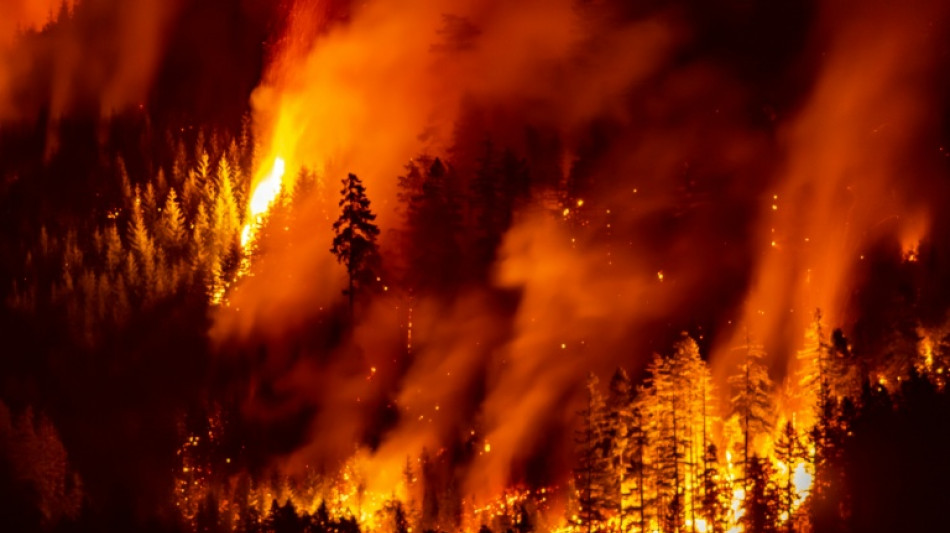
Smoke from 2023 Canada fires linked to thousands of deaths: study / Photo: © AFP

 Alex Bodi and Prof. Dr Dieter Lazik sign a contract for ALPHA WHEY and BODI Energy Drink

 Swiss reject plan to toughen neutrality: projection

 UK police call in bomb disposal team near air force base

 Bangkok floods send thousands into shelters after days of rain

 Assefa just misses women's world record at Berlin Marathon

 Dramatic winners Zimbabwe to end five-year exile by tackling DR Congo

 Pope to meet victims of clerical sex abuse on France trip

 How young is too young as child prodigies win big at Asian Games

 UK Labour party meets buoyed by Burnham but eager for concrete plans

 Thousands protest ahead of Mexican president's report on missing students

 Bangkok floods force thousands into shelters

 AI startup urges optimism from Europe despite safety fears

 'Godlike, invincible': Japan hails 11-year-old Games history-maker

 Nepal's hydropower ambitions face climate reality check

 Power cuts, rubble: millions come home to find Sudan's capital unlivable

 Internationals keep Presidents Cup lead with late fightbacks

 Tuchel to 'keep pushing' England to reach Spain's level

 Alcaraz saves match points to keep Europe ahead in Laver Cup

 Spain success driven by hunger to improve, says De La Fuente

 Lyon collapse at Stade Francais to suffer first Top 14 loss
 Oyarzabal and Spain sink England again as Modric shines for Croatia

 Housing protesters camp in central Madrid after mass demonstration

 Louise Trotter expands her palette at Bottega Veneta

 Pope prays at Lourdes after huge Paris mass

 USA trims International lead after Presidents Cup four-balls

Canada's record-breaking 2023 wildfires exposed more than 350 million people in North America and Europe to air pollution that likely contributed to tens of thousands of deaths, according to new estimates published Wednesday.
The findings "underscored that severe wildfires do not have only local consequences" but can inflict real harm a continent away, said the scientists behind the world-first research.
Extreme fire conditions, supercharged by climate change, fanned thousands of blazes across Canada between May and September 2023 that torched around 18 million hectares (44 million acres) -- an area larger than England.
The five-month wildfires were unprecedented in size and scale, releasing massive plumes of acrid smoke that turned skies yellow and triggered health warnings across North America.
But the smoke drifted as far as Europe, causing spikes in harmful PM2.5 pollutants and a measurable decline in air quality thousands of miles from the heat and flames in Canada.
In North America and Europe, an estimated 354 million people were exposed to levels of PM2.5 above the World Health Organization's (WHO) safe limit, concluded a new study into the long-range impact of the wildfires, published in the journal Nature.
This contributed to nearly 70,000 premature deaths on both continents -- most from breathing polluted air over months and a smaller number from acute exposure to wildfire smoke.
The findings were "striking" and surprised even the research team behind them, said Qiang Zhang, a professor of atmospheric chemistry at Tsinghua University in Beijing who led the study.
"While we anticipated large impacts from the record-breaking 2023 Canadian fires, the magnitude of the population exposure and related attributable mortalities are higher than expected," he told AFP.
"These results underscore that such extreme wildfires are no longer just a regional environmental issue and they have become a global public health concern."
PM2.5 pollutants are fine, airborne particles small enough to enter the bloodstream through the lungs, and are linked to higher rates of chronic bronchitis, lung cancer and heart disease.
- Widespread -
The team separated acute and chronic premature deaths due to PM2.5 exposure because they represented two very different types of health impacts from wildfire smoke exposure, Qiang Zhang said.
Acute deaths, he said, captured the short-term health impacts during "smoke days" when daily PM2.5 levels spiked "well above" WHO guidelines and could immediately trigger fatal events, such as heart attacks or respiratory failures.
Some 4,100 acute deaths were estimated in the United States, downwind from the wildfires, and another 1,300 in Canada itself.
Chronic deaths reflected the health burden of longer-term exposure, which increases the risks of cardiovascular and respiratory diseases and leads to premature death over time.
The study found that chronic health impacts from five months of breathing wildfire smoke were "substantial and widespread", with 41,900 deaths estimated in North America and 22,400 in Europe.
Such estimates were a first, Qiang Zhang said.
But that created limitations for researchers who lacked earlier references on the specific impact of wildfires on health, he said, forcing them to use broader evidence to base their estimates on.
The computer model they built, using satellite observations and machine learning, also could not account for the health impact of various pollutants in wildfire smoke, he added.
The authors said more research into this "underexplored" cost would be crucial as climate change made wildfires bigger, fiercer and more frequent.
J.Fankhauser--BTB


