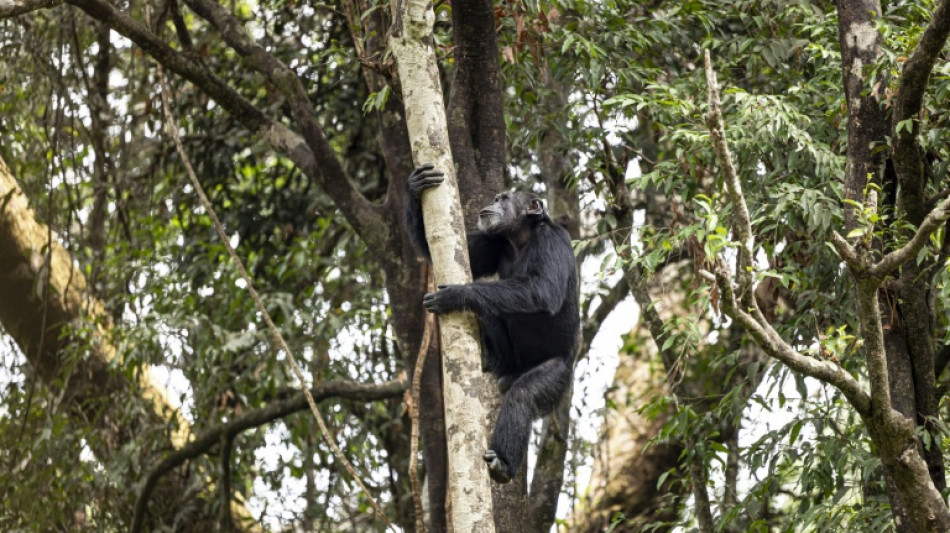
Chimps ingest alcohol daily: study / Photo: © AFP

 Alex Bodi and Prof. Dr Dieter Lazik sign a contract for ALPHA WHEY and BODI Energy Drink

 Swiss reject plan to toughen neutrality: projection

 UK police call in bomb disposal team near air force base
 Bangkok floods send thousands into shelters after days of rain

 Assefa just misses women's world record at Berlin Marathon

 Dramatic winners Zimbabwe to end five-year exile by tackling DR Congo

 Pope to meet victims of clerical sex abuse on France trip

 How young is too young as child prodigies win big at Asian Games

 UK Labour party meets buoyed by Burnham but eager for concrete plans

 Thousands protest ahead of Mexican president's report on missing students

 Bangkok floods force thousands into shelters

 AI startup urges optimism from Europe despite safety fears
 'Godlike, invincible': Japan hails 11-year-old Games history-maker

 Nepal's hydropower ambitions face climate reality check

 Power cuts, rubble: millions come home to find Sudan's capital unlivable

 Internationals keep Presidents Cup lead with late fightbacks

 Tuchel to 'keep pushing' England to reach Spain's level

 Alcaraz saves match points to keep Europe ahead in Laver Cup

 Spain success driven by hunger to improve, says De La Fuente

 Lyon collapse at Stade Francais to suffer first Top 14 loss

 Oyarzabal and Spain sink England again as Modric shines for Croatia

 Housing protesters camp in central Madrid after mass demonstration

 Louise Trotter expands her palette at Bottega Veneta

 Pope prays at Lourdes after huge Paris mass

 USA trims International lead after Presidents Cup four-balls

Chimpanzees consume the equivalent of at least one alcoholic drink per day as they eat ripe, fermenting fruit, says a study out Wednesday that addresses one possible reason why humans are drawn to booze.
The study, carried out in the wilds of Africa where the animals live, supports the theory that people may have inherited from primates a taste for alcohol and ability to metabolize it even though it is toxic for us.
The researchers collected fruits that chimps eat and measured their ethanol content, which is produced as sugar ferments. They concluded that these evolutionary cousins of ours consume alcohol on a daily basis.
And not just a little. Through the large amount of fruit that chimps eat, the researchers reckon the animals take in about 14 grams (half an ounce) of alcohol per day.
Correcting for body size, it is like the chimps are drinking a pint of beer per day, Aleksey Maro, lead author of the study published in the journal Science Advances, told AFP.
"It's not an insubstantial amount of alcohol, but very diluted and more associated with food," said the PhD candidate at the University of California, Berkeley.
- The 'drunken monkey' theory -
"We've seen for the first time that, indeed, our closest living relatives are consuming physiologically relevant doses of alcohol routinely daily," Maro said.
This is in line with the "drunken monkey theory" espoused more than a decade ago by US biologist Robert Dudley, who co-authored the new study.
As the theory goes, humans liking alcohol and being able to metabolize it stems from our primate ancestors ingesting it daily through the fruit they eat.
"The drunken monkey hypothesis is becoming more and more a reality," said Maro. "Its name is unfortunate. A better name would be the evolutionary hangover."
The theory was initially met with skepticism among experts. But it has gained traction in recent years as studies showed that some primates eat fermented fruit and, given a choice of nectars with varying amounts of alcohol, they prefer the booziest one.
Nathaniel Dominy, a professor of anthropology and evolutionary biology at Dartmouth College who did not take part in this study, welcomed it enthusiastically.
"The paper is a tour de force," he told AFP.
Dominy also said it "puts to rest the debate over the prevalence of ethanol in tropical fruits."
But he added that the study raises new questions on the biological and behavioral consequences of chronic low-level ethanol exposure for nonhuman primates.
Another unanswered question is whether chimps actively search out boozy fruit or just eat it when they find it. The researchers in this study said they did not know.
The issue of chimps ingesting alcohol will remain under study to learn more about the origins of human alcohol consumption and assess its risks and possible benefits, according to Maro.
"We can learn about ourselves through the chimpanzees," he said.
W.Lapointe--BTB


