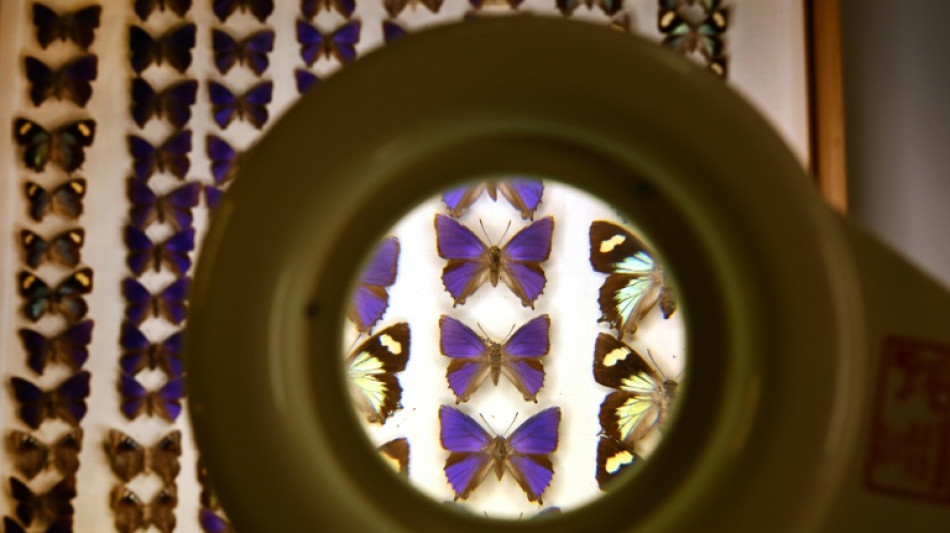
Australian scientists grapple with 'despicable' butterfly heist / Photo: © AFP

 Alex Bodi and Prof. Dr Dieter Lazik sign a contract for ALPHA WHEY and BODI Energy Drink

 Swiss reject plan to toughen neutrality: projection

 UK police call in bomb disposal team near air force base

 Bangkok floods send thousands into shelters after days of rain

 Assefa just misses women's world record at Berlin Marathon
 Dramatic winners Zimbabwe to end five-year exile by tackling DR Congo

 Pope to meet victims of clerical sex abuse on France trip

 How young is too young as child prodigies win big at Asian Games

 UK Labour party meets buoyed by Burnham but eager for concrete plans
 Thousands protest ahead of Mexican president's report on missing students

 Bangkok floods force thousands into shelters

 AI startup urges optimism from Europe despite safety fears

 'Godlike, invincible': Japan hails 11-year-old Games history-maker

 Nepal's hydropower ambitions face climate reality check

 Power cuts, rubble: millions come home to find Sudan's capital unlivable

 Internationals keep Presidents Cup lead with late fightbacks

 Tuchel to 'keep pushing' England to reach Spain's level

 Alcaraz saves match points to keep Europe ahead in Laver Cup
 Spain success driven by hunger to improve, says De La Fuente

 Lyon collapse at Stade Francais to suffer first Top 14 loss

 Oyarzabal and Spain sink England again as Modric shines for Croatia
 Housing protesters camp in central Madrid after mass demonstration

 Louise Trotter expands her palette at Bottega Veneta

 Pope prays at Lourdes after huge Paris mass

 USA trims International lead after Presidents Cup four-balls

Almost eight decades after Colin Wyatt stole and then vandalised thousands of precious Australian butterfly specimens, scientists are still untangling his web of deception.
Between 1946 and 1947, the British ski champion and acclaimed painter charmed his way into museums in Melbourne, Sydney and Adelaide and pilfered 3,000 of the insects.
He then painted their wings to make them look like different species and stripped labels to erase vital records about which specimen belonged to which museum.
His motive remains a mystery -- Wyatt later blamed the breakdown of his marriage.
Wyatt died in a plane crash in 1975 and most of his collection was sold to museums -- sending his mislabelled insects to all corners of the globe.
Decades on, lepidopterists are still struggling to repair the damage.
"He created such a taxonomic mess, it will never really be able to be sorted out," Museums Victoria's head of strategic collection management Maryanne McCubbin told AFP.
"I just get so angry. It is a despicable criminal act and it has huge scientific consequences," she said.
"He had no right to steal collections that we hold on behalf of the public."
The numbers are staggering.
In Melbourne, Wyatt smuggled 827 lepidopterans -- winged insects that include butterflies and moths -- out of the museum in tin containers in a single weekend.
He stole another 1,500 butterflies from a museum in Sydney as well as 603 from the Adelaide Museum.
Those butterflies now must be affixed with a label designating them as having "passed through C. W. Wyatt Theft coll. 1946–1947".
- 'A really vindictive theft' -
"It was a really vindictive theft," Victoria Museum collection manager of terrestrial invertebrates Simon Hinkley told AFP.
"Never in my lifetime have I seen something like this."
Wyatt posted the almost 3,000 stolen butterflies back to Britain before fleeing.
The plundered pieces included holotypes -- the original specimen from when the species was first officially described.
There were also samples of rare metallic blue butterflies that often fly at the top of trees -- caught by a net-wielding collector who strapped himself to tree trunks, local media reported at the time.
The empty museum drawers were not discovered until later.
But it did not take long for the museums to narrow down a suspect and contact London authorities.
Police found Wyatt at home with the stolen Australian butterflies, part of a collection nearing 40,000, TIME magazine reported at the time.
A British judge let him off with a 100 pound fine, equivalent to 5,000 pounds ($6,800) today.
The Australian specimens were repatriated, with staff from the three facilities taking more than nine days to sort the colourful fliers and return them home.
- From Munich to Melbourne -
Since the heist, museums have used taxonomists to examine butterfly collections and identify where specimen label data does not match their knowledge of that species -- a never-ending puzzle.
But not all of them made it back and Wyatt's stolen butterflies are still being found.
A precious holotype butterfly was discovered in Munich in 2022, mislabelled for almost eight decades.
It was only after a skilled entomologist spotted the Peacock Jewel and realised that it belonged to the Melbourne facility that the butterfly was returned.
The flying jewel, which has iridescent peacock-green and orange wings, will be hand-delivered to Melbourne.
In another case, a lepidopterist in Canberra found a butterfly had been painted to resemble another species and mislabelled.
Hinkley said he wonders how many more specimens are incorrectly labelled.
"If I could go back and meet him and get him before he did that, I'd be keen to ask him why he did it," he said.
"The damage he did was significant," he said.
"What he did messes with the whole collection... you can't trust anything that has been through his hands."
W.Lapointe--BTB


