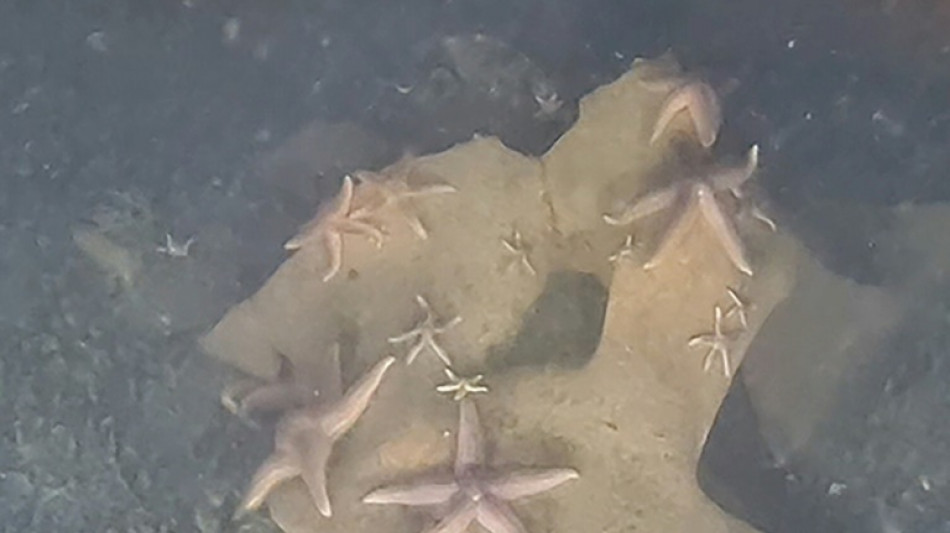
Sea life thriving on unexploded Nazi bombs, sub discovers / Photo: © DeepSea Monitoring Group/AFP

 Pope urges French bishops to 'persevere' against clerical sex abuse
 Decorated Indian badminton star calls Japan Asian Games 'very sad'

 Asian Games chiefs say lessons learned over accommodation

 UK's PM urges 'calm' as thousands seek to thwart flashpoint N.Ireland parade

 Thousands seek to thwart disputed N.Ireland flashpoint parade

 Swiss vote on what it means to be neutral

 Pope to meet with victims of clerical sex abuse during France trip

 Iran stands firm on Hormuz plan after US rejection
 Madrid protest camp grows after eviction outrage

 Italy winemakers hail bumper harvest but cut output

 Kyiv shoppers feel the pinch from Russian strikes
 Japanese anime actor fights TikTok over AI voice cloning
 Curtain falls on the romance of India's single-screen cinemas
 Smells like teen spirit as US thrash Peru 4-1

 Cavy chaos: Hundreds attend New Zealand's biggest guinea pig show

 Venezuela releases more political prisoners after opposition talks

 England's best 'for a long time' despite Spain defeat, says Kane

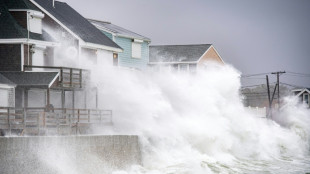 Powerful storm pummels northeast US with rain, high winds

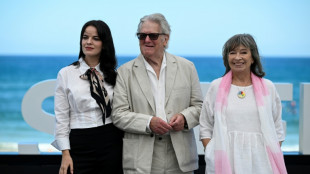 Filmmaker Mike Leigh wins top prize at Spain festival with 'last film'

 Spain beat England in Nations League to extend unbeaten run

 Ireland squad vote to play Israel tie despite Gaza unease
 Gutsy Vollering wins cycling road race world title

 Vollering wins cycling road race world title

 Man City's meteoric rise clouded by dark shadow

 Mbappe out for two weeks or more with knee injury say Real

Marine life is thriving on unexploded Nazi bombs sitting at the bottom of a German bay, a submersible has discovered, even capturing footage of starfishes creeping across a huge chunk of TNT.
The discovery, which was revealed in a study published Thursday, was "one of those rare but remarkable eureka moments," marine biologist Andrey Vedenin told AFP.
The waters off Germany's coast are estimated to be littered with 1.6 million tons of unexploded munitions left behind from both world wars.
In October last year, a team of German scientists went to a previously uncharted dump site in the Baltic Sea's Luebeck Bay and sent an unmanned submersible 20 metres down to the seafloor.
They were surprised when footage from the sub revealed 10 Nazi-era cruise missiles. Then they were stunned when they saw animals covering the surface of the bombs.
There were roughly 40,000 animals per square metre -- mostly marine worms -- living on the munitions, the scientists wrote in the journal Communications Earth & Environment.
They also counted three species of fish, a crab, sea anemones, a jellyfish relative called hydroids and plenty of starfishes.
While animals covered the hard casing of the bombs, they mostly avoided the yellow explosive material -- except for one instance.
The researchers were baffled to see that more than 40 starfishes had piled on to an exposed chunk of TNT.
"It looked really weird," said Vedenin, a scientist at Germany's Carl von Ossietzky University and the study's lead author.
Exactly why the starfishes were there was unclear, but Vedenin theorised they could be eating bacterial film collecting on the corroding TNT.
- Life on weapons of death -
The explosive chemicals are highly toxic, but the animals appeared to have found a way to live near it.
Other than the death-wish starfishes, they did not seem to be behaving strangely.
"The crabs were just sitting and picking something with their claws," Vedenin said.
To find out what kind of bombs they were dealing with, he went online and found a manual from the Nazi air force Luftwaffe describing how to handle and store V-1 flying bombs. The cruise missile exactly matched the 10 bombs from the footage.
Vedenin said "there is some irony" in the discovery that these "things that are meant to kill everything are now attracting so much life."
He compared it to how animals such as deer now thrive in radioactive areas abandoned by humans near the site of the Chernobyl nuclear disaster.
Hard surfaces on the seafloor are important for marine life that want more than mud and sand.
Animals once flocked to huge boulders that littered the Baltic Sea, however humans removed the stones to build infrastructure such as roads at the start of the 20th century.
So when the Nazi bombs are eventually cleared from the bay, the researchers called for more stones -- or concrete structures -- to be put in place to continue supporting the sea life.
The scientists also plan to return to the spot next month to set up a time-lapse camera to watch what the starfishes do next.
Y.Bouchard--BTB