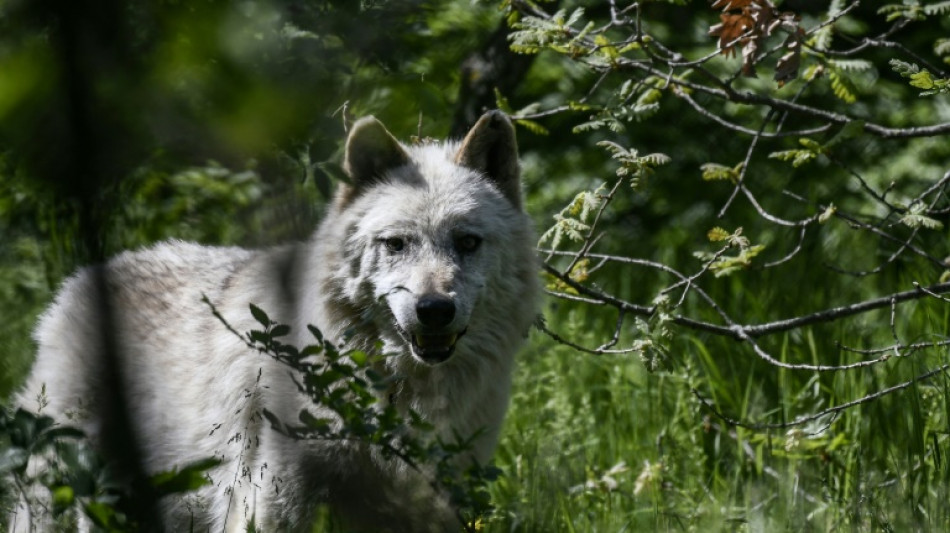
Wolf attack in Greece prompts calls for hunting rights / Photo: © AFP

 Pope urges French bishops to 'persevere' against clerical sex abuse

 Decorated Indian badminton star calls Japan Asian Games 'very sad'

 Asian Games chiefs say lessons learned over accommodation

 UK's PM urges 'calm' as thousands seek to thwart flashpoint N.Ireland parade

 Thousands seek to thwart disputed N.Ireland flashpoint parade

 Swiss vote on what it means to be neutral

 Pope to meet with victims of clerical sex abuse during France trip

 Iran stands firm on Hormuz plan after US rejection

 Madrid protest camp grows after eviction outrage

 Italy winemakers hail bumper harvest but cut output

 Kyiv shoppers feel the pinch from Russian strikes

 Japanese anime actor fights TikTok over AI voice cloning
 Curtain falls on the romance of India's single-screen cinemas

 Smells like teen spirit as US thrash Peru 4-1

 Cavy chaos: Hundreds attend New Zealand's biggest guinea pig show

 Venezuela releases more political prisoners after opposition talks

 England's best 'for a long time' despite Spain defeat, says Kane

 Powerful storm pummels northeast US with rain, high winds

 Filmmaker Mike Leigh wins top prize at Spain festival with 'last film'

 Spain beat England in Nations League to extend unbeaten run

 Ireland squad vote to play Israel tie despite Gaza unease

 Gutsy Vollering wins cycling road race world title

 Vollering wins cycling road race world title

 Man City's meteoric rise clouded by dark shadow

 Mbappe out for two weeks or more with knee injury say Real

Hunters and farmers in Greece are demanding the right to cull wolves after one attacked a child on a beach this month, warning that the protected species is multiplying in the wild.
The animal "grabbed" the five-year-old girl by the waist as she played on a beach in the Halkidiki peninsula, northern Greece, her mother told Skai TV.
A bystander drove the wolf off by throwing stones, but it later followed the girl and her mother to their apartment yard, she said.
Greek hunters have long maintained that the wolf population in Greece is much greater than estimated, increasing the threat to hunting dogs and livestock.
"Where I go hunting, there are wolf sightings almost every day," said Stelios Thomas, a 60-year-old from Thessaloniki who ventures out some 50 kilometres (30 miles) east of the city.
"I am now afraid to go to the mountain. They have eaten many dogs and livestock lately. There are attacks almost every day," he told AFP.
Local officials said they were laying traps in the area, but that if the animal could not be captured, it would be killed.
- 'Better be removed' -
Yorgos Iliopoulos, a biologist and wolf expert with the environmental NGO Callisto, said the wolf involved appeared to be unusually accustomed to humans.
"This animal evidently either found food in this area, or was erroneously fed by a human as a cub," he said.
"Its behaviour cannot be reversed and it is better to remove it, preferably through capture," he said.
The Thessaloniki-based organisation aims to study, protect and manage the populations and habitats of large carnivores such as bears and wolves and other endangered species.
In early 2024, Callisto helped remove a young wolf from the Greek police academy in Amygdaleza, near Athens.
The young male was collared and released in the foothills of Mount Parnitha, where wolves have returned after a six-decade absence.
From his studies on the Parnitha wolves, Iliopoulos said that the packs in the area "are attracted by the dead bodies of farm animals or dogs".
- Wolf revival -
According to a recent six-year study by Callisto, the wolf population in Greece is estimated at 2,075.
Their range is also spreading, Iliopoulos said.
"Wolves are now in Attica," the region surrounding Athens, and in the southern mainland "there has been a resurgence in the Peloponnese over the past two or three years," he said.
"Some individuals crossed the Isthmus at Corinth and dispersed into the Peloponnese. Last winter, we confirmed the presence of a breeding wolf pack in the Taygetos (mountain) region," he added.
The abandonment of agriculture in the mountains and increased availability of prey such as wild boar and deer have help the wolf population rebound, he said.
"Similar trends are seen with all large mammals in Greece and Europe."
- Bear scare -
Sightings of bears in inhabited areas have also increased in the Greek countryside.
Last week, an 80-year-old man in Zagori, northwestern Greece, was injured by a brown bear that entered his garden looking for food.
Wildlife group Arcturos estimates there are between 550 and 900 bears in Greece, an increase over the last two decades, but still not high enough to lift hunting restrictions.
Bears began approaching inhabited areas in Greece around a decade ago, but authorities have long neglected to set up rapid response teams, the group said in a July statement.
"The Greek countryside is not what it was 20 years ago, and so it would be impossible for bears to be the same too," said Arcturos's general director Alexandros Karamanlidis.
Callisto spokesperson Iason Bantios called the bear sightings "a manageable phenomenon that should not cause panic".
"It requires adequate operational organisation, proper planning, and targeted action protocols," he said.
M.Ouellet--BTB


