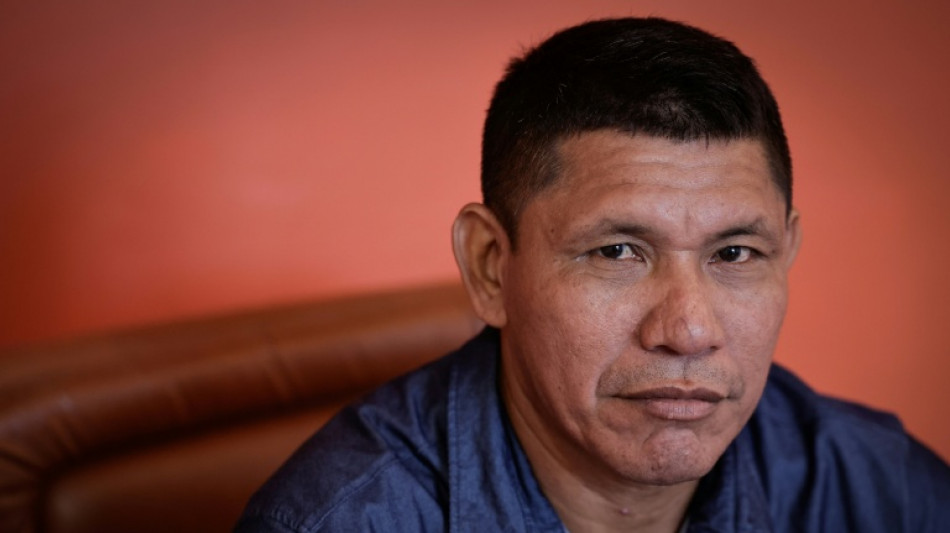
'Let them live in peace': survivor's fight for uncontacted Amazon people / Photo: © AFP

 How young is too young as child prodigies win big at Asian Games

 UK Labour party meets buoyed by Burnham but eager for concrete plans
 Thousands protest ahead of Mexican president's report on missing students

 Bangkok floods force thousands into shelters

 AI startup urges optimism from Europe despite safety fears
 'Godlike, invincible': Japan hails 11-year-old Games history-maker

 Nepal's hydropower ambitions face climate reality check

 Power cuts, rubble: millions come home to find Sudan's capital unlivable

 Internationals keep Presidents Cup lead with late fightbacks

 Tuchel to 'keep pushing' England to reach Spain's level

 Alcaraz saves match points to keep Europe ahead in Laver Cup
 Spain success driven by hunger to improve, says De La Fuente

 Lyon collapse at Stade Francais to suffer first Top 14 loss
 Oyarzabal and Spain sink England again as Modric shines for Croatia

 Housing protesters camp in central Madrid after mass demonstration

 Louise Trotter expands her palette at Bottega Veneta

 Pope prays at Lourdes after huge Paris mass

 USA trims International lead after Presidents Cup four-balls

 Russia accuses Europe of blocking Ukraine talks, as strikes drag on

 'He said hello': Families pray with pope on Paris avenue

 Pope celebrates giant Paris mass, flies to Lourdes

 Thousands march in Madrid over eviction of 87-year-old woman
 England women back to winning ways with last-gasp defeat of New Zealand

 Trump rejects Iran proposal for deal to reopen Hormuz

 England's Cox says injured Buttler leaves 'big shoes to fill'
Atxu Marima survived the flu that killed his family after a jaguar attack drove them from their Indigenous group in the Amazon -- but he cannot return for fear of endangering his people.
Instead he has dedicated himself to campaigning for Brazil's isolated communities to be left alone.
"I am here to tell the story of my people," Marima told AFP during a trip to Paris to raise awareness.
Marima is only around 40 but has already had many lives. Born Atxu among the Hi-Merima people, a nomadic group in the south of Amazonas state, he became Romerito (Little Romero) as a child labourer after fleeing the forest. But now to his wife and three children, he is Artur.
Until about the age of seven or eight, he lived between the Purus and Jurua rivers with his father, mother, and siblings as part of one of Brazil's officially recognised "uncontacted" Indigenous communities.
The country is home to more such groups than any other, with 114 officially recognised as living with little or no contact with the outside world.
For decades Brazil encouraged contact with these communities, before reversing course in 1987 after recognising the devastation it brought.
Marima and his family experienced this firsthand when tragedy forced them to seek out what he called a "civilised community" -- a decision that cost him his family, home, language and culture.
- 'Everyone got sick' -
Marima's childhood in the Amazon had been idyllic —- singing to trees to encourage them to bear fruit, families gathering to dance and racing across the forest floor with his siblings.
Until one day a jaguar attacked his father. He survived the mauling but suffered a severe head wound and began hallucinating that his children were prey -- tapirs and pigs to hunt with his arrows.
His mother fled with them, leaving his father dying in his hammock above a grave they had prepared for him.
Marima never saw him again.
"My family, especially my mother, then decided to make contact with the 'civilised' world," he told AFP.
It soon exposed them to diseases for which they had no defences.
"Everyone got sick and died," he said, recalling how his mother, aunt and several brothers succumbed to what he called the flu.
Marima and four siblings were the only survivors, scattered among local families.
Renamed Romerito, his adoptive family forced him to work in "slave-like conditions" until he left around the age of 15.
He believes he is the last of the siblings still alive.
-'Afraid of being shot'-
In 1987 Brazil adopted a no-contact policy, allowing interaction only if initiated by the Indigenous people themselves. Otherwise, they must be left alone.
Prior to that, "it was normal for half of the population of uncontacted people to die within the first year of contact," mostly from disease, said Priscilla Schwarzenholz, a researcher at Survival International.
Today Marima said isolated groups also fear contact because they are "afraid of being shot, because the 'civilisers' have guns."
"It's not worth getting in touch with my people... I'll pass on an illness to them," he said.
"I am no longer that person from the forest."
-'Live in peace'-
Marima now works with Brazil's National Foundation for Indigenous Peoples (Funai), monitoring the Hi-Merima territory, which the government legally recognised in 2005.
He spoke with pride about his work preventing illegal fishing, saying those responsible try to "invade" and show "no respect for the area".
Forest fires and deforestation pose another risk to their survival, he warned, noting that last year's intense heat and drought endangered their homes and hunting.
"People lack the common sense to protect the Amazon rainforest," he said.
Despite those threats, the Hi-Merima appear to have grown over the last 20 years, since incursions into their territory became illegal.
"You can see that there are kids, there are babies... they are growing and they are healthy," Schwarzenholz said, putting their number at about 150, based on traces they leave in the forest.
"I know they (the Hi–Merima) don't know I exist," Marima said.
But he said sharing his story was his way of staying connected while advocating for isolated groups to decide if -- and when -- they make contact.
Until then, "let them live in peace," he said.
F.Pavlenko--BTB


