
World on track to dangerous warming as emissions hit record high: UN / Photo: © AFP

 How young is too young as child prodigies win big at Asian Games

 UK Labour party meets buoyed by Burnham but eager for concrete plans

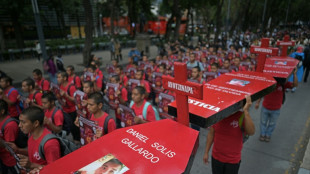 Thousands protest ahead of Mexican president's report on missing students

 Bangkok floods force thousands into shelters

 AI startup urges optimism from Europe despite safety fears

 'Godlike, invincible': Japan hails 11-year-old Games history-maker

 Nepal's hydropower ambitions face climate reality check

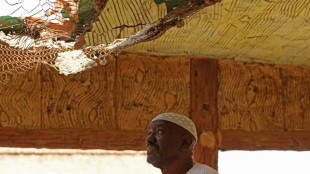 Power cuts, rubble: millions come home to find Sudan's capital unlivable

 Internationals keep Presidents Cup lead with late fightbacks

 Tuchel to 'keep pushing' England to reach Spain's level

 Alcaraz saves match points to keep Europe ahead in Laver Cup
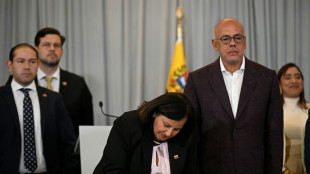
 Spain success driven by hunger to improve, says De La Fuente

 Lyon collapse at Stade Francais to suffer first Top 14 loss
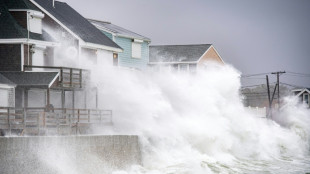
 Oyarzabal and Spain sink England again as Modric shines for Croatia

 Housing protesters camp in central Madrid after mass demonstration

 Louise Trotter expands her palette at Bottega Veneta

 Pope prays at Lourdes after huge Paris mass

 USA trims International lead after Presidents Cup four-balls

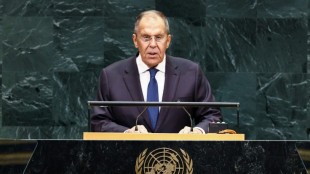 Russia accuses Europe of blocking Ukraine talks, as strikes drag on

 'He said hello': Families pray with pope on Paris avenue

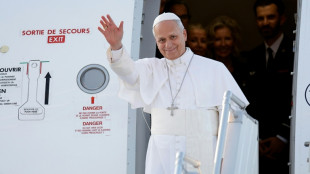 Pope celebrates giant Paris mass, flies to Lourdes

 Thousands march in Madrid over eviction of 87-year-old woman
 England women back to winning ways with last-gasp defeat of New Zealand

 Trump rejects Iran proposal for deal to reopen Hormuz

 England's Cox says injured Buttler leaves 'big shoes to fill'

National commitments to slash heat-trapping pollution would limit global warming up to 2.5C this century -- nowhere near enough to avoid devastating climate impacts despite a sweep of new pledges, the UN warned Tuesday.
Scientists are in broad agreement that warming above 1.5C relative to pre-industrial times risks catastrophic consequences, and every effort must be made to stick as close as possible to this safer threshold.
But the world is set to blow past 1.5C in a matter of years and planet-warming emissions keep rising, hitting a new record high in 2024, according to a report by the UN Environment Programme (UNEP).
The sobering assessment was published just days before world leaders gather in Brazil on Thursday and Friday ahead of the COP30 climate summit in the rainforest city of Belem.
With an overshoot of 1.5C now inevitable, focus has shifted to how quickly temperatures can be returned to less-risky levels.
"Our mission is simple, but not easy: make any overshoot as small and as short as possible," UN Secretary-General Antonio Guterres said Tuesday at the launch of UNEP's Emissions Gap report.
Big polluters most responsible for the crisis have been urged to pledge faster and deeper emissions cuts to bend the curve back to 1.5C by the end of the century.
Instead, the latest round of carbon-cutting targets announced ahead of the UN climate talks "have barely moved the needle", concluded UNEP's latest assessment.
"Ambition and action are nowhere near the levels needed globally or collectively," Anne Olhoff, the report's chief scientific editor, told AFP.
- 'Bleak picture' -
The latest assessment projects that the world's collective commitments to tackle climate change, if enacted in full, would result in 2.3C to 2.5C of warming by 2100.
That poses an unacceptable threat to the survival of nations most at risk by rising seas and extreme weather, and the global failure to rise to this challenge will loom over COP30.
Scientists have strong evidence that warming above 1.5C -- let alone a degree or more -- increases not only the intensity of hurricanes, floods and other disasters, but the likelihood of catastrophic climate tipping points.
At 1.4C above pre-industrial times, the Earth is already too warm for most tropical coral reefs to survive, while ice sheets and the Amazon rainforest could suffer severe and lasting changes below 2C, with consequences for the entire planet.
Under the Paris Agreement, each round of climate pledges is supposed to be more ambitious than the last to keep long-term warming "well below" 2C and as close as possible to 1.5C.
Despite being obligated to do so, only around one-third of countries announced a 2035 emissions reduction target by September 30, UNEP said.
This year's warming projections are 0.3C lower than last year, but Olhoff said little of that reduction was thanks to these latest pledges.
Updates to methodology accounted for 0.1C while another 0.1C was attributed to US commitments made under the Biden administration.
These gains are unlikely to materialise as President Donald Trump has vowed to pull the United States out of the Paris accord and ditch the climate policies of his predecessor.
"If we don't include the US, then the progress is quite limited," Olhoff said.
The dozens of other climate pledges made by governments in recent months "do not have a large effect on the temperature projections", she added.
"That is a very bleak picture, you can say."
- Record emissions -
Global emissions grew 2.3 percent in 2024 compared to the previous year, an increase driven by India followed by China, Russia and Indonesia.
This rise was quite high in the context of recent years "and comparable to the emissions growth in the 2000s", the report said.
Wealthy and powerful G20 economies accounted for three-quarters of global emissions and of the six largest polluters, the EU was the only one to cut greenhouse gases in 2024.
As they come under pressure to set new and ever-more ambitious targets, UNEP said most nations were not even on track to meet their earlier 2030 goals.
Based on just the current policies in place, Earth is expected to be 2.8C hotter in 2100.
COP30 will seek to allay fears that climate action is on the back burner as the United States shuns the process, collective targets are missed and governments prioritise other concerns.
"We still need unprecedented cuts to greenhouse gas emissions, in an ever-compressing timeframe, amid a challenging geopolitical context," wrote UNEP chief Inger Andersen in the report.
O.Krause--BTB


