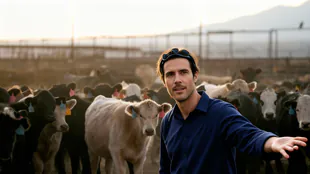
Desert-grown superfood puts 'healthy' burgers on UAE menus / Photo: © AFP

 Far-Right Extremists Claim Opportunity to Seize Control of GOP After Midterms

 New Campaign Highlights Knowledge Gaps on Carbon Monoxide Safety Among Americans

 JR East Launches 'teppay' to Integrate Suica Balance with Mobile Payments

 Phil Spencer on Housing Market Fairness: How Buyers and Sellers Navigate Falling Prices

 Beirut Cinema Festival Draws Thousands Despite War Fatigue

 AMD Forecasts First-Ever Revenue Lead Over Intel on AI Chip Surge

 GoodData.AI Launches the Agentic Serving Plane, a New Category of Enterprise Data Infrastructure for AI Agents

 Abu Dhabi Demand Response Project Achieves 401 MW Peak Reduction in 2025

 Panthers expected to begin 2027 NRL season away from new stadium
A hardy plant grown using salt water is thriving in the UAE's desert farms and helping create "healthy" burgers, showing sustainable agriculture's potential in the toughest conditions.
Salicornia, a succulent, is already being used as a salt replacement in burger patties -- a rare farming success in the oil-rich United Arab Emirates, which imports nearly all of its food.
"You have the salty flavour with less sodium, but you also have other benefits," said Tina Siegismund, head of marketing and innovation at UAE-based Global Food Industries, a frozen food manufacturer.
The asparagus-like plant reduces sodium content by 40 percent in the company's healthy burgers, which also contain chicken, quinoa and kale.
Native to parts of North America, Europe, South Africa and South Asia, the plant is ideal for the UAE's inhospitable climate, and contains anti-bacterial and anti-inflammatory properties, according to Siegismund.
Agriculture produces less than one percent of GDP in the UAE, a country on the frontline of climate change with temperatures regularly topping 50 degrees Celsius (122 Fahrenheit) and rising rapidly.
Salicornia cultivation began last year in a number of farms across the UAE as part of an experiment using brine run-off from desalination plants by the Dubai-based International Center for Biosaline Agriculture (ICBA).
Augusto Becerra Lopez-Lavalle, chief scientist at ICBA, said research was now underway into generating more of the "high-value crop", which sells for $20 a kilo (2.2 pounds) in France.
"We went from... building this prototype, to piloting at scale with eight farmers, and now the question is how to scale up," Lopez-Lavalle told AFP.
In the future, salicornia could "become a really important food ingredient" he added.
"If there is an economic value and the production system is developed for this, it can become a replacement for salt and any other micronutrients that are added today artificially to processed food."
For now, salicornia remains a niche product, its health benefits unknown to most, admits Siegismund.
"It's not a product that makes big, big profit, but we believe in it and we will continue," she said.
G.Schulte--BTB