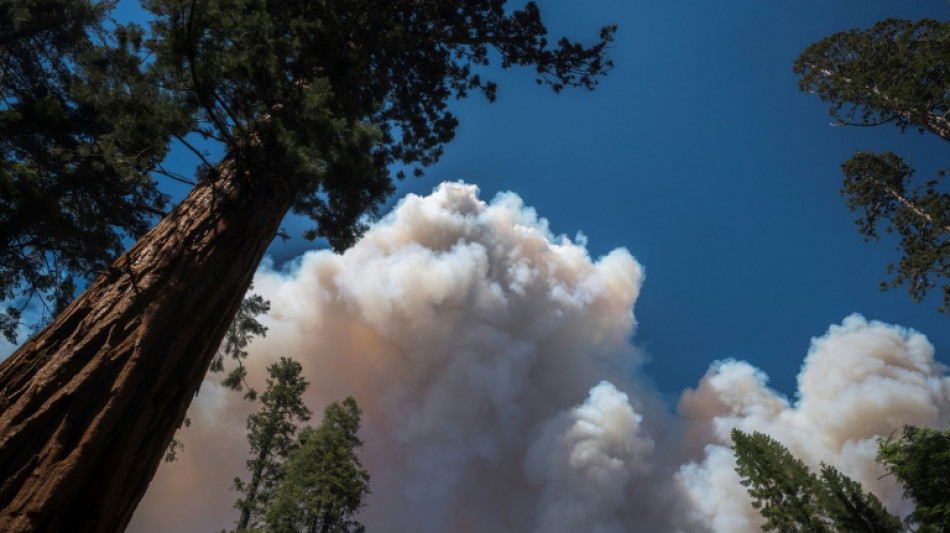
California wildfire threat to Yosemite giant sequoias 'almost gone' / Photo: © AFP/File

 Far-Right Extremists Claim Opportunity to Seize Control of GOP After Midterms

 New Campaign Highlights Knowledge Gaps on Carbon Monoxide Safety Among Americans

 JR East Launches 'teppay' to Integrate Suica Balance with Mobile Payments

 Phil Spencer on Housing Market Fairness: How Buyers and Sellers Navigate Falling Prices

 Beirut Cinema Festival Draws Thousands Despite War Fatigue

 AMD Forecasts First-Ever Revenue Lead Over Intel on AI Chip Surge

 GoodData.AI Launches the Agentic Serving Plane, a New Category of Enterprise Data Infrastructure for AI Agents

 Abu Dhabi Demand Response Project Achieves 401 MW Peak Reduction in 2025

 Panthers expected to begin 2027 NRL season away from new stadium
The wildfire threat to the world's largest trees in California has almost passed, with the blaze now spreading away from giant sequoia trees in Yosemite National Park, a forestry official said Thursday.
More than 1,000 firefighters have scrambled to contain the Washburn fire, which started a week ago, and which for days threatened the world-renowned Mariposa Grove of giant sequoias.
"The threat is essentially almost gone," Stanley Bercovitz, a US Forest Service spokesperson, told AFP.
"Currently none [of the giant sequoias] have been killed. You never know, down the road. In two years, if maybe some of the younger ones, their needles start to turn yellow... it might be because of the fire," he added.
"But otherwise... almost every tree was very fortunate to have a low-grade fire burn around it."
The Mariposa Grove is the largest group of sequoias in Yosemite, with over 500 mature trees.
Giant sequoias are the world's largest trees by volume. Their relatives, the California redwoods, can grow taller -- well over 100 meters (330 feet) -- but are not as wide.
Crews worked to remove quick-burning leaves, sticks and branches. Sprinklers supplied with water tanks have been running 24 hours a day, increasing overall humidity in the area.
The fire has spread over 4,375 acres (1,770 hectares) and is 23 percent contained, according to the latest official data.
It is currently moving north and east, into the neighboring Sierra National Forest.
Weather conditions have helped efforts to control the blaze.
"It's not being driven by the wind. It's just being driven by the fuels," said Bercovitz.
He added: "The threat is not completely gone. Until the fire is 100 percent controlled, there's still always some threat.
"But it is currently greatly reduced, and burning away [from the giant sequoias]."
Giant sequoias, which can live for thousands of years, typically endure many fires, the heat from which helps their cones to open, allowing the seeds to disperse.
But longer, hotter and more aggressive fires can damage them, sometimes irreparably, and California has recently seen multiple severe fire seasons in a row.
In 2020, up to 10,000 of the giants -- up to 14 percent of the world's total -- perished in one fire, and another 3,600 died last year.
Scientists say global warming, which is being driven chiefly by humanity's unchecked burning of fossil fuels, is making extreme weather events more likely.
G.Schulte--BTB