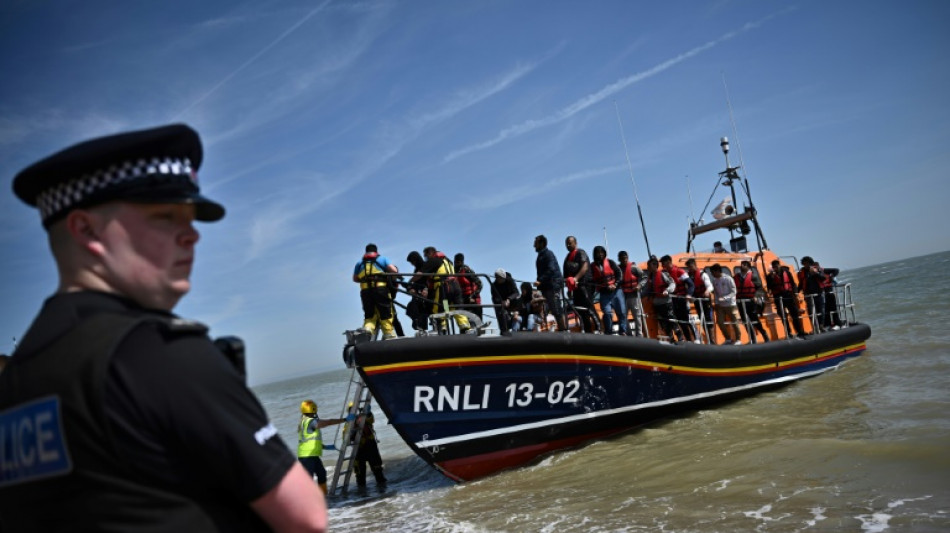
MPs question deterrent effect of UK's Rwanda migrant policy / Photo: © AFP

 Far-Right Extremists Claim Opportunity to Seize Control of GOP After Midterms

 New Campaign Highlights Knowledge Gaps on Carbon Monoxide Safety Among Americans

 JR East Launches 'teppay' to Integrate Suica Balance with Mobile Payments

 Phil Spencer on Housing Market Fairness: How Buyers and Sellers Navigate Falling Prices

 Beirut Cinema Festival Draws Thousands Despite War Fatigue

 AMD Forecasts First-Ever Revenue Lead Over Intel on AI Chip Surge

 GoodData.AI Launches the Agentic Serving Plane, a New Category of Enterprise Data Infrastructure for AI Agents

 Abu Dhabi Demand Response Project Achieves 401 MW Peak Reduction in 2025

 Panthers expected to begin 2027 NRL season away from new stadium
British MPs on Monday told the government there was "no clear evidence" that its controversial policy to deport some asylum seekers to Rwanda would stop Channel crossings in small boats.
The House of Commons Home Affairs Committee said "much more clarity" was needed on the plan, including how much it will cost.
Instead, the MPs urged ministers to look at less eye-catching solutions to the issue, including closer cooperation with European neighbours.
"There is no clear evidence that the policy will deter migrant crossings," the cross-party committee said in a report on the "small boats" phenomenon.
In fact, it pointed out, numbers attempting the journey from northern France in inflatable dinghies and other unsuitable craft had increased since the policy was first announced in April.
It attributed this to "scaremongering" by people-smuggling gangs warning migrants about the change in the law.
The Channel crossings have put Prime Minister Boris Johnson and his government under political pressure, given that they promised to tighten Britain's borders after leaving the European Union.
More than 28,500 people -- most of them young men -- arrived in 2021. Some 13,000 have arrived already this year out of 60,000 expected this year.
Most claim asylum but the government says the costs involved in the application process -- more than £1.5 billion ($1.8 billion) -- are unsustainably high.
The first flight carrying asylum seekers was due to take off for Rwanda in mid-June but was grounded due to legal challenges.
The Home Affairs Committee said there was "no magical solution" to deal with irregular migration.
But it said "close cooperation with international partners, particularly those in France" stood more chance of success in deterring Channel crossings.
That included intelligence-sharing to smash criminal gangs behind the practice, and rebuilding connections destroyed by Brexit to enable Britain to send illegal arrivals back across the Channel.
The committee pointed out that there were a total of 48,450 asylum applications in Britain in 2021 -- a similar number to every year since 2014 and "far less" than in the early 2000s.
But it said the current asylum caseload of more than 125,000 was a result of "antiquated IT systems, high staff turnover and too few staff".
D.Schneider--BTB