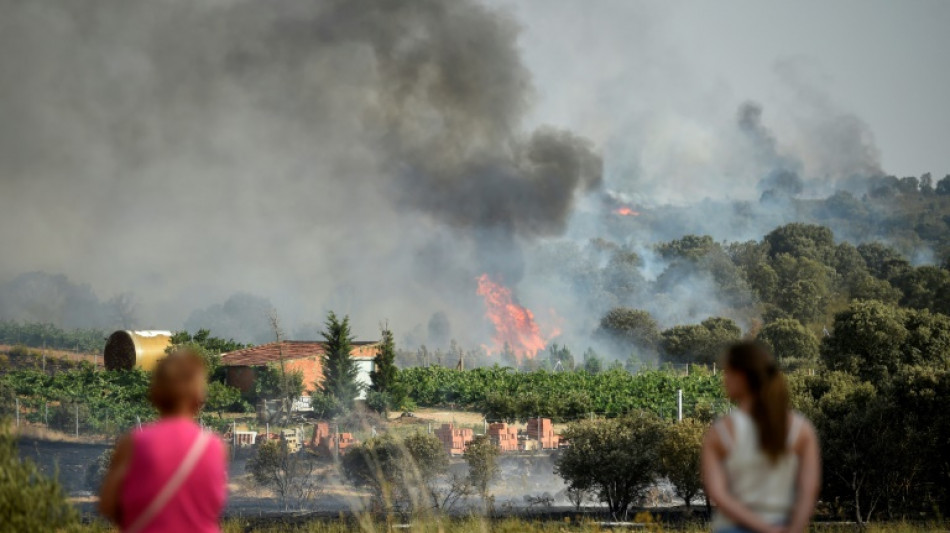
Europe heat sparks harmful ozone pollution, 'extreme' fire risk / Photo: © AFP/File

 Ireland squad vote to play Israel tie despite Gaza unease

 Gutsy Vollering wins cycling road race world title

 Vollering wins cycling road race world title

 Man City's meteoric rise clouded by dark shadow

 Mbappe out for two weeks or more with knee injury say Real

 Lyon collapse away to Stade and suffer first Top 14 loss

 Russia accuses Europe of seeking to thwart Ukraine talks

 Man City chairman defiant over reported Premier League charges

 Germany ready to 'walk through fire' for Klopp, says Tah

 At least 16 killed in Russian and Ukrainian strikes

 Powerful storm pummels US Northeast

 Bangkok declares disaster after homes flooded, roads submerged by heavy rain

 Norris calls for errant Colapinto to be banned for causing Baku crash

 Russell finds himself again and prepares to heap pressure on Antonelli

 South Korea hold nerve to win Asian Games basketball gold

 Russell holds off Verstappen to claim imperious victory in Baku

 Russell holds off Verstappen to win Azerbaijan Grand Prix

 India's Kohli says 2027 ODI World Cup will be his last

 Huge crowds cheer Pope Leo along Champs-Elysees ahead of Paris mass

 Putellas wants to bring 'winning culture and mentality' to London City

 Rare Italian opera returns to Moscow after nearly 120-year hiatus

 Pope to celebrate giant Paris mass after 'peace' appeal

 Homes flooded, roads submerged: Bangkok declares disaster over heavy rains

 Ahead of Paris mass, pope urges life together in 'dignity and peace'

 Austria 'ghetto' language classes leave children to repeat school
Europe's searing heatwave is generating very high levels of harmful ozone pollution, the region's atmospheric monitoring service warned Tuesday, adding that large areas of western Europe also face "extreme" danger of wildfires.
Record temperatures, which scientists say are driven by climate change, are predicted in France and Britain Tuesday as suffocating heat that has gripped southwest Europe and sparked ferocious wildfires moves northwards.
"Tinder dry conditions and extreme heat are exacerbating the risk of wildfires," according to a statement from the Copernicus monitoring service.
The organisation's emergency management service has warned that a large proportion of western Europe is in "extreme fire danger" with some areas of "very extreme fire danger".
The heatwave is also causing high levels of ground-level ozone, Copernicus said.
Unlike the protective layer in the upper atmosphere, this is a major greenhouse gas and component of urban smog that harms human health and inhibits photosynthesis in plants.
"The potential impacts of very high ozone pollution on human health can be considerable both in terms of respiratory and cardio-vascular illness," said Mark Parrington, Senior Scientist from the Copernicus Atmosphere Monitoring Service.
Ozone is formed as emissions from fossil fuels and other man-made pollutants react in the presence of sunlight and Copernicus said cutting emissions of these pollutants is "crucial".
Scientists have already detected "extremely high surface ozone pollution" across western and southern Europe, particularly over the Iberian Peninsula and parts of northern Italy.
Daily maximum levels of surface ozone, which normally peaks during the middle of the day, reached unhealthy levels in Portugal, Spain and Italy, according to Copernicus.
Scientists now warn that, while the situation is likely to ease across the Iberian Peninsula, very high surface ozone levels are now being seen in areas of northern and western parts of the continent as temperatures rise.
The ozone levels in these regions are forecast to peak in the next few days, before easing.
Copernicus also predicted no relief from the wildfires that have engulfed swathes of forests across parts of southern Europe.
- One million ozone pollution deaths -
In southwest France, two massive fires have created apocalyptic scenes of destruction, despite much of the country's entire firefighting capacity being deployed.
Copernicus said total carbon emissions from the wildfires in Spain so far in July are the highest seen for the June-July period since 2003.
Parrington said high surface ozone can lead to sore throats, coughing, headaches and an increased risk of asthma attacks.
The Clean Air Alliance estimates that ozone pollution causes approximately one million additional deaths per year.
Ozone is also a key concern for agricultural regions and food security.
In January, researchers estimated that persistently high levels of ozone pollution in Asia are costing China, Japan and South Korea an estimated $63 billion annually in lost rice, wheat and maize crops.
P.Anderson--BTB