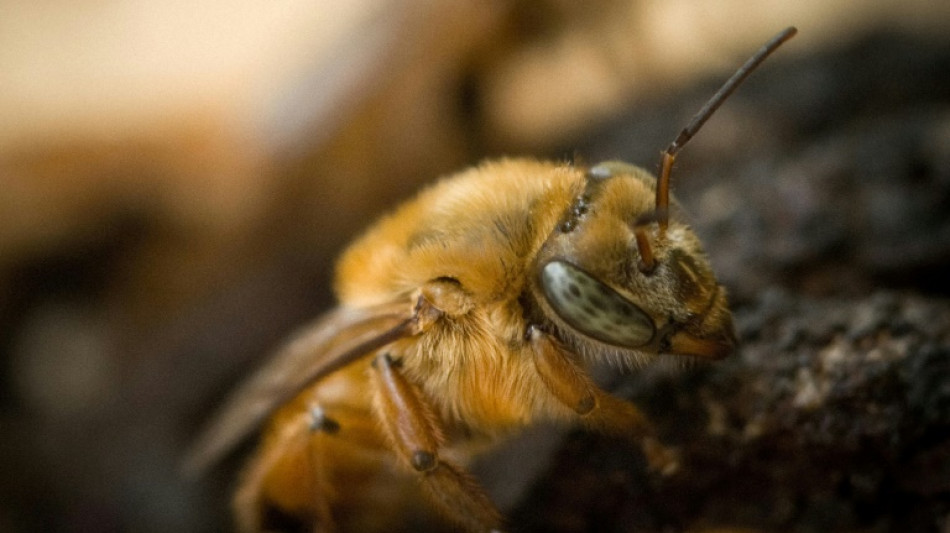
Brazil buzzing over potential of its native bees / Photo: © AFP

 Ireland squad vote to play Israel tie despite Gaza unease

 Gutsy Vollering wins cycling road race world title

 Vollering wins cycling road race world title

 Man City's meteoric rise clouded by dark shadow

 Mbappe out for two weeks or more with knee injury say Real

 Lyon collapse away to Stade and suffer first Top 14 loss

 Russia accuses Europe of seeking to thwart Ukraine talks

 Man City chairman defiant over reported Premier League charges

 Germany ready to 'walk through fire' for Klopp, says Tah

 At least 16 killed in Russian and Ukrainian strikes

 Powerful storm pummels US Northeast

 Bangkok declares disaster after homes flooded, roads submerged by heavy rain

 Norris calls for errant Colapinto to be banned for causing Baku crash

 Russell finds himself again and prepares to heap pressure on Antonelli

 South Korea hold nerve to win Asian Games basketball gold

 Russell holds off Verstappen to claim imperious victory in Baku

 Russell holds off Verstappen to win Azerbaijan Grand Prix

 India's Kohli says 2027 ODI World Cup will be his last

 Huge crowds cheer Pope Leo along Champs-Elysees ahead of Paris mass

 Putellas wants to bring 'winning culture and mentality' to London City

 Rare Italian opera returns to Moscow after nearly 120-year hiatus

 Pope to celebrate giant Paris mass after 'peace' appeal

 Homes flooded, roads submerged: Bangkok declares disaster over heavy rains

 Ahead of Paris mass, pope urges life together in 'dignity and peace'

 Austria 'ghetto' language classes leave children to repeat school

Brazilian part-time beekeeper Luiz Lustosa lifts the lid on a wooden hive. The reaction is instant, and angry, as thousands of bees envelop him in a buzzing cloud.
Lustosa wears no specialized suit or gloves, however, just a light net to cover his face. These bees are stingless.
"What a wonder!" Lustosa marvels at the honey-filled wax craters in the hive as the bees attack him furiously, but impotently -- his childlike amazement not diminished by six years working with the insects.
Long overlooked, Brazil's native bees are making a comeback, with people such as Lustosa, a 66-year-old public servant, getting in on the movement to boost their profile.
Of 550 stingless bee species known to exist in tropical and sub-tropical areas of the world, some 250 are found in Brazil, according to Cristiano Menezes of Brazil's Embrapa Agricultural Research Corporation.
Yet they are little known outside of rural and Indigenous communities, having been relegated to a lesser place by European and African honeybees brought to Brazil over the centuries for their more prolific honey- and wax-producing skills.
Most of Brazil's honey today comes from non-native, stinging bees.
- 'Here to help us' -
Lustosa is president of the Native Bee Institute, a non-profit organization that plants trees to expand the habitat of native bees and educates people about their important role as pollinators.
"We explain to children that the bees don’t sting, that they are necessary for the environment and nature, and they are there to help us," Lustosa told AFP at the institute's premises in Brasilia, where he runs workshops and sells native honey.
A study in 2016 estimated that about 1.4 million jobs and three-quarters of all crops worldwide depend on pollinators such as bees -- a service rendered for free but worth tens of billions of dollars, according to scientific studies.
Bees account for 80 percent of plant pollination by insects.
Unlike their immigrant counterparts, Brazil's native bees are picky, dining exclusively on the fruit and pollen of indigenous fruit and avocado trees -- for whose pollination they are crucial.
Beekeepers "depend on vegetation, a healthy forest" for the bees to feed on, said Jeronimo Villas-Boas, a fellow native beekeeper and ecologist.
"For this reason, beekeepers are agents of conservation."
Villas-Boas is helping indigenous communities improve the quality of the native honey they produce and links them up with buyers in a bid to get them in on the "business" of the coveted sweet liquid.
"Bees enable businesses with a positive impact on society, the environment and agriculture," says Menezes.
Native bees produce a honey that proponents claim is healthier for its lower sugar content. The flavor and acidity differs from species to species.
They produce about 30 times less honey than their stinging cousins, and as a result, native honey costs about $55 per kilo in Brazil, compared to $6 per kilo for the other.
One of Villas-Boas's clients is Brazilian chef Alex Atala, whose D.O.M. restaurant in Sao Paulo holds two Michelin stars for its locally-based cuisine.
Honey from the tubi native bee is a key ingredient in one of Atala's award-winning dishes of cassava cooked in milk.
"We have a world as rich as that of wine to get to know," Atala told AFP.
"Eating our biodiversity will generate value for products that today are forgotten, devalued."
Y.Bouchard--BTB