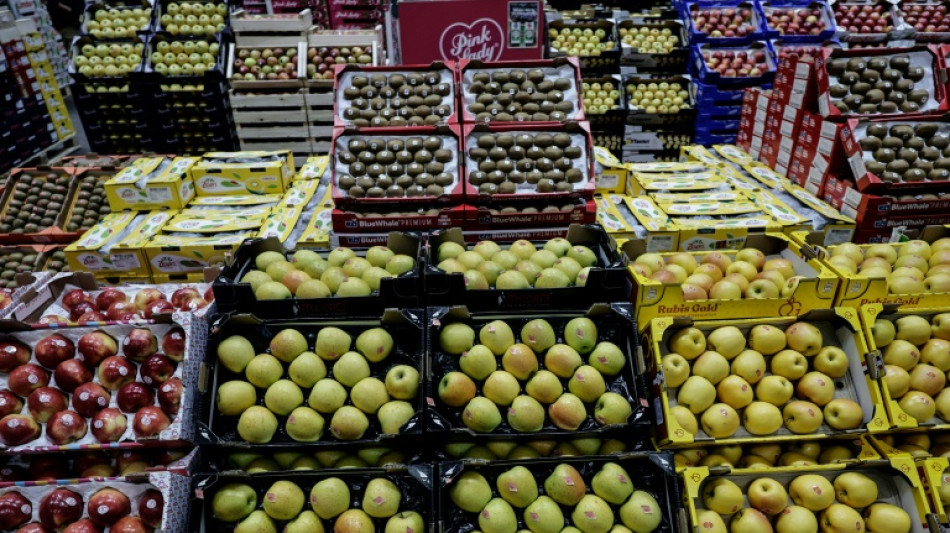
'Pesticide cocktails' pollute apples across Europe: study / Photo: © AFP/File

 Japanese anime actor fights TikTok over AI voice cloning
 Curtain falls on the romance of India's single-screen cinemas

 Smells like teen spirit as US thrash Peru 4-1

 Cavy chaos: Hundreds attend New Zealand's biggest guinea pig show

 Venezuela releases more political prisoners after opposition talks

 England's best 'for a long time' despite Spain defeat, says Kane

 Powerful storm pummels northeast US with rain, high winds

 Filmmaker Mike Leigh wins top prize at Spain festival with 'last film'

 Spain beat England in Nations League to extend unbeaten run

 Ireland squad vote to play Israel tie despite Gaza unease

 Gutsy Vollering wins cycling road race world title

 Vollering wins cycling road race world title
 Man City's meteoric rise clouded by dark shadow

 Mbappe out for two weeks or more with knee injury say Real

 Lyon collapse away to Stade and suffer first Top 14 loss

 Russia accuses Europe of seeking to thwart Ukraine talks

 Man City chairman defiant over reported Premier League charges

 Germany ready to 'walk through fire' for Klopp, says Tah

 At least 16 killed in Russian and Ukrainian strikes

 Powerful storm pummels US Northeast

 Bangkok declares disaster after homes flooded, roads submerged by heavy rain
 Norris calls for errant Colapinto to be banned for causing Baku crash

 Russell finds himself again and prepares to heap pressure on Antonelli

 South Korea hold nerve to win Asian Games basketball gold

 Russell holds off Verstappen to claim imperious victory in Baku

Environmental groups Thursday raised the alarm after finding toxic "pesticide cocktails" in apples sold across Europe, in a new study highlighting widespread contamination.
PAN Europe, a coalition of NGOs campaigning against pesticide use, had around 60 apples randomly purchased in 13 European countries -- including France, Spain, Italy and Poland -- analysed for chemical residues.
Eighty‑five percent of the samples contained multiple pesticide residues, the organisations said, with some apples showing traces of up to seven different chemicals.
In 71 percent of cases, PAN Europe detected pesticides classed among the most hazardous in the European Union -- so‑called "candidates for substitution" that the bloc aims to phase out as soon as possible.
The analysis also found that 64 percent of samples contained at least one per- and polyfluoroalkyl substance, also known as "forever chemicals", which are found throughout the environment and everyday products.
Pesticide residues are permitted in the EU below certain maximum levels. But PAN Europe warned of the "cocktail effect," when consumers are exposed to several pesticides simultaneously in a single product.
Martin Dermine, a senior official at the coalition, criticised the European Food Safety Authority (EFSA) for assessing pesticides individually rather than the risk from "multiple exposure" to several substances.
"In this report, we show that 85 percent of the apples have multiple residues, and we don't know if they are safe for consumption or not," he said, pointing to potential links with cancer and infertility.
If the same apples were sold as processed baby food, 93 percent of the samples would be banned, PAN Europe said, as their pesticide residues exceed the stricter limits set for children under three.
EU rules are tougher for baby foods to protect early development. PAN Europe advised consumers to buy organic apples or peel conventionally grown ones before eating them.
Along with bananas, apples rank among Europeans' favourite fruits, and are the most widely grown in the EU, particularly in Poland, Italy and France.
Apples are also among the most heavily treated fruits, with pesticides used in particular to fight apple scab, the main fungal threat to orchards. More than half of the numerous annual treatments carried out on the fruit -- about 35 on average -- target the disease.
B.Shevchenko--BTB


