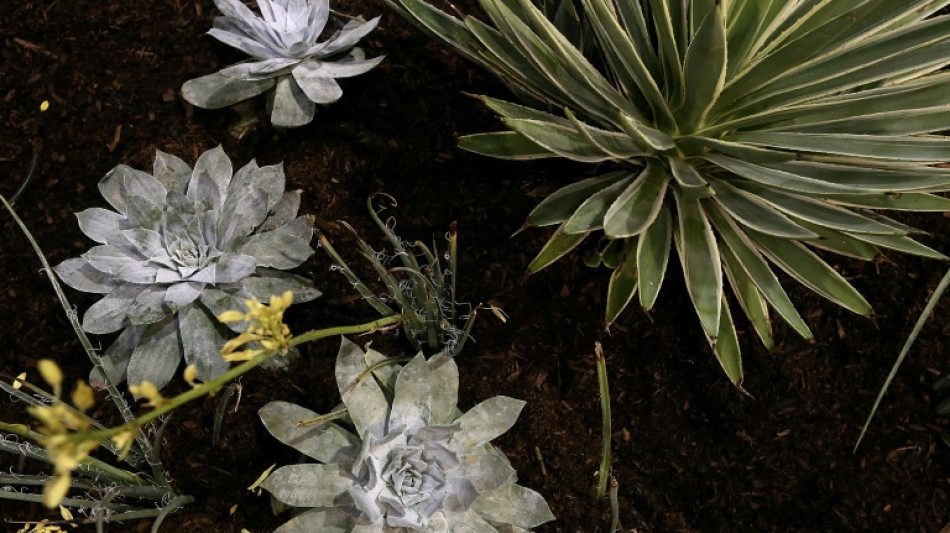
Climate, collectors blamed for S.Africa's succulents decline / Photo: © GETTY IMAGES NORTH AMERICA/AFP/File

 Ireland squad vote to play Israel tie despite Gaza unease
 Gutsy Vollering wins cycling road race world title

 Vollering wins cycling road race world title

 Man City's meteoric rise clouded by dark shadow

 Mbappe out for two weeks or more with knee injury say Real

 Lyon collapse away to Stade and suffer first Top 14 loss

 Russia accuses Europe of seeking to thwart Ukraine talks

 Man City chairman defiant over reported Premier League charges

 Germany ready to 'walk through fire' for Klopp, says Tah

 At least 16 killed in Russian and Ukrainian strikes

 Powerful storm pummels US Northeast
 Bangkok declares disaster after homes flooded, roads submerged by heavy rain

 Norris calls for errant Colapinto to be banned for causing Baku crash

 Russell finds himself again and prepares to heap pressure on Antonelli
 South Korea hold nerve to win Asian Games basketball gold

 Russell holds off Verstappen to claim imperious victory in Baku

 Russell holds off Verstappen to win Azerbaijan Grand Prix

 India's Kohli says 2027 ODI World Cup will be his last

 Huge crowds cheer Pope Leo along Champs-Elysees ahead of Paris mass

 Putellas wants to bring 'winning culture and mentality' to London City

 Rare Italian opera returns to Moscow after nearly 120-year hiatus

 Pope to celebrate giant Paris mass after 'peace' appeal

 Homes flooded, roads submerged: Bangkok declares disaster over heavy rains

 Ahead of Paris mass, pope urges life together in 'dignity and peace'

 Austria 'ghetto' language classes leave children to repeat school
Climate change and collectors of rare plants are decimating succulents in South Africa, government researchers said Wednesday, warning hundreds of these rugged species are at risk of extinction.
Succulents growing in the country's semi-arid regions are experiencing unprecedented rates of decline following a rapid rise in global demand for collectable plants driven by Asia, according to the South African National Biodiversity Institute (SANBI), a government research body.
"Over the past three years plant material confiscated from plant traffickers by law enforcement agencies has increased annually by over 250 percent," the institute said in a statement.
SANBI said more than 200 succulents -- typically thick, fleshy plants that retain water to survive dry weather conditions -- have been added to an International Union for Conservation of Nature (IUCN) Red List of threatened species, which was updated last week.
Unique species growing in the Succulent Karoo -- a region shared between South Africa and Namibia which includes some of the world's most biodiverse desert and semi-desert areas -- are particularly sought after, it said.
The plants are often sold on social media, it added.
"People buying these plants, most of them don't realize that they're breaking the law," said Craig Hilton-Taylor, who heads the IUCN's Red List unit.
"They're completely ignorant or naive about illegal plant trade... they just think, 'Oh, that's a nice thing to buy for my house or my garden'," he said.
Global warming is also contributing to the decline, the institute said.
The region has suffered from a prolonged, severe drought over the past decade.
This has taken a toll on many species in the region, including the critically endangered giant quiver tree. Its population is set to decline 90 percent by 2080, SANBI said.
"A combination of illegal collection, long-term droughts related to climate change, and ongoing land degradation as a result of livestock overgrazing and mining are creating a devastating storm causing unprecedented loss of biodiversity in the world's richest desert ecosystem," it said.
W.Lapointe--BTB