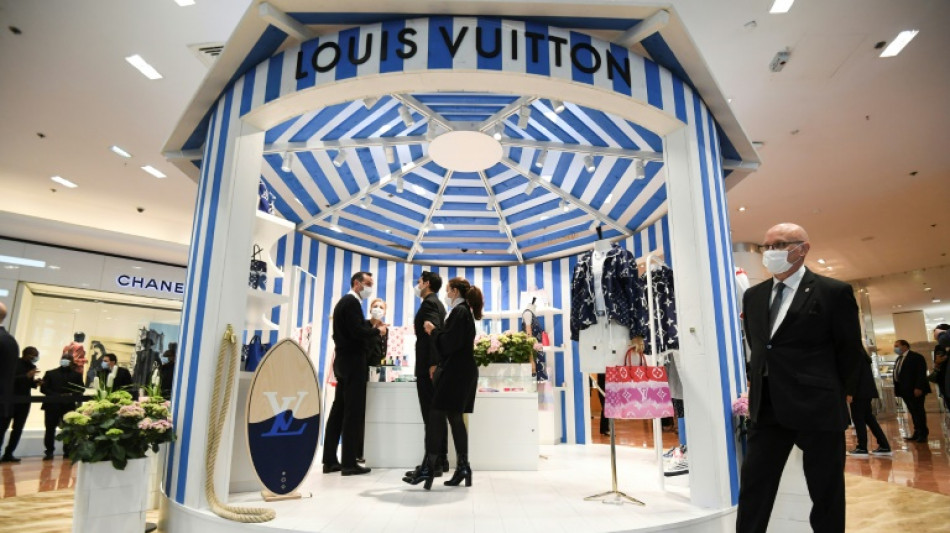
French luxury houses give unsold goods a second chance / Photo: ©

 Fury to face British rival Joshua in Cardiff on December 11

 Streamex Converts Interest Into Capital as GLDY Investment Strategy Secures $1M+ Institutional Allocation

 STARTRADER Named Best Fintech Forex Broker at Forex Expo Dubai 2026

 Japan swimmer Ohashi, 17, shrugs off Covid to smash world record

 Shin Ohashi: Junk food-loving teen and new world record-holder

 Greek PM urges 'courage' in talks with UK over Parthenon Marbles

 'I was drowning': Iran Nobel winner exposes pain of separation from children

 Israel's US envoy says son fighting for life

 Olympic champion Yulo completes gymnastics gold collection at Asian Games

 England cannot imitate Spain's success, says Gordon

 Hungary detects invasive spotted lanternfly for first time in EU

 Ο Alex Bodi και ο καθηγητής Δρ. Stefan Haupt συμφωνούν σε συνεργασία για μια θρυλική συλλογή έργων τέχνης στη Ρουμανία

 France's top-selling newspaper to slash jobs

 Tigray rebels in 'full-blown' war with govt

 Alex Bodi och prof. dr Stefan Haupt ingår samarbetsavtal om en legendarisk konstsamling i Rumänien

 อเล็กซ์ โบดี และศาสตราจารย์ ดร. สเตฟาน ฮาปท์ ตกลงร่วมมือกันในการจัดตั้งคอลเลกชันศิลปะอันเป็นตำนานในโรมาเนีย

 Alex Bodi a prof. dr. Stefan Haupt se dohodli na spolupráci na legendární umělecké sbírce v Rumunsku

 알렉스 보디와 슈테판 하우프트 교수, 루마니아의 전설적인 미술품 컬렉션을 위한 협력 합의

 BaazEX Enters the Asian Trading Market With a New Approach to Online Forex Trading.

 Asian markets fall on US-China jitters as leaders meet

 Thais hail teen rocker Nene for 'America's Got Talent' win

 Zverev, Agassi defend 'spectacular' Laver Cup

 Eel-powered Japan whizz-kid, 11, dominates in historic Games debut

 Madagascar's Gen Z 'betrayed' after ushering in new rule

 As Moscow steps up attacks, Kyiv residents brace for harsh winter

In the extravagant world of the French luxury industry, brands used to prefer destroying their unsold goods rather than offering their high-priced products at a discount.
But gone are the days of binning the coats, handbags and shoes pooh-poohed by shoppers after a new anti-waste law came into force at the start of the year.
Now luxury houses are managing their stocks more carefully, offering deals to staff, making donations and recycling goods.
"It's a subject that has become important today," said Julie El Ghouzzi, a luxury goods expert at the Cultz consulting agency.
She pointed to the scandal that engulfed Burberry in 2018 after the British luxury brand disclosed that it had destroyed 28 million pounds ($38 million, 34 million euros at current exchange rates) of unsold goods in 2017 -- the equivalent of 20,000 of its trench coats.
Following the firestorm the revelation triggered, Burberry announced it would halt the practice from the following year.
Markdowns to move goods are not an option in the luxury business as lower prices can undermine the attractiveness of their labels, which thrive on their elite status.
"In the luxury sector, if the price tag is lower, so is the desire to buy it," said El Ghouzzi.
- Mentalities have changed -
Luxury houses are paying more attention to the subject now, said Arnaud Cadart, a portfolio manager at Paris-based asset manager Flornoy.
"Mentalities have changed, we're no longer in an economy that values unbridled creation above all else," he said.
Also gone is the mentality that "if it doesn't work we'll destroy it," said Cadart.
Now luxury houses strive to fine-tune their stocks.
The Kering group, which owns the Gucci, Saint Laurent, and Balenciaga labels among others, has invested in artificial intelligence in order to better manage its stock.
At its competitor LVMH, the world's largest luxury group that includes Louis Vuitton, Dior, and Celine among many others, environmental development director Helene Valade said "the luxury business model is closely adjusted to demand" with low levels of stock being held by the firms.
Nevertheless, she acknowledged that the new law will push luxury houses to learn even more about their clients to better anticipate their purchases and thus reduce stocks to a minimum.
El Ghouzzi said Louis Vuitton is already quite good at keeping track of its stock.
"They know exactly what they have in stock and are capable of managing it down to the millimeter," she said, adding "that's not the case in many other houses."
When there are nevertheless unsold goods, selling them to staff at advantageous prices is one option. These large fashion groups have large staffs, with more than 150,000 employees at LVMH, 38,000 at Kering and 16,600 at Hermes.
Gifts to associations is another option.
LVMH has a partnership with Cravate Solidaire, an association that collects donations of professional clothing and provides it to people with disadvantaged backgrounds trying to land jobs.
- Upcycling -
Designers have also begun to make use of discarded or leftover materials, a practice often called upcycling.
"Previously, a designer with a brilliant idea would go search for materials to realise their idea," LVMH's Valade told AFP.
"Today, the process is sometimes the reverse: there are certain designers who start with the materials at hand -- old collections, unused fabric hanging about, leftover bits of leather... and it inspires them," she said.
This was the case for late American designer Virgil Abloh, who was the artistic director of Louis Vuitton's menswear collection from 2018 until his death in 2021.
Marc Jacobs in New York works with Fabscrap, which recycles unused fabric to create insulation or products like furniture lining, or donates it to students and artists to use for their creations.
LVMH also has a partnership with WeTurn, which collects unsold clothing and material to recycle it into new thread and fabric.
Hermes said that in 2020 it sold 39,000 upcycled products.
"The activities which destroy the most are fashion, leather goods and cosmetics," said portfolio manager Cadart.
Given the efforts undertaken and the current economic conditions, items are more often out of stock than lying about unsold.
"Since 2014, Hermes has thrown out almost nothing, everything flies off the shelves," Cadart added.
At LVMH, Valade said, "leather goods are, at the moment, in more of a situation of being out of stock" than not being sold.
She pointed to an upcycled Loewe bag made from scrap leather cuttings that sells for 1,700 euros and which is currently out of stock.
O.Krause--BTB