With new ships, Canada aims to be 'icebreaking superpower' / Photo: © AFP

 Messi on target again but Miami downed by Columbus

 In Washington's political cauldron, a fight over foie gras
 Flavio Bolsonaro: political heir in his father's shadow

 Ravens grab last-second win in Rio as Commanders stop Seahawks

 USA rallies to capture 11th consecutive Presidents Cup

 Phillies clinch, Astros wrap up division on final day of MLB season

 Commanders hand champion Seahawks their first loss

 Dupont scores twice to send Toulouse top of Top 14

 Ireland beat Israel but no handshakes due to war in Gaza

 Tense standoff over flashpoint N.Ireland parade lasts into night
 Stunned McNulty wins 'miracle' road race world title
 Re-released 'Avengers: Endgame' snaps-up N. America box office lead
 American McNulty wins shock road race world title
 Serbia's President Aleksandar Vucic announces resignation
 Tuchel urges Bellingham to play with 'rage'

 Russian strikes on Ukraine kill 8
 Bavuma, Miller hit centuries as South Africa clinch series
 Spain bring in Le Normand for injured Garcia
 UK Labour party meets buoyed by Burnham but seeking concrete plans
 Nor'easter lashes US east with punishing rain and wind
 UK police arrest five on suspicion of preparing 'terrorist act' near air base

 Washington denounces Iran's truce proposal as 'cynical'
 Armani sprinkles glitter on discreet elegance at Milan show

 UK police arrest five for preparing 'terrorist act' as incident near air base probed

 อเล็กซ์ โบดี และศาสตราจารย์ ดร. ดีเทอร์ ลาซิก ลงนามสัญญาสำหรับ ALPHA WHEY และ BODI เครื่องดื่มให้พลังงาน

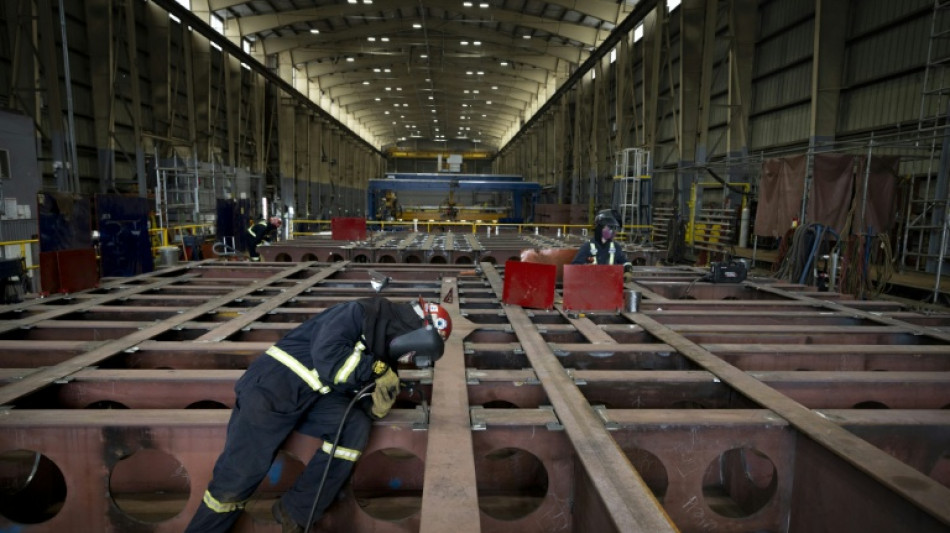
At a massive shipyard in North Vancouver, Canadian workers grind metal beams for a powerful new icebreaker crucial to cementing the country's presence in the increasingly contested Arctic.
Icebreakers are specialized, expensive vessels able to navigate in the frozen far north.
And "this is the crown jewel," Eddie Schehr, vice president of production at the Seaspan shipyard, told AFP.
For Prime Minister Mark Carney, who heads to Norway on Friday to observe Arctic defense drills involving troops from 14 NATO states, Canada's extreme north has emerged as a strategic priority.
"Canada is, and forever will be, an Arctic nation," he said ahead of the trip.
During a stop in Canada's Northwest Territories before flying to Norway, Carney announced nearly CAN$35 billion ($25.7 billion) in Arctic funding, with most of the funds dedicated to upgrading existing military infrastructure.
"We cannot rely on other nations for our security," he said. "We are securing every corner of this terrain."
Concerns about Russian aggression, especially after the invasion of Ukraine, have focused attention on the Arctic, where territorial sovereignty is disputed in several areas.
Climate change is intensifying competition, with previously inaccessible minerals increasingly available for exploitation as the ice thaws and new shipping routes open.
For Wesley Wark, a national security expert at the Center for International Governance Innovation, icebreaker fleets are a key part of the defense innovation required to safeguard Canada's position.
"We're in the business of trying to reassert ourselves as an icebreaking superpower," he told AFP.
- 'Crown jewel' -
Two new ships are under construction, each costing more than CAN$3 billion.
One, partly being built in Finland, is due for delivery in 2030.
The other vessel, set to be ready in 2032, is being made at the Seaspan shipyards in North Vancouver.
Senior vice president Dave Hargreaves said Canada's existing icebreaking fleet is "getting old."
And this ship, he said, "gives Canada the ability to have a strong presence in the Arctic, which is where you start."
Canada's decision to upgrade its icebreaker fleet preceded US President Donald Trump's return to office.
But Carney has delivered stark warnings about new risks from United States since entering Canadian politics last year, including a claim from last year's federal election campaign that Trump wanted to "break us so America can own us."
Wark told AFP that Canada's challenge in the Arctic has two main planks.
First, Carney's government wants "to show that it's a strong NATO partner and to take part in NATO collective security," he said, adding that NATO is "deeply concerned about Russian activities in the Arctic."
Russia has the world's largest icebreaker fleet by far -- Canada is a distant second -- and Wark said Carney wants to signal both to a domestic audience and allies that Canada can defend NATO's "Arctic flank."
- 'Hard power capacity' -
Canada must also consider that "the United States itself potentially represents a danger to Canadian security," Wark said.
Trump has discussed annexing Canada at various points in his second term. He again mocked Carney as the "governor" of a US state this week, renewing a taunt he first levelled at former prime minister Justin Trudeau.
Wark maintains the chance of direct military confrontation with the United States is low.
The more immediate risk is that Washington may conclude Canada is incapable of defending the Arctic, compelling the US military to take charge, he said.
"I think Canadian officials have come to understand that the United States administration, Trump, people around Trump in positions of power and influence, do not hold Canada in high regard as a country... essentially arguing Canada has no military," he said.
For Canada, "the incentive to increase its hard power capacity is partly driven by those American concerns," Wark further said, while stressing that, "whatever the Trump administration might say, Canada is not a military freeloader."
Unlike Russia, Canada has no intention of arming its icebreakers.
But the ships are designed to operate in the harshest Arctic conditions, equipped for intelligence gathering, search-and-rescue as well as scientific exploration.
The Seaspan ship "can go anywhere in the Canadian Arctic any time of the year, which is a very difficult requirement to meet," Hargreaves said.
P.Anderson--BTB



