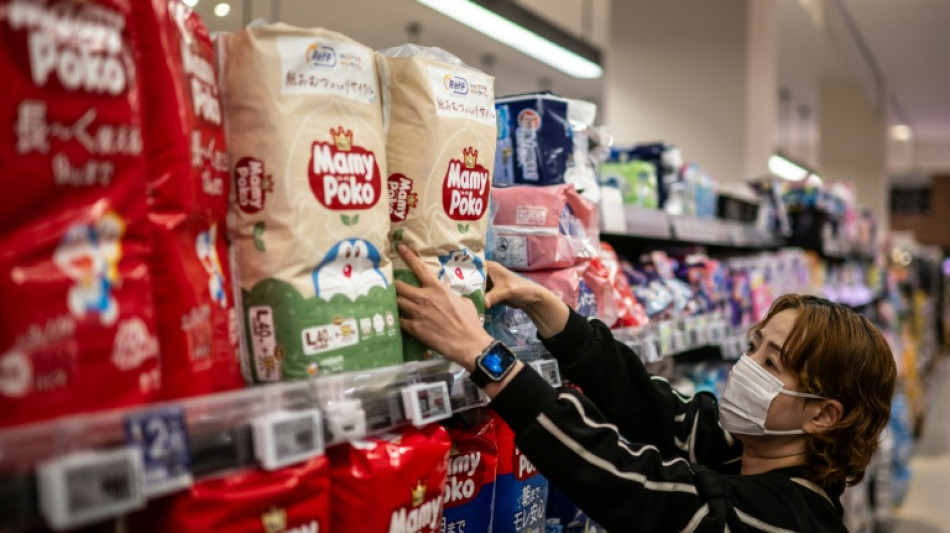
Dirty diapers born again in Japan recycling breakthrough / Photo: © AFP

 Internationals keep Presidents Cup lead with late fightbacks

 Tuchel to 'keep pushing' England to reach Spain's level

 Alcaraz saves match points to keep Europe ahead in Laver Cup
 Spain success driven by hunger to improve, says De La Fuente

 Lyon collapse at Stade Francais to suffer first Top 14 loss

 Oyarzabal and Spain sink England again as Modric shines for Croatia

 Housing protesters camp in central Madrid after mass demonstration

 Louise Trotter expands her palette at Bottega Veneta

 Pope prays at Lourdes after huge Paris mass

 USA trims International lead after Presidents Cup four-balls

 Russia accuses Europe of blocking Ukraine talks, as strikes drag on

 'He said hello': Families pray with pope on Paris avenue

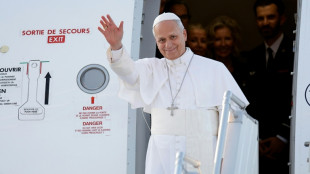 Pope celebrates giant Paris mass, flies to Lourdes

 Thousands march in Madrid over eviction of 87-year-old woman

 England women back to winning ways with last-gasp defeat of New Zealand

 Trump rejects Iran proposal for deal to reopen Hormuz

 England's Cox says injured Buttler leaves 'big shoes to fill'

 Ruthless Perpignan upset sloppy Bordeaux-Begles

 Deadly abbey attack feeds anti-Ukrainian sentiment in Poland

 Antonelli says he drove 'safety-first' on his worst weekend of season

 Fernandez fights back to reach Singapore Open final

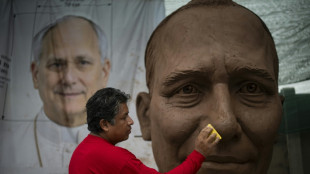 Giant statue of Pope Leo XIV takes shape in Peru workshop

 Ukraine crush holders Italy to reach first BJK Cup final

 Pope celebrates giant Paris mass in landmark visit

 Germany selects Munich for Olympics host bid

Billions of dirty diapers end up buried or burned every year in Japan -- more from seniors than babies -- but a recycling breakthrough has given them a new lease of life, one hot mess at a time.
A pilot project, billed as a world first, reuses the main ingredient in nappies to make new ones, offering hopes to ease bloated landfill sites and respond to a growing need for adult diapers in ageing Japan.
"Demand for baby diapers is falling. But a growing number of elderly people wear diapers, and more recently, even pets do too," Takahisa Takahara, president of Japanese hygiene product maker Unicharm, the firm behind the new initiative, told AFP.
"If we can transform the sense of guilt ordinary consumers may feel about using disposable products into something positive, and make using recycled products the norm in society, it will become economically viable," he said.
Unicharm is testing the scheme in two pioneering southern Japanese municipalities, Shibushi and Osaki, which recycle 80 percent of household waste -- four times the Japanese average.
The two localities, home to about 40,000 people, decided to take radical action around 25 years ago after predictions that their communal rubbish dump would be full by 2004.
Now, the landfill site will stay open for another four decades.
In 2024, diapers were included in the recycling drive, with residents required to write their names on designated bin bags.
"Ultimately, our top priority is to reduce our trash and extend the life of the landfill," Shibushi environment official Kenichi Matsunaga told AFP.
- Nappy ending -
The collected diapers are shredded, washed and separated into pulp, plastic and super-absorbent polymer (SAP).
Unicharm has been able to recycle these materials into products with less rigorous sanitary requirements, like toilet paper.
It has also achieved the breakthrough of managing to use the pulp, which makes up the bulk of a diaper, to make new ones.
The process follows a special ozone treatment for sterilisation, bleaching and deodorisation.
By 2028, Unicharm aims to recycle the plastic and absorbent polymer from soiled diapers to make new ones as well, Tsutomu Kido, senior executive officer of Unicharm's recycling business, told AFP.
For now, its recycled products are on sale only in some local stores, priced around 10 percent higher than those with fresh raw materials, or distributed to selected childcare and senior care centres.
The company is also testing a method to cut the amount of water in the recycling process, and aims to team up with 20 municipalities by 2035 to recycle their diapers.
- Ageing nation -
Japan has a poor recycling rate, reusing not even 20 percent of municipal waste, according to the National Institute for Environmental Studies.
That compares to 67 percent in Germany, 44 percent in Britain and around 32 percent in the United States.
Waste per capita, however, is less than two-thirds the OECD average -- a typical American throws almost three times more.
Japan does relatively well on generating electricity by incinerating trash, too.
In the ageing nation, home to almost 100,000 people over 100, diapers and related products are used more by seniors than babies.
In 2024, Japan produced 9.6 billion adult diapers and incontinence pads, compared to eight billion for babies, according to the Japan Hygiene Products Industry Association.
The group predicts Japan will throw away 2.6 million tons of dirty diapers every year by 2030, up from around 2.2 tons in 2020.
By that date, the share of dirty diapers in Japanese trash by weight will rise to 7.1 percent from 5.2 percent in 2020, the environment ministry said.
By 2030, the national government wants at least 100 of more than 1,700 municipalities to start recycling diapers, or at least talk about it.
K.Thomson--BTB


