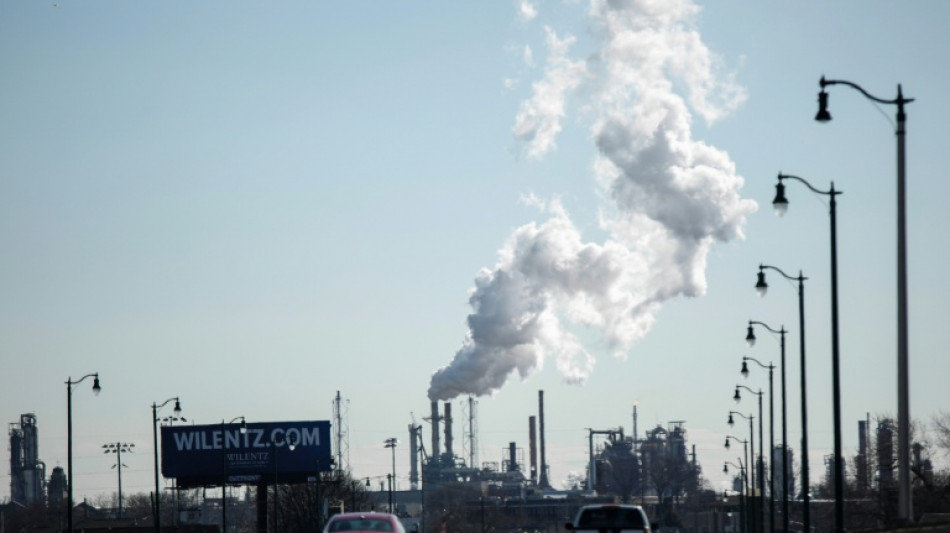
Study links major polluters to big climate damages bill / Photo: © AFP

 Internationals keep Presidents Cup lead with late fightbacks

 Tuchel to 'keep pushing' England to reach Spain's level

 Alcaraz saves match points to keep Europe ahead in Laver Cup

 Spain success driven by hunger to improve, says De La Fuente

 Lyon collapse at Stade Francais to suffer first Top 14 loss
 Oyarzabal and Spain sink England again as Modric shines for Croatia

 Housing protesters camp in central Madrid after mass demonstration

 Louise Trotter expands her palette at Bottega Veneta

 Pope prays at Lourdes after huge Paris mass

 USA trims International lead after Presidents Cup four-balls

 Russia accuses Europe of blocking Ukraine talks, as strikes drag on

 'He said hello': Families pray with pope on Paris avenue

 Pope celebrates giant Paris mass, flies to Lourdes

 Thousands march in Madrid over eviction of 87-year-old woman

 England women back to winning ways with last-gasp defeat of New Zealand

 Trump rejects Iran proposal for deal to reopen Hormuz

 England's Cox says injured Buttler leaves 'big shoes to fill'

 Ruthless Perpignan upset sloppy Bordeaux-Begles
 Deadly abbey attack feeds anti-Ukrainian sentiment in Poland
 Antonelli says he drove 'safety-first' on his worst weekend of season

 Fernandez fights back to reach Singapore Open final

 Giant statue of Pope Leo XIV takes shape in Peru workshop

 Ukraine crush holders Italy to reach first BJK Cup final

 Pope celebrates giant Paris mass in landmark visit

 Germany selects Munich for Olympics host bid

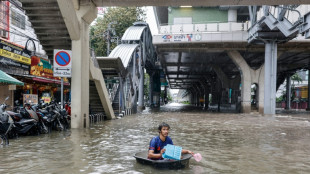
The economic cost of carbon emissions is far higher than previously estimated, said a new study Wednesday that links big polluters to tens of trillions of dollars in climate-related damages worldwide.
The study in the journal Nature measures how human-caused warming affects economic growth and assigns a share of global damages to specific emitters -- from major economies to oil giants.
The findings land as a growing wave of lawsuits seek to hold fossil fuel producers and other carbon-heavy businesses accountable for climate "loss and damage".
Claimants argue that large polluters are legally liable for their outsized contribution to climate change and its associated extreme weather events, particularly in poorer nations.
This study did not seek to answer the "legal and ethical" question of compensation, said Marshall Burke, a professor at Stanford University and the study's lead author.
"Our goal was first and foremost scientific, but we hope to contribute to the broader policy discussion of how to measure loss and damage and what to do about it," Burke told AFP.
It does offer "guidance" on the scale of potential costs and a framework "for estimating how specific emissions from specific emitters at specific points in time lead to damages" worldwide, he added.
They assessed the impact of rising temperatures on economic factors including labour productivity and agriculture, but also some associated climate-driven weather extremes.
US emissions between 1990 and 2020 were the largest source of estimated global damages at $10.2 trillion followed by China ($8.7 trillion) and the European Union ($6.4 trillion).
Emissions linked to Saudi oil giant Saudi Aramco between 1988 and 2015 resulted in $3 trillion in cumulative global economic damages by 2020, the study also said.
- Settling debts -
But the authors found the largest share of climate damages lies ahead.
"We were surprised not only by the overall magnitude of estimated damages, which are in the tens of trillions of dollars, but also by how much larger future damages from past emissions are than past damages from past emissions," Burke said.
One tonne of C02 emitted in 1990 caused about $180 in global damages by 2020, but was expected to inflict a further $1,840 through 2100 -- roughly 10 times more than the costs already incurred.
This is because CO2 has a long lifespan, lingering in the atmosphere where it contributes to warming for decades to come.
For this reason "settling debts for past damages will not settle debts for past emissions", the authors wrote.
Even under relatively conservative assumptions, the cost per tonne of carbon emitted is far higher than many government estimates.
The research also highlights how high-emitting activities such as air travel contribute to future damage. Taking a long-haul flight each year over a decade, for example, could generate around $25,000 in losses by 2100.
As emissions rise and poorer nations bear the brunt, wealthy countries and fossil fuel businesses are facing mounting scrutiny over their disproportionate role in driving climate damage.
Last year, a separate Nature study found extreme heat linked to emissions from 111 fossil fuel companies caused $28 trillion in global economic losses between 1991 and 2020.
Companies have long argued it is impossible to attribute harm from a global problem to any single emitter, and courts have been cautious about awarding compensation.
E.Schubert--BTB


