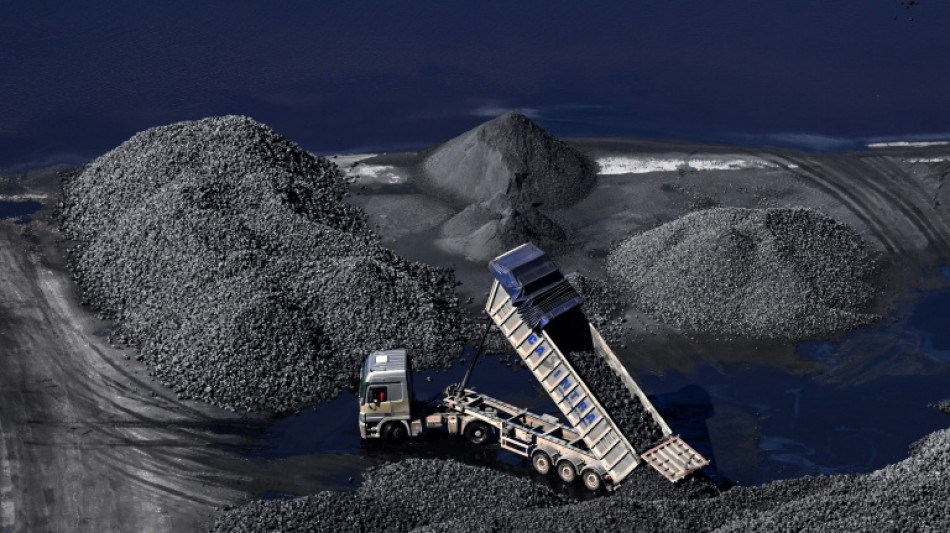
Nations gather for first-ever conference on fossil fuel exit / Photo: © AFP

 Venezuela releases more political prisoners after opposition talks

 England's best 'for a long time' despite Spain defeat, says Kane

 Powerful storm pummels northeast US with rain, high winds

 Filmmaker Mike Leigh wins top prize at Spain festival with 'last film'

 Spain beat England in Nations League to extend unbeaten run

 Ireland squad vote to play Israel tie despite Gaza unease

 Gutsy Vollering wins cycling road race world title

 Vollering wins cycling road race world title
 Man City's meteoric rise clouded by dark shadow

 Mbappe out for two weeks or more with knee injury say Real
 Lyon collapse away to Stade and suffer first Top 14 loss

 Russia accuses Europe of seeking to thwart Ukraine talks

 Man City chairman defiant over reported Premier League charges
 Germany ready to 'walk through fire' for Klopp, says Tah

 At least 16 killed in Russian and Ukrainian strikes

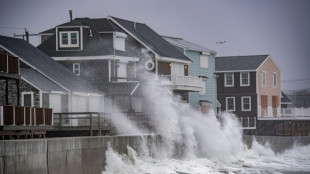 Powerful storm pummels US Northeast

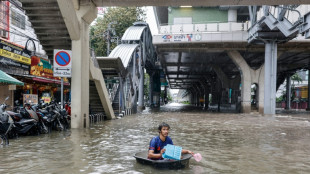 Bangkok declares disaster after homes flooded, roads submerged by heavy rain

 Norris calls for errant Colapinto to be banned for causing Baku crash

 Russell finds himself again and prepares to heap pressure on Antonelli

 South Korea hold nerve to win Asian Games basketball gold

 Russell holds off Verstappen to claim imperious victory in Baku

 Russell holds off Verstappen to win Azerbaijan Grand Prix
 India's Kohli says 2027 ODI World Cup will be his last
 Huge crowds cheer Pope Leo along Champs-Elysees ahead of Paris mass

 Putellas wants to bring 'winning culture and mentality' to London City

More than 50 nations are attending a world-first conference on phasing out fossil fuels in Colombia next week as the Iran war underscores how dependent countries remain on planet-heating coal, oil and gas.
Ministers arrive in the Caribbean city of Santa Marta against a backdrop of wartime fuel shortages, soaring prices and a scramble for energy security in what the International Energy Agency has called the biggest oil supply shock ever.
The gathering was born out of frustration with consensus-based United Nations climate talks, where efforts to negotiate a fossil fuel exit strategy have stalled.
But organisers say the energy shock caused by Iran's chokehold on the Strait of Hormuz, the key transit point for Gulf oil and gas shipments, has strengthened the case for a fossil fuel phaseout, even as some countries look to coal in the short-term to secure supplies.
Concerns over energy security are expected to shape the high-level discussions over April 28 and 29 as much as climate priorities, analysts say.
The meeting was announced months ago but has taken on "greater relevance" with the energy crisis, said Colombia's environment minister Irene Velez Torres, whose country is co-hosting with the Netherlands.
Major fossil fuel producing nations Australia, Canada and Norway are expected along with developing oil giants Angola, Mexico and Brazil and coal-reliant emerging markets Turkey and Vietnam.
They will join dozens of other countries from small-island developing states to major economies Germany, France and the UK.
However the world's biggest coal, oil and gas producers -- notably the United States, China, Saudi Arabia and Russia -- are skipping the event.
- 'Honest space' -
It will be closely watched for political signals from an emerging coalition of fossil fuel producers and consumers pushing for a phaseout outside the UN process.
Colombia -- a coal and oil exporter -- said the "strategically important" participating countries accounted for one-fifth of global fossil fuel production and nearly one-third of consumption.
Fossil fuel interests have been accused of influencing UN negotiations on climate change and some governments and activists have questioned the involvement of producer nations in Santa Marta.
"The larger the group of countries, the more diffused the interests are and the less chance you've got of getting a sharp outcome," climate scientist Bill Hare, founder of Climate Analytics think tank, told AFP.
Velez Torres said, however, it was a "major step forward" to have producer countries present tackling this "taboo".
"We need to start a more honest space where we can discuss this more openly, and bring all cards to the table. Nobody is saying that the way to eliminating fossil fuels is easy. But we need to bring these people together," she said.
For some, the conference's appeal is partly its distance from the UN climate talks.
"I think the Santa Marta meeting is long overdue," Maina Talia, climate minister of low-lying Tuvalu, told reporters.
- Energy bind -
Roughly twice as much investment goes into clean energy as fossil fuels, which are the primary driver of human-caused climate change.
But heat-trapping emissions from burning coal, oil and gas rose again in 2025 to a record high.
In response to the energy crisis, some countries intend to ramp up coal use to plug short-term supply gaps, underlining the challenge of reducing reliance on fossil fuels even in advanced economies.
Vanuatu's Climate Minister Ralph Regenvanu, whose Pacific Island nation is highly reliant on energy imports, told reporters the crisis was "unequivocally a call to lessen dependence on fossil fuels for everyone".
"We're very much looking forward to being first movers in this space," said Regenvanu.
Nearly 200 countries agreed at COP28 in 2023 to transition away from fossil fuels but efforts to turn that pledge into action have faced strong resistance since.
Tensions boiled over at COP30 in Brazil in November when nations could not even agree to include an explicit reference to fossil fuels in the final deal.
Santa Marta was less a rival to the UN talks than an opportunity for motivated nations "to take concrete steps forward", said Beth Walker, an analyst from the E3G think tank.
"There's a lot of difficult questions and issues to grapple with, but this is an important conversation and I think can start to create its own legitimacy and momentum in the long run," Walker told AFP.
No major announcements are expected but the conference's recommendations will feed into a voluntary "roadmap" away from fossil fuels being led by Brazil.
H.Seidel--BTB



