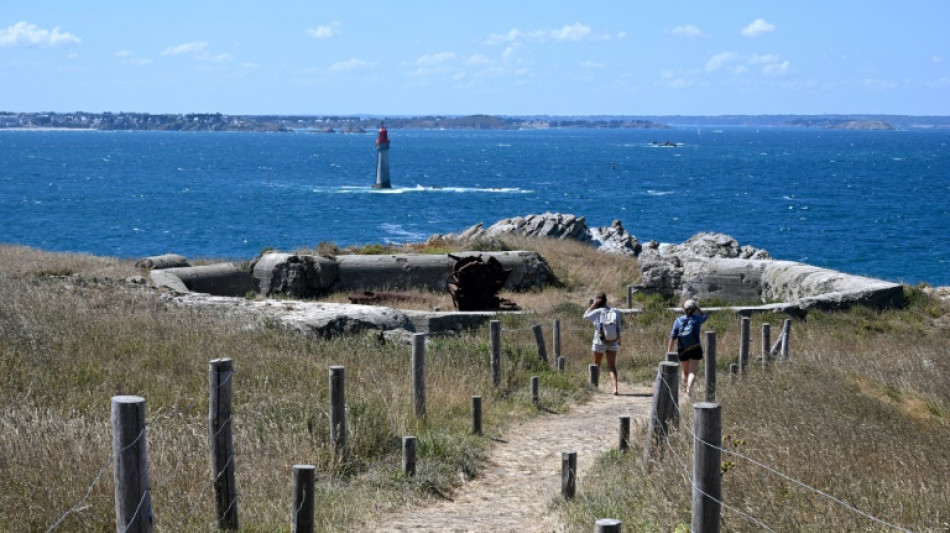
Mine-riddled French island becomes unlikely walkers' paradise / Photo: © AFP

 Venezuela releases more political prisoners after opposition talks

 England's best 'for a long time' despite Spain defeat, says Kane

 Powerful storm pummels northeast US with rain, high winds

 Filmmaker Mike Leigh wins top prize at Spain festival with 'last film'

 Spain beat England in Nations League to extend unbeaten run

 Ireland squad vote to play Israel tie despite Gaza unease

 Gutsy Vollering wins cycling road race world title

 Vollering wins cycling road race world title

 Man City's meteoric rise clouded by dark shadow

 Mbappe out for two weeks or more with knee injury say Real

 Lyon collapse away to Stade and suffer first Top 14 loss

 Russia accuses Europe of seeking to thwart Ukraine talks

 Man City chairman defiant over reported Premier League charges

 Germany ready to 'walk through fire' for Klopp, says Tah

 At least 16 killed in Russian and Ukrainian strikes

 Powerful storm pummels US Northeast
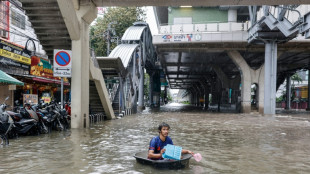 Bangkok declares disaster after homes flooded, roads submerged by heavy rain

 Norris calls for errant Colapinto to be banned for causing Baku crash

 Russell finds himself again and prepares to heap pressure on Antonelli

 South Korea hold nerve to win Asian Games basketball gold

 Russell holds off Verstappen to claim imperious victory in Baku

 Russell holds off Verstappen to win Azerbaijan Grand Prix

 India's Kohli says 2027 ODI World Cup will be his last

 Huge crowds cheer Pope Leo along Champs-Elysees ahead of Paris mass

 Putellas wants to bring 'winning culture and mentality' to London City

Every year, thousands of day-trippers make the short boat journey from France's northern coast to the island of Cezembre, marvelling at the spectacular maritime views and flourishing wildlife.
But they better tread carefully and stick to the path, as almost all the island remains perilous due to unexploded munitions from World War II.
Cezembre opened to visits only in 2018, over seven decades after the end of World War II, after extensive demining efforts allowed the opening of a marked path for visitors.
However, the area safe for visitors makes up just three percent of the island, which experts say was the most bombed area of all of World War II in terms of the number of hits per square metre.
"It's magnificent!" enthused Maryse Wilmart, a 60-year-old visitor from the southwestern town of La Rochelle, contemplating the sandy beach with turquoise waters and looking out to the ramparts of the port city of Saint-Malo beyond.
"But when you see all that behind us... Can you even imagine what happened here?" she asked, pointing to the barbed wire and signs warning "Danger! Ground not cleared beyond the fences!"
- 'Like Stalingrad' -
A visitor needs to go back 80 years to understand what happened on this usually uninhabited rocky outcrop.
In 1942, the occupying Nazi German army seized the strategically important island and installed bunkers and artillery pieces.
On August 17, 1944, Saint-Malo was liberated by the Americans but the Nazi commander of Cezembre, leading some 400 men, refused to surrender.
There then followed a devastating bombardment from the air by the Allies.
"It is said that per square metre it sustained the greatest number of bombardments of all the theatres of operation of World War II," said Philippe Delacotte, author of the book "The Secrets of the Island of Cezembre".
"There were between 4,000 and 5,000 bombs dropped", some of which contained napalm, he said.
On September 2, 1944, the white flag was finally raised and some 350 exhausted men surrendered.
"Some survivors claimed it was like Stalingrad," Delacotte said. The island was completely devastated, to the extent that its altitude even dropped because of the bombs.
After the war, the island became the property of the French ministry of defence and access was totally closed, with the first demining efforts starting in the 1950s.
It was handed over to a public coastal conservation body, the Conservatoire du Littoral, in 2017.
- 'Recolonised and revegetated' -
The path of about 800 metres (875 yards) lets visitors wander between rusty cannons and bunkers, with breathtaking views towards Cap Frehel and the Pointe de la Varde.
Since the opening of the path, "there has been no accident" even if "there are always people who want to go beyond the authorised section," said Jean-Christophe Renais, a coast guard.
Over time, colonies of seabirds have reappeared, including seagulls, cormorants, razorbills and guillemots.
"Biodiversity is doing wonderfully, everything has been recolonised and revegetated, birds have taken back possession of the site," said Gwenal Hervouet, who manages the site for Conservatoire du Littoral.
"It's just a joy."
Because of the focus on restoring wildlife, the trail was partially closed in April "to maximise the chances of success and the flight of peregrine falcon chicks," said local conservation activist Manon Simonneau.
Some walkers say they hope the trail will be lengthened to allow a complete tour of the island, but according to the Conservatoire there is little chance of this -- the cost of further demining would be astronomical, so it is now birds and nature that are the masters of Cezembre.
I.Meyer--BTB



