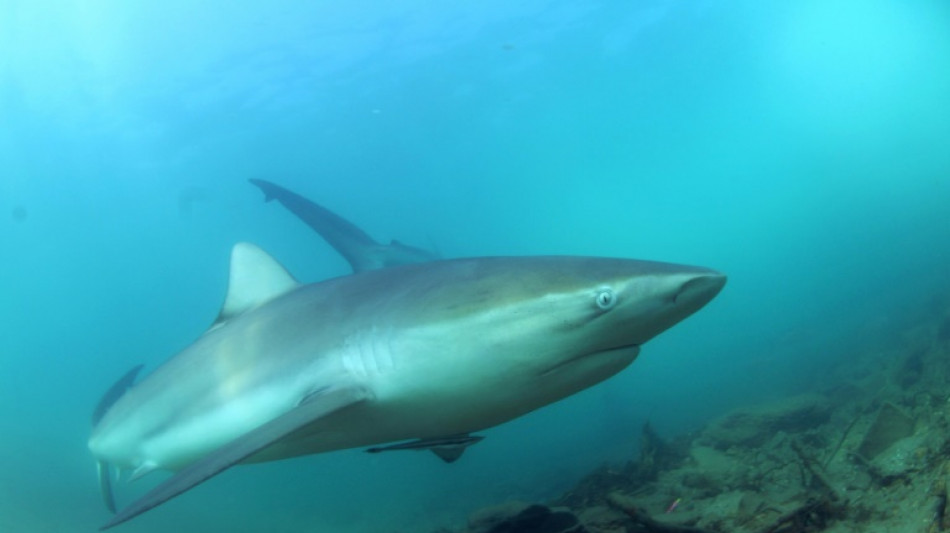
Endangered sharks, rays caught in protected Med areas: study / Photo: © Out of The Blu/AFP/File

 Venezuela releases more political prisoners after opposition talks

 England's best 'for a long time' despite Spain defeat, says Kane

 Powerful storm pummels northeast US with rain, high winds

 Filmmaker Mike Leigh wins top prize at Spain festival with 'last film'

 Spain beat England in Nations League to extend unbeaten run

 Ireland squad vote to play Israel tie despite Gaza unease

 Gutsy Vollering wins cycling road race world title

 Vollering wins cycling road race world title

 Man City's meteoric rise clouded by dark shadow

 Mbappe out for two weeks or more with knee injury say Real

 Lyon collapse away to Stade and suffer first Top 14 loss

 Russia accuses Europe of seeking to thwart Ukraine talks

 Man City chairman defiant over reported Premier League charges

 Germany ready to 'walk through fire' for Klopp, says Tah

 At least 16 killed in Russian and Ukrainian strikes

 Powerful storm pummels US Northeast

 Bangkok declares disaster after homes flooded, roads submerged by heavy rain

 Norris calls for errant Colapinto to be banned for causing Baku crash

 Russell finds himself again and prepares to heap pressure on Antonelli

 South Korea hold nerve to win Asian Games basketball gold

 Russell holds off Verstappen to claim imperious victory in Baku

 Russell holds off Verstappen to win Azerbaijan Grand Prix

 India's Kohli says 2027 ODI World Cup will be his last

 Huge crowds cheer Pope Leo along Champs-Elysees ahead of Paris mass

 Putellas wants to bring 'winning culture and mentality' to London City

Endangered sharks, rays and skates in the Mediterranean are more frequently caught in protected than in unprotected areas, according to research published Tuesday highlighting the need for better conservation for critically threatened species.
The three types of elasmobranch are among the species most threatened by overfishing.
While often landed as by-catch -- or caught in nets of boats seeking to land other species -- demand for their fins and meat has driven an estimated 71-percent decline in ocean sharks and rays since 1970.
Although they are among the oldest marine species on Earth, their slow growth rate and late maturity mean one third of elasmobranchs are categorised by the International Union for the Conservation of Nature (IUCN) as at risk of extinction.
While dozens of nations have banned large-scale fishing of endangered shark, ray and skate species, true global catch figures are likely to be hugely underestimated as 90 percent of the world's fishing fleet is made up of small-scale boats.
Researchers in Italy wanted to get a better idea of how species fare in the Mediterranean's partially protected areas, which allow some fishing with restrictions.
They used photo-sampling and image analysis to compile a database covering more than 1,200 small-scale fishing operations across 11 locations in France, Italy, Spain, Croatia, Slovenia and Greece.
- Protected areas -
The team then used statistical models to demonstrate that catches of threatened species were higher in partially protected areas than in areas with no protection at all.
"People assume that it is large-scale trawlers that are impacting biodiversity, which is true and there's a lot of evidence for this," said co-author Antonio Di Franco, from the Sicily Marine Centre.
"There is less research on small-scale fishing's impact and our research shows that there is this potential."
The team found that catches they analysed in partially protected areas landed 24 species of shark, skate and ray -- more than a third of which are endangered.
This is likely in part due to the species' preference for coastal waters, where most small-scale fisheries prefer to operate.
"We don't know the activity of small-scale fisheries in general, we don't know how many nets they actually fish or where they fish," said Di Franco.
Overall, in the partially protected areas studied, 517 elasmobranchs were caught compared with 358 in non-protected areas.
In terms of mass, the weight of shark, ray or skate species caught in partially protected areas was roughly double that in non-protected areas.
More than 100 countries have committed to increase the amount of protected oceans worldwide to 30 percent by 2030.
Di Franco said there were a number of steps countries could take to help threatened species, including fitting smaller fishing boats with GPS trackers and ensuring that protected areas were joined up, allowing the species to more easily change living regions.
"Protected areas are a great potential benefit to biodiversity but the point is to look at management," he told AFP.
"But often countries don't have the capacity to properly manage stocks."
S.Keller--BTB



