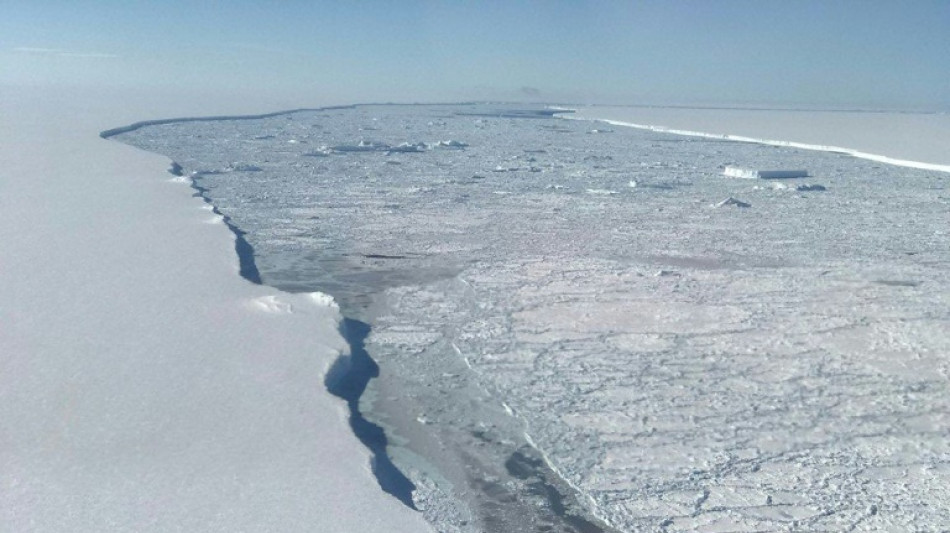
World's biggest ice sheet could cause massive sea rise without action: study / Photo: © NASA/AFP/File

 Venezuela releases more political prisoners after opposition talks

 England's best 'for a long time' despite Spain defeat, says Kane

 Powerful storm pummels northeast US with rain, high winds

 Filmmaker Mike Leigh wins top prize at Spain festival with 'last film'

 Spain beat England in Nations League to extend unbeaten run

 Ireland squad vote to play Israel tie despite Gaza unease

 Gutsy Vollering wins cycling road race world title

 Vollering wins cycling road race world title
 Man City's meteoric rise clouded by dark shadow

 Mbappe out for two weeks or more with knee injury say Real

 Lyon collapse away to Stade and suffer first Top 14 loss

 Russia accuses Europe of seeking to thwart Ukraine talks

 Man City chairman defiant over reported Premier League charges

 Germany ready to 'walk through fire' for Klopp, says Tah

 At least 16 killed in Russian and Ukrainian strikes

 Powerful storm pummels US Northeast

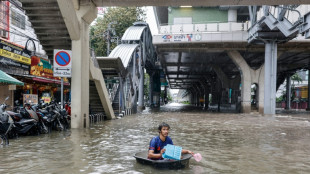 Bangkok declares disaster after homes flooded, roads submerged by heavy rain

 Norris calls for errant Colapinto to be banned for causing Baku crash

 Russell finds himself again and prepares to heap pressure on Antonelli

 South Korea hold nerve to win Asian Games basketball gold

 Russell holds off Verstappen to claim imperious victory in Baku

 Russell holds off Verstappen to win Azerbaijan Grand Prix

 India's Kohli says 2027 ODI World Cup will be his last

 Huge crowds cheer Pope Leo along Champs-Elysees ahead of Paris mass

 Putellas wants to bring 'winning culture and mentality' to London City

The world's biggest ice sheet could cause "several metres" of sea-level rise over centuries if the global temperature rises more than 2°C, according to a British study published Wednesday.
Researchers at Durham University concluded that if global greenhouse emissions remain high, the melting East Antarctica Ice Sheet (EAIS) could cause nearly half a metre of sea-level rise by 2100. Their analysis was published in the scientific journal Nature.
If emissions remain high beyond that, the EAIS could contribute around one to three metres to global sea levels by 2300, and two to five metres by 2500, they said.
However, if emissions were dramatically reduced, EAIS could contribute around two centimetres of sea level rise by 2100, according to the assessment.
This would represent far less than the ice loss expected from Greenland and West Antarctica.
"A key conclusion from our analysis is that the fate of the East Antarctic Ice Sheet remains very much in our hands," said lead author Chris Stokes, from Durham University's Department of Geography.
"This ice sheet is by far the largest on the planet, containing the equivalent of 52 metres of sea level and it's really important that we do not awaken this sleeping giant.
"Restricting global temperature increases to below the 2°C limit set by the Paris Climate Agreement should mean that we avoid the worst-case scenarios, or perhaps even halt the melting of the East Antarctic Ice Sheet, and therefore limit its impact on global sea level rise," he added.
- Computer simulations -
The study did note that the worst scenarios projected were "very unlikely".
World leaders agreed at the 2015 UN Climate Change Conference in Paris to limit global warming to well below 2°C and pursue efforts to limit the rise to 1.5°C.
The research team, which included scientists from the UK, Australia, France and the US, analysed how the ice sheet responded to past warm periods when making their predictions.
They ran computer simulations to model the effects of different greenhouse gas emission levels and temperatures on the ice sheet by the years 2100, 2300 and 2500.
They found evidence to suggest that three million years ago, when temperatures were around 2-4°C higher than present, part of the EAIS "collapsed and contributed several metres to sea-level rise".
"Even as recently as 400,000 years ago -- not that long ago on geological timescales -- there is evidence that a part of the EAIS retreated 700 km inland in response to only 1-2°C of global warming," they added.
Nerilie Abram, a co-author of the study from the Australian National University in Canberra, warned the sheet "isn't as stable and protected as we once thought."
W.Lapointe--BTB



