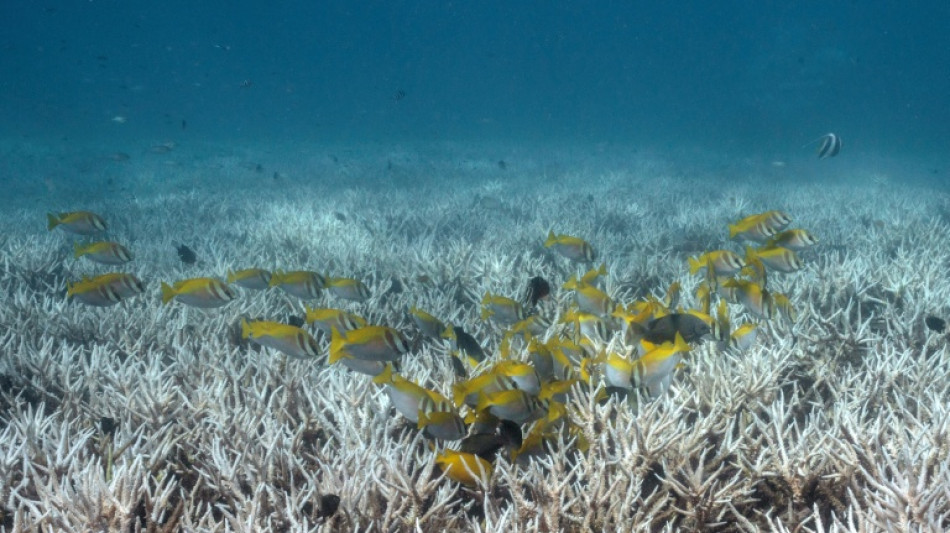
'Dread': coral scientists fear bleaching El Nino could bring / Photo: © AFP/File

 Ireland squad vote to play Israel tie despite Gaza unease

 Gutsy Vollering wins cycling road race world title

 Vollering wins cycling road race world title

 Man City's meteoric rise clouded by dark shadow

 Mbappe out for two weeks or more with knee injury say Real

 Lyon collapse away to Stade and suffer first Top 14 loss

 Russia accuses Europe of seeking to thwart Ukraine talks

 Man City chairman defiant over reported Premier League charges

 Germany ready to 'walk through fire' for Klopp, says Tah

 At least 16 killed in Russian and Ukrainian strikes

 Powerful storm pummels US Northeast

 Bangkok declares disaster after homes flooded, roads submerged by heavy rain

 Norris calls for errant Colapinto to be banned for causing Baku crash

 Russell finds himself again and prepares to heap pressure on Antonelli

 South Korea hold nerve to win Asian Games basketball gold

 Russell holds off Verstappen to claim imperious victory in Baku

 Russell holds off Verstappen to win Azerbaijan Grand Prix

 India's Kohli says 2027 ODI World Cup will be his last

 Huge crowds cheer Pope Leo along Champs-Elysees ahead of Paris mass

 Putellas wants to bring 'winning culture and mentality' to London City

 Rare Italian opera returns to Moscow after nearly 120-year hiatus

 Pope to celebrate giant Paris mass after 'peace' appeal

 Homes flooded, roads submerged: Bangkok declares disaster over heavy rains

 Ahead of Paris mass, pope urges life together in 'dignity and peace'

 Austria 'ghetto' language classes leave children to repeat school
The arrival of a potentially powerful El Nino weather system this year could devastate coral reefs around the world already weakened by back-to-back rounds of bleaching, scientists warn.
Forecasters are increasingly convinced that this year will see a return of the weather phenomenon, and that it could be exceptionally strong.
El Nino, which occurs around every two to seven years, shifts normal weather patterns on land, bringing drought to some places and heavy rains elsewhere.
It is associated with warmer seawater and, in some places, reduced cloud cover, both of which are bad news for global coral reefs.
"Every global coral bleaching event has been during an El Nino year," said Clint Oakley, a coral scientist at Victoria University of Wellington.
He described feeling "dread, although not surprise", at the prospect of a strong El Nino, which could prove "serious and devastating for many reefs around the world".
Coral's survival depends on a special relationship with a kind of algae.
The algae reside in the structure built by corals, and in return produce nutrients for their host by photosynthesis.
But for reasons that still elude scientists, this arrangement falls apart when seawater warms too much and the algae leave or are expelled.
The algae provide coral's characteristic colours, and their departure leaves behind a ghostly white structure that is gradually starving.
- 'Functionally extinct' -
If the waters cool quickly enough, the coral can survive on food stores until algae resume residence.
But even if that happens, it will be malnourished, vulnerable to infection and less able to devote the energy needed for reproduction.
"And if it takes too long for the waters to cool down, or if the heat is too extreme, then they will essentially starve and they'll die," explained Jen Matthews, a coral scientist at University of Technology Sydney.
Periodic, localised bleaching is a natural and even healthy process for reefs.
The problem is repeated mass bleaching, which has become the norm with rising sea temperatures caused by climate change.
"If you're being bleached before you've even recovered and been able to produce juveniles again, then that's only a downwards trajectory from there," said Oakley.
The last global mass bleaching event was declared in 2024.
In the Caribbean, some types of coral are now "functionally extinct", while Australia's Great Barrier Reef -- the only living creature visible from space -- lost between 15 and 40 percent of its coral cover in different locations between 2024 and 2025.
A super El Nino would push sea temperatures up, from a baseline that is already often too warm for corals.
"The average sea temperature for the last few years is the same as what it was at the peak of the 1998 global bleaching event," said Oakley.
- 'Just buying time' -
There are some corals globally that have proven resilient to warmer waters, but they cannot make up for the losses caused by rounds of bleaching.
Scientists are also experimenting with techniques ranging from nutritional gel to feed corals to shading techniques and genetic engineering to protect reefs.
"There's a lot of really important and innovative management strategies out there," Matthews said, "but they're all just buying time."
There are still uncertainties about El Nino's arrival and impacts, and scientists caution that forecasts should be interpreted with that in mind.
"An El Nino is likely, but the strength and duration are still uncertain," said Kimberley Reid, a research fellow in atmospheric sciences at the University of Melbourne.
"El Nino is one piece of the puzzle that affects the weather at a certain location, but there are other factors like local ocean temperatures and winds across the Indian Ocean," she added.
Even without an El Nino, the long-term prospects look dire for coral.
Up to 50 percent of the world's coral has been lost in recent decades, diminishing ecosystems that provide nurseries for fish that feed the world, and protect coastlines from storm surges.
It is a sobering reality, said Matthews.
"If we don't get our act together on climate change, then all we're doing is buying time until our reefs, as we know them, disappear."
J.Bergmann--BTB