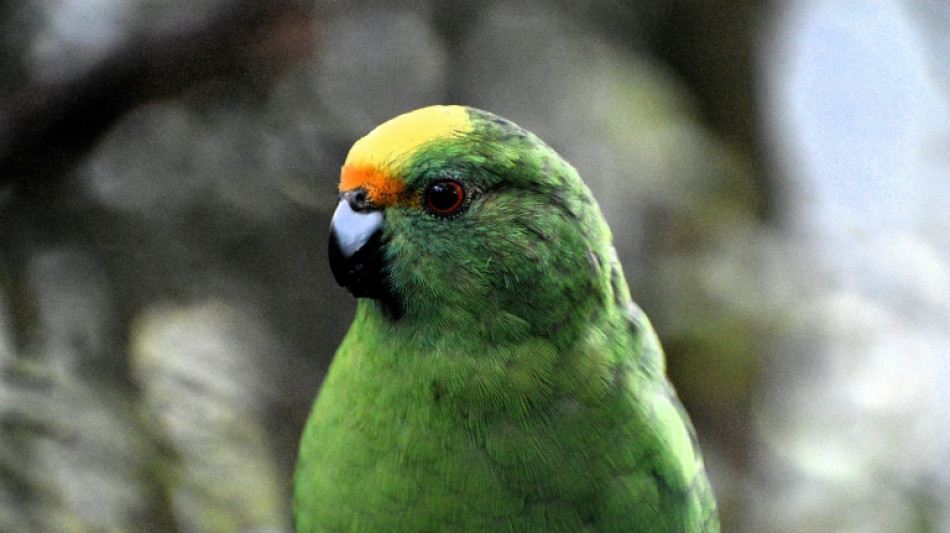
Love birds: twice-extinct parakeet gets lifeline from randy pair / Photo: © The Isaac Conservation and Wildlife Trust/AFP

 Ireland squad vote to play Israel tie despite Gaza unease

 Gutsy Vollering wins cycling road race world title

 Vollering wins cycling road race world title

 Man City's meteoric rise clouded by dark shadow

 Mbappe out for two weeks or more with knee injury say Real

 Lyon collapse away to Stade and suffer first Top 14 loss

 Russia accuses Europe of seeking to thwart Ukraine talks

 Man City chairman defiant over reported Premier League charges

 Germany ready to 'walk through fire' for Klopp, says Tah

 At least 16 killed in Russian and Ukrainian strikes

 Powerful storm pummels US Northeast

 Bangkok declares disaster after homes flooded, roads submerged by heavy rain

 Norris calls for errant Colapinto to be banned for causing Baku crash

 Russell finds himself again and prepares to heap pressure on Antonelli

 South Korea hold nerve to win Asian Games basketball gold

 Russell holds off Verstappen to claim imperious victory in Baku

 Russell holds off Verstappen to win Azerbaijan Grand Prix

 India's Kohli says 2027 ODI World Cup will be his last

 Huge crowds cheer Pope Leo along Champs-Elysees ahead of Paris mass

 Putellas wants to bring 'winning culture and mentality' to London City

 Rare Italian opera returns to Moscow after nearly 120-year hiatus

 Pope to celebrate giant Paris mass after 'peace' appeal

 Homes flooded, roads submerged: Bangkok declares disaster over heavy rains

 Ahead of Paris mass, pope urges life together in 'dignity and peace'

 Austria 'ghetto' language classes leave children to repeat school

One of the world's rarest parakeets has seen its numbers surge thanks to a pair of super breeders now responsible for more than 10 percent of the total population.
The New Zealand native kakariki karaka -- or orange-fronted parakeet -- is critically endangered and has twice been declared extinct, only to be rediscovered.
There are around 450 of the birds left, mainly in sanctuaries and predator-free islands but also in wild populations.
Parents Nacho and Trixie were paired up in 2024 at the Isaac Conservation and Wildlife Trust in Christchurch and have since produced 55 chicks, including 33 this year alone.
Wildlife manager Leigh Percasky praised "super-mum" Trixie.
"The breeding season has ended and yet she's still producing eggs and raising chicks," Percasky said.
"Ideally we'd prefer her to stop so she can have a rest, but she shows no signs of that with another seven chicks in her most recent clutch.
"Nacho also deserves credit as he's responsible for finding food for both Trixie and the chicks which is incredibly busy."
- Captive breeding -
Wayne Beggs, lead of the Department of Conservation's kakariki karaka recovery programme, said breeding pairs like Nacho and Trixie were ensuring the species didn't go extinct.
"We rely on the captive breeding programmes as without them we couldn't establish new sites," Beggs said.
"The wild populations are very vulnerable to predators, so we always need backup populations."
Percasky said Nacho and Trixie had made a "massive contribution" to the survival of their species, but he wants the love birds to "have a well-earned break" after their latest clutch.
"I'm not sure where they get all their energy from."
P.Anderson--BTB