
Five things to know about heatwaves in Europe / Photo: © AFP

 Ireland squad vote to play Israel tie despite Gaza unease

 Gutsy Vollering wins cycling road race world title

 Vollering wins cycling road race world title

 Man City's meteoric rise clouded by dark shadow

 Mbappe out for two weeks or more with knee injury say Real

 Lyon collapse away to Stade and suffer first Top 14 loss

 Russia accuses Europe of seeking to thwart Ukraine talks

 Man City chairman defiant over reported Premier League charges

 Germany ready to 'walk through fire' for Klopp, says Tah

 At least 16 killed in Russian and Ukrainian strikes

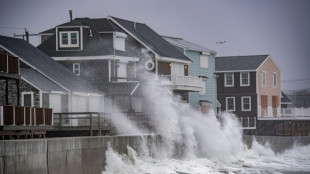 Powerful storm pummels US Northeast

 Bangkok declares disaster after homes flooded, roads submerged by heavy rain

 Norris calls for errant Colapinto to be banned for causing Baku crash

 Russell finds himself again and prepares to heap pressure on Antonelli

 South Korea hold nerve to win Asian Games basketball gold

 Russell holds off Verstappen to claim imperious victory in Baku

 Russell holds off Verstappen to win Azerbaijan Grand Prix

 India's Kohli says 2027 ODI World Cup will be his last

 Huge crowds cheer Pope Leo along Champs-Elysees ahead of Paris mass

 Putellas wants to bring 'winning culture and mentality' to London City

 Rare Italian opera returns to Moscow after nearly 120-year hiatus

 Pope to celebrate giant Paris mass after 'peace' appeal

 Homes flooded, roads submerged: Bangkok declares disaster over heavy rains

 Ahead of Paris mass, pope urges life together in 'dignity and peace'

 Austria 'ghetto' language classes leave children to repeat school

The scorching weather that has smashed temperature records across Europe this week shows the growing number and intensity of heatwaves on the continent.
Europe is the continent that has experienced the fastest warming since 1990, according to data from the US National Oceanic and Atmospheric Administration (NOAA).
As cities from Rome to London swelter in the unusually early spell of intense temperatures, here are five things to know about heatwaves in 21st-century Europe.
- Wake-up call 2003 -
The intense heatwave that hit Western Europe during the first half of August 2003 was a real shock in several countries.
The exceptional temperatures endured in France, Italy, Spain, and Portugal led to tens of thousands of deaths: a European study published in 2007 estimated there were 70,000 “additional deaths” in 16 countries during the summer of 2003.
In the following years, a number of countries set up alert systems for intense summer heat, such as France's “heatwave plan”.
Another heatwave that hit Russia in 2010 led to nearly 56,000 “additional deaths,” according to the Russian statistics agency.
And more than 61,000 deaths are thought to be attributable to the heat during the summer of 2022 in 35 European countries, according to a French-Spanish study.
- From east to west and north to south -
While the 2003 heatwave mainly affected western and southern Europe, every region of the continent has been hit by heatwaves since the start of the century.
Russia's 2010 heatwave, lasting an exceptional 45 days, saw a record temperature of 37.2°C in Moscow in July.
In June and July 2019, it was mostly northern and western Europe that suffered, with records broken in the Netherlands, Belgium, Germany, and the United Kingdom.
The French record of 46 C, in Verargues in country's south, dates from that year.
In 2021, it was southern Europe's turn to fry, with an all-time record temperature for Europe of 48.8 C recorded in Syracuse in Sicily on August 11, as well as a national record in Spain, and “the worst heatwave since 1987” in Greece, according to Athens.
- Earlier and later -
Heatwaves in Europe are covering a bigger geographic area and extending both earlier and later in the calendar than before.
In 2019, and again in 2022, the first heatwave to strike Europe arrived in mid-June, with heat records for the month broken in Germany and Austria in 2022.
The following year, the European heatwave stretched into September, worsening drought conditions in southern Europe.
And this month, an “unprecedented” episode of early heat hit Western Europe: May temperature records fell in France, the UK and Portugal, while in Italy several major cities were put on red alert for heat on Thursday.
- More frequent -
Studies and scientific bodies agree that heatwaves in Europe are becoming more frequent.
French weather service Meteo-France says that of the 51 heatwaves recorded nationwide since 1947, 34 have come since 2000 and 26 since 2011.
A German-Romanian study covering the period 1921–2021, published in 2025, concluded that there had been a significant increase in the frequency of heatwaves across most regions of Europe, especially over the last 30 years.
- All-time temperature records -
Twenty-first-century heatwaves in Europe have come with record temperatures, such as the absolute continental peak reached in Syracuse in 2021 -- a record confirmed by the World Meteorological Organization.
Other national records -- meaning the highest temperature ever recorded in the country at a single location, not an average -- have been set in several European countries in recent years.
These include the French record hit in June 2019, a British record of 40.3 C in July 2022, a German peak of 41.2 C in July 2019 and a top Spanish temperature of 47.6 C in August 2021.
P.Anderson--BTB