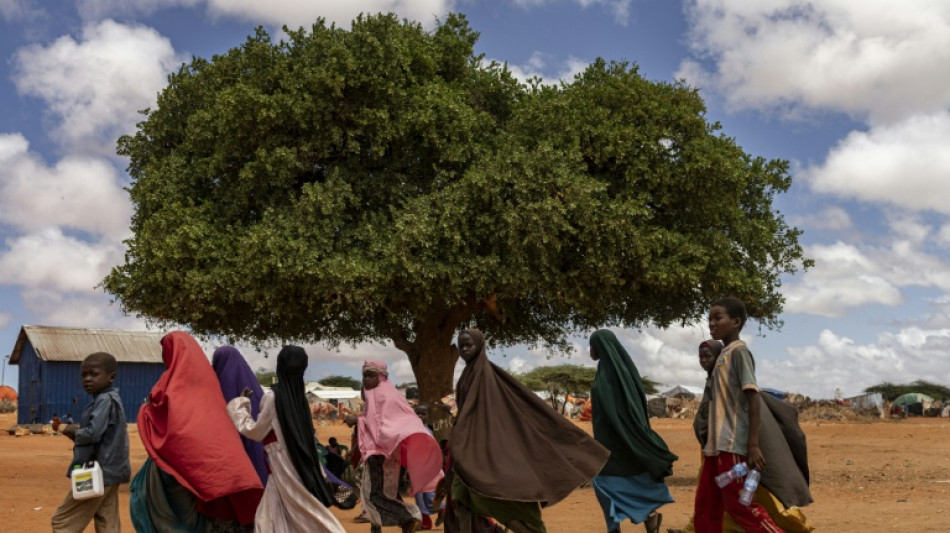
Nearly half the world's children exposed to three or more climate risks: UNICEF / Photo: © AFP

 USA trims International lead after Presidents Cup four-balls

 Russia accuses Europe of blocking Ukraine talks, as strikes drag on

 'He said hello': Families pray with pope on Paris avenue

 Pope celebrates giant Paris mass, flies to Lourdes

 Thousands march in Madrid over eviction of 87-year-old woman
 England women back to winning ways with last-gasp defeat of New Zealand

 Trump rejects Iran proposal for deal to reopen Hormuz

 England's Cox says injured Buttler leaves 'big shoes to fill'
 Ruthless Perpignan upset sloppy Bordeaux-Begles
 Deadly abbey attack feeds anti-Ukrainian sentiment in Poland
 Antonelli says he drove 'safety-first' on his worst weekend of season

 Fernandez fights back to reach Singapore Open final

 Giant statue of Pope Leo XIV takes shape in Peru workshop

 Ukraine crush holders Italy to reach first BJK Cup final

 Pope celebrates giant Paris mass in landmark visit

 Germany selects Munich for Olympics host bid
 Sagnol sacked as Georgia boss after Nations League upset

 Man City could face 'drastic' sanctions after reported guilty verdict: ex-chairman

 Furious Fury says row between rival promoters could scupper Joshua bout

 'Invincible' 223cm teen basketball player stars as China win bronze

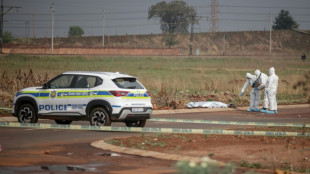 Tenth woman found dead in South Africa's string of killings
 Japan schoolboy, 11, wins gold while empty seats blight Asian Games

 Japan organisers 'not satisfied' as empty seats blight Asian Games
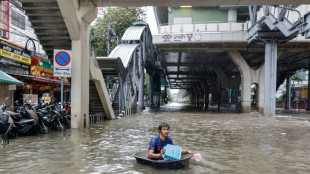
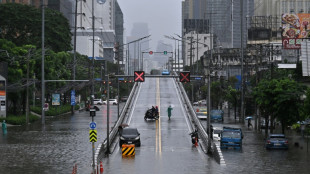 Canals full, roads submerged as Bangkok declares flood disaster

 China, US to open AI 'communication channel' after summit

More than one billion children face at least three overlapping climate hazards, UNICEF warned Monday, while highlighting the disproportionate impact in some regions of the world.
For the report, the UN agency cross-referenced data showing where the roughly 2.4 billion children on the planet live with the geographic distribution of the eight most common climate impacts. They are coastal flooding, river flooding, drought, tropical storms, heat waves -- at least three days above a high temperature threshold, which varies by country -- extreme heat, wildfires and sandstorms.
The report primarily focuses on the 1.1 billion children who are exposed to at least three risks, with the most common combination being drought, extreme heat (above 35 degrees Celsius) and heat waves.
That combination affects some 296 million children, including 74 million in Nigeria, 34 million in Pakistan and 32 million in India.
The number of children in this three-or-more category has increased sharply over the past 20 years.
Almost all children -- some 2.3 billion -- are exposed to at least one risk. Two billion are exposed to at least two, while 364 million face at least four.
Of the 123,000 children exposed to seven or more climate hazards, some 46,000 are in Myanmar.
"Children are at the forefront of the impact of climate change," said UNICEF chief Catherine Russell.
As for the worst place for a child, "there isn't a super short answer," one of the report authors, Tom Slaymaker, told AFP.
- 'Hot spots' -
"But they're not all equal," Slaymaker said. "We do see some hot spots... it's really concentrated in Sub-Saharan Africa and parts of South Asia."
Countries with large populations of children -- including Bangladesh, India, Nigeria and Pakistan -- are at the top of the list for the number of children exposed to at least three hazards.
But in sheer percentage terms, countries in Sub-Saharan Africa -- particularly the Sahel -- have the largest proportion of children affected by hazards. The impacts are often exacerbated by governments' inability to cope with climate hazards.
Chad, for example, faces a humanitarian crisis with limited access to water, electricity and food. According to the report, more than 95 percent of kids in the country are exposed to at least three hazards -- one of the highest proportions in the world.
Other particularly vulnerable countries include 39 island states that face challenges such as limited freshwater, import dependence, and inability to easily shelter elsewhere after a disaster such as a hurricane.
- Nowhere to hide -
No country is truly spared, the report shows.
"In many countries, there will be small pockets of the population which are not exposed to these hazards," Slaymaker said. "They tend to be in the northern hemisphere, particularly so, parts of Scandinavia."
But that is because the report looks only at the eight most common risks worldwide, he stressed, noting that children in those countries may face other threats not covered in the report, such as melting glaciers or thawing permafrost.
abd/pnb/ksb/dw
P.Anderson--BTB