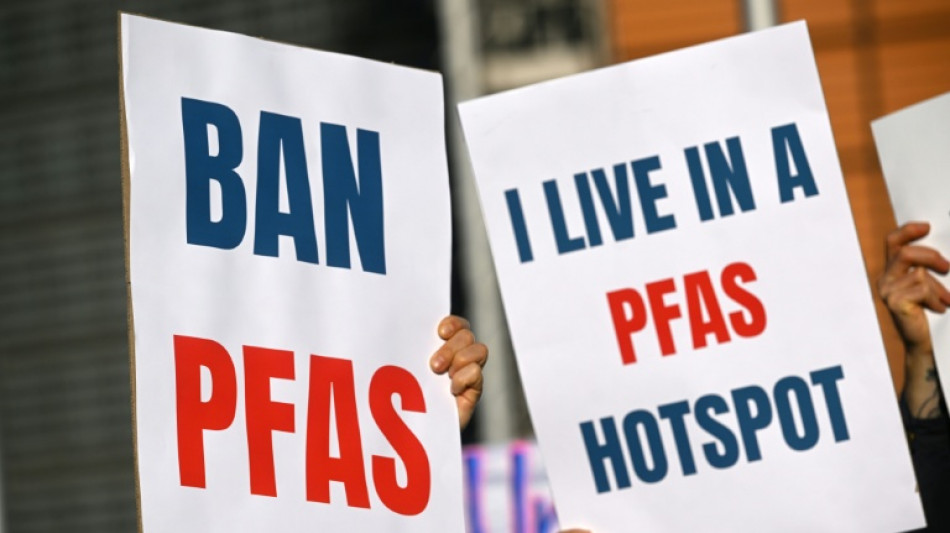
Forever chemicals and pesticides under Trump: what to know / Photo: © AFP

 Man City chairman defiant over reported Premier League charges

 Germany ready to 'walk through fire' for Klopp, says Tah

 At least 16 killed in Russian and Ukrainian strikes

 Powerful storm pummels US Northeast

 Bangkok declares disaster after homes flooded, roads submerged by heavy rain

 Norris calls for errant Colapinto to be banned for causing Baku crash

 Russell finds himself again and prepares to heap pressure on Antonelli

 South Korea hold nerve to win Asian Games basketball gold

 Russell holds off Verstappen to claim imperious victory in Baku

 Russell holds off Verstappen to win Azerbaijan Grand Prix

 India's Kohli says 2027 ODI World Cup will be his last

 Huge crowds cheer Pope Leo along Champs-Elysees ahead of Paris mass

 Putellas wants to bring 'winning culture and mentality' to London City

 Rare Italian opera returns to Moscow after nearly 120-year hiatus

 Pope to celebrate giant Paris mass after 'peace' appeal

 Homes flooded, roads submerged: Bangkok declares disaster over heavy rains

 Ahead of Paris mass, pope urges life together in 'dignity and peace'

 Austria 'ghetto' language classes leave children to repeat school
 S.African women runners arm themselves after string of killings

 'I felt embarrassed': Japan eSports whizz-kid, 11, wins Games gold

 Indonesia fires threatens critically-endangered orangutan: IUCN

 Bangkok declares flood disaster across city

 'World records not enough': North Korea weightlifters target Olympic gold rush

 Iran proposes Hormuz plan, Trump reportedly refuses
 El Nino rewrites the menu in the world's top restaurants
Since returning to power, President Donald Trump's administration has approved five new pesticides considered by many to be PFAS "forever chemicals," a class of toxic substances facing increasing restrictions around the world.
But Trump's Environmental Protection Agency (EPA) has an alternative definition of per- and polyfluoroalkyl substances that excludes the pesticides, and says they pose no threat to human health.
The last three approvals were made without press statements, surfacing only when nonprofits publicized them this month.
Critics say the chemicals may pose hidden risks, and many of them break down into trifluoroacetic acid (TFA), now abundant in global drinking water and potentially linked to serious harms, including fetal and reproductive damage.
"If we want to do something about this class of chemicals, then you need to draw boundaries," Cindy Hu, an environmental scientist at George Washington University told AFP.
- Damning history -
PFAS are defined by the carbon-fluorine bond, the most stable in organic chemistry, whose strength and liquid repelling properties made the chemicals prized firefighting foam, nonstick pans, raincoats and more.
But evidence linking them to cancers, immune conditions and reproductive harms has triggered billion-dollar settlements, new laws and corporate phase-outs.
The Organization for Economic Co-operation and Development (OECD) adopted a broad definition in 2021 encompassing any molecule with a single fully-fluorinated carbon atom. Roughly half of US states, Congress and the Pentagon have upheld it, as did 150 scientists in a 2024 consensus statement.
In 2023, the EPA under then-president Joe Biden went its own way, narrowing the definition to only include chemicals with two or more adjacent fully-fluorinated carbon atoms, which it deemed less likely to persist.
One such pesticide was greenlit under Biden. Trump's second term has added five more.
Trump's EPA says pesticides are essential for food abundance, that all are reviewed, and that single-fluorinated ones can be less toxic than alternatives. It notes they are also registered or proposed in the European Union, Canada and Australia.
- 'Getting worse' -
That is not good enough for many scientists and activists, who fear a growing threat to the food supply and to farm workers.
Trifludimoxazin, one of the new herbicides, has "suggestive evidence of carcinogenic potential," the EPA's own review found.
And the new approvals are just the tip of the iceberg: a 2024 retrospective analysis revisited hundreds of pesticide ingredients approved in the past and found 66 would have met the OECD definition of PFAS.
"It's an issue that most administrations have kind of conveniently swept under the rug," Nathan Donley of the Center for Biological Diversity, who led the study, told AFP. "But it's definitely getting worse."
"If you were to buy 10 peaches or plums at random in the US, chances are nine of them are going to have at least residues of highly toxic PFAS pesticides," Varun Subramaniam, an Environmental Working Group scientist who conducted an analysis of produce samples, told AFP.
Many such pesticides break down into TFA, which is now found extensively in water, and the EU's food safety agency last week sharply cut the acceptable daily intake.
- Ex-lobbyists -
Criticism has focused on former lobbyists in senior EPA posts.
A Freedom of Information Act request led by Donley found those officials, alongside EPA chief Lee Zeldin, coordinated edits last November to the agency's webpage on PFAS and pesticides, stripping out any acknowledgment of the more widely-accepted definition.
The edit came the same day CropLife America, the pesticide industry's trade association, submitted a paper arguing against further regulation that cited the revised page. CropLife America told AFP it did not coordinate with the EPA over the timing of its submission, but rather re-submitted its manuscript to reference the revised page.
For researcher Hu, the debate echoes an earlier chapter in the PFAS story. When first-generation PFAS were phased out in the 2000s, industry replaced them with shorter-chain molecules marketed as safer -- one of which, GenX, caused a drinking water contamination crisis in North Carolina.
"It's a continuation of the same storyline," she said, advocating the "precautionary principle" that would presume such chemicals as harmful until proven otherwise.
M.Odermatt--BTB